Music Theory · 2026-08-26 · 5 min read
Gamaka in Carnatic Music: Why a Note Is More Than a Pitch
What is gamaka in Carnatic music? This beginner guide explains why oscillations, slides, and other note movements matter to raga identity, and how to listen without turning ornamentation into a checklist.
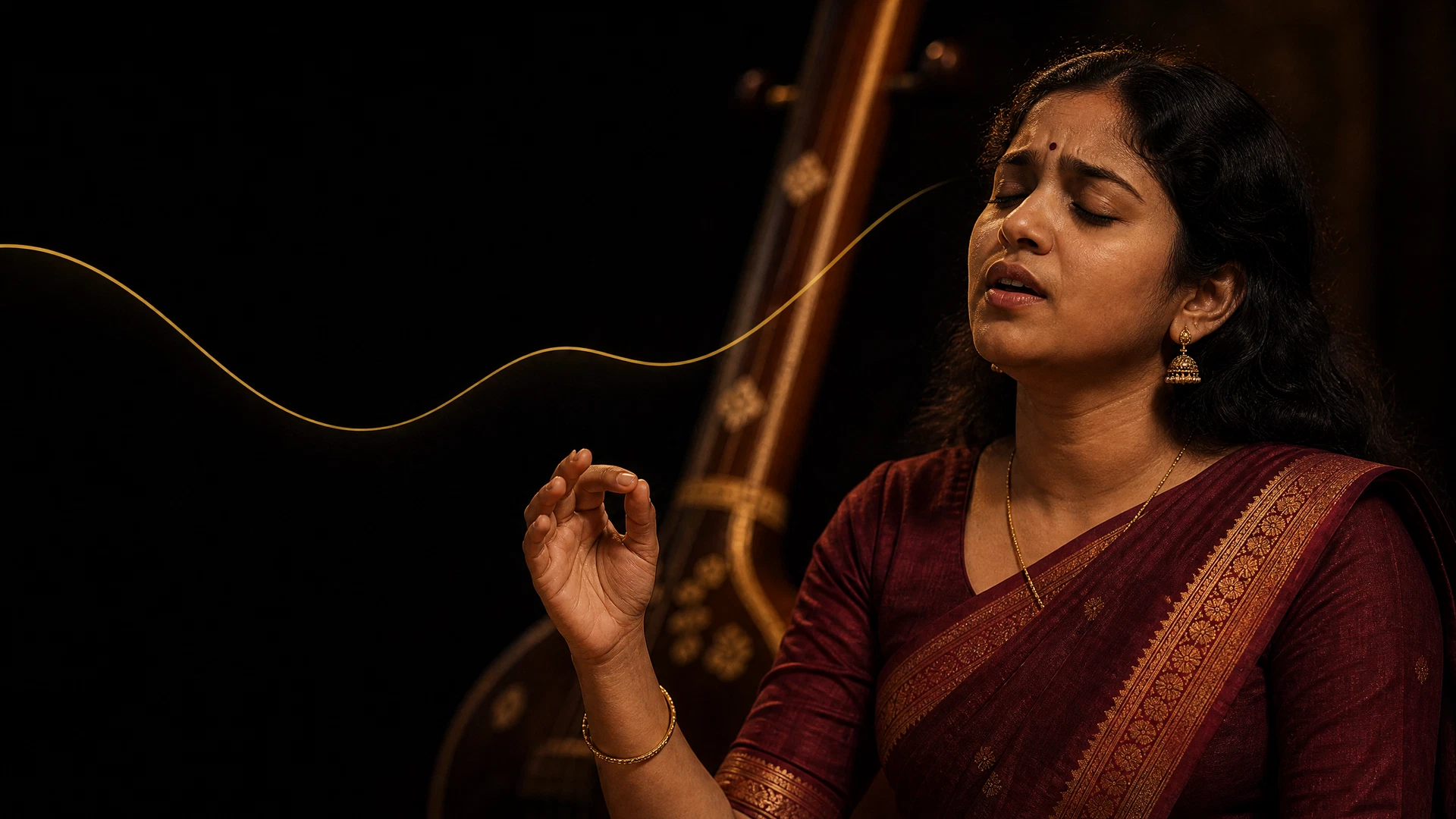
Quick Facts
- A gamaka is an audible movement applied to a note or phrase in Carnatic music.
- It can include oscillation, slide, double touch, flick, or another characteristic inflection.
- Gamaka is not an optional decorative layer added after a raga is complete. It can be central to raga character.
- Written notes do not always show the full sound of a gamaka.
- The right first question is not “which gamaka is this?” but “how does this note move?”
Table of Contents
- [What Gamaka Means](#what-gamaka-means)
- [Why a Note Can Move](#why-a-note-can-move)
- [Gamaka and Raga Identity](#gamaka-and-raga-identity)
- [A Listening Experiment](#a-listening-experiment)
- [Why Notation Is Only a Starting Point](#why-notation-is-only-a-starting-point)
- [Listen to the Route](#listen-to-the-route)
What Gamaka Means
When a new listener sees a Carnatic notation page, it is natural to imagine that each written swara has one fixed sound. In performance, a note may arrive with a visible or audible movement. That movement is part of what listeners call gamaka.
Raga Sangrah describes gamaka as an audible pattern applied to a note or phrase, including movements such as a wide oscillation or a slide. Artium Academy likewise places gamakas within the expressive and structural fabric of a kriti. The language differs, but the shared point is clear: Carnatic sound lives in how a note is approached and released, not only in its named pitch.
Why a Note Can Move
Think of a written note as a place on a map. Gamaka describes the route toward, around, or away from that place. That route may make a phrase sound recognisable in its raga.
| Listening question | What it may reveal |
|---|---|
| Does the sound settle directly or approach from another note? | A slide or shaped arrival |
| Does one note seem to lean or oscillate? | A sustained movement rather than a fixed point |
| Does the phrase feel smooth, angular, or turning? | The larger contour of the raga phrase |
Do not try to label every movement from a first listen. Your ear is learning a language of motion.
Gamaka and Raga Identity
Raga identity is more than an ascending and descending scale. Characteristic phrases and note movements help distinguish ragas that might otherwise look similar on paper. That is why a teacher’s demonstration matters so much for students.
The Raga Guide for Beginners introduces the idea of raga as a melodic framework. This guide adds a crucial listening detail: the framework includes movement, not only a list of swaras.
A Listening Experiment
Watch the official YouTube video
In this official Indire Indu Vadane recording, choose one short vocal phrase. Listen once for the destination note. Listen again for how the voice reaches it. The second question is often where gamaka becomes audible.
You do not need to imitate the phrase. Listening closely is enough. If you are learning to sing, bring a specific phrase to your teacher rather than attempting to copy an unfamiliar ornament by ear alone.
Why Notation Is Only a Starting Point
Notation can help a learner remember text, swara order, and rhythmic placement. It is valuable, but it does not replace a living demonstration of sound. A notation symbol may point toward a movement without capturing every detail of weight, range, or timing.
That is not a limitation to be feared. It is part of why attentive listening remains central in Carnatic learning. The First Lessons path gives a gradual route from swara exercises toward fuller compositions, where these nuances become more meaningful.
Frequently Asked Questions
Is gamaka the same as vibrato?
Not exactly. A comparison may help a first-time listener hear motion, but gamakas belong to specific Carnatic raga practices and should not be reduced to one Western technique.
Do all notes in a raga use the same gamaka?
No. The treatment of a note depends on the raga, phrase, position, and musical context.
Can I learn gamaka from written notation alone?
Notation is useful support, but it cannot replace careful listening and teacher guidance for the sound and shape of a movement.
Why does gamaka matter to a listener?
It helps explain why the same named note can feel different across phrases and ragas. Hearing movement makes raga character more audible.
What should I read next?
Go to How to Identify a Raga by Listening for a practical way to connect phrases, movement, and memory.
Listen to the Route
The note is important, but the route is often where the raga begins to speak. Let one phrase move slowly enough for your ear to notice how it arrives.
Published by Medha Naada
This guide is published by Medha Naada, Medha Vidyabhushan's official portfolio. It combines the credited sources below with plain-language listening or learning prompts. Historical details, song credits, and public records are limited to the cited material.
A written guide can support listening and preparation, but a qualified teacher remains the right source for personal vocal technique, pronunciation feedback, or repertoire decisions.
How this guide is supported
The sources support the basic description of gamaka and its relation to Carnatic expression. The listening experiment is editorial and does not claim to identify or classify every gamaka in a recording.
- Gamaka Ornamentation & Anuswara Guide. Raga Sangrah Editorial. Gamaka as an audible movement pattern and the distinction between a clear gamaka and a subtler anuswara or shadow-note function.
- What is Kriti in Carnatic Music?. Kamalika Roy Chowdhury. The connection among raga, tala, sahityam, and gamakas within a Carnatic kriti and its learning context.