Song Meaning · 2026-09-22 · 8 min read
Agajaanana Padmaarkam: Meaning, Pronunciation, and a Ganesha Shloka Listening Guide
A careful guide to the Agajaanana Padmaarkam Ganesha shloka with Sanskrit text, transliteration, plain-English meaning, pronunciation prompts, and official Medha listening paths.

Quick Facts
- Agajaanana Padmaarkam is a short Sanskrit shloka that addresses Ganesha through images including the elephant face and the single tusk.
- The opening image reads Ganesha as the sun to the lotus-like face of Pārvatī, also called Agajā in the source explanation.
- The compact sequence often printed as anekadantam is carefully read here as anekadaṃ tam, “him who gives many desired ends,” rather than as a second tusk description.
- Medha Vidyabhushan’s official September 16, 2026 Short identifies the shloka and credits the vocal to Medha Vidyabhushan.
- A translation is a listening aid, not a substitute for the Sanskrit sound or for a teacher’s pronunciation guidance.
A short shloka can be easy to replay and still ask for close attention. Agajaanana Padmaarkam moves through a mother-and-child image, Ganesha’s elephant face, a distinctive single tusk, and a shared act of worship. This guide gives the Sanskrit text, a readable transliteration, a careful plain-English sense, and a modest way to move from Medha Vidyabhushan’s short clip into further Ganesha listening.
There is one important editorial boundary at the start. Public online witnesses differ in spacing and in the form printed around padmārkam or padmākam. The Green MESG page prints the familiar padmārkam reading, while Shlokam.org’s explanatory page presents the compound through an excerpt from Swami Dayananda Saraswati’s Prayer Guide. Neither is treated here as a critical edition. The text below follows the familiar padmārkam reading and states its interpretive choices openly.
Table of Contents
- [The Verse at a Glance](#the-verse-at-a-glance)
- [Sanskrit Text and Transliteration](#sanskrit-text-and-transliteration)
- [How the Images Work](#how-the-images-work)
- [Pronunciation Without Rushing](#pronunciation-without-rushing)
- [From a Short Shloka to Ganesha Listening](#from-a-short-shloka-to-ganesha-listening)
- [Conclusion](#conclusion)
The Verse at a Glance
The verse is a praise and meditation addressed to Ganesha. In the broad cultural context, UCLA’s South Asia resource describes Ganesh as elephant-headed and one-tusked, and notes the customary practice of propitiating him at the beginning of cultural events. That helps explain why a listener may encounter a Ganesha shloka near the beginning of a devotional or musical setting. It does not make this one verse a compulsory opening for every family, lesson, or performance.
The name Ekadanta, “one-tusked,” also has a visible iconographic life. A Victoria and Albert Museum record for an eleventh- or twelfth-century South Indian Ganesha identifies the figure as elephant-headed and describes its lower right hand holding a broken tusk. That object is useful context for the name, not a single explanation for every Ganesha story.
The first compound presents Ganesha as a sun to Pārvatī’s lotus-like face. It evokes a face flowering with joy at the sight of a beloved child. The verse then shifts to names that identify Ganesha and finally to the shared act: “we worship” or “we meditate upon.”
Sanskrit Text and Transliteration
A familiar printed form is:
अगजानन पद्मार्कं गजाननमहर्निशम् । अनेकदन्तं भक्तानामेकदन्तमुपास्महे ॥
agajānanapadmārkaṃ gajānanam aharniśam | anekadantaṃ bhaktānām ekadantam upāsmahe ||
For learning, it is helpful to show the word joins more clearly:
agajā-ānana padma-arkaṃ / gajānanam aharniśam aneka-daṃ taṃ bhaktānām / ekadantam upāsmahe
The second line needs special care. In continuous writing, the sounds can look like anekadantam. Shlokam.org’s explanatory prose parses the phrase as aneka-daṃ tam: “him who gives many” to devotees. This reading makes the following ekadantam, “one-tusked,” the verse’s explicit tusk epithet. It is better to explain the compact sound pattern than to create a contradiction by translating the earlier sequence as “many-tusked.”
Sanskrit compounds and sound joins can carry more than a literal gloss shows. If you are comparing a book, a family recitation, or a teacher’s version with this page, keep its wording intact rather than silently merging texts.
How the Images Work
The table offers a literal orientation and listening cue, not a new scholarly translation. The University of Cologne’s digitized Monier-Williams dictionary supports arka as sun, padma as lotus, gaja as elephant, and danta as tooth or elephant tusk.
| Sanskrit phrase | Compact literal gloss | Careful listening sense |
|---|---|---|
| agajā-ānana padmārkam | “sun to the lotus of Agajā’s face” | Ganesha is imagined as the sun that makes Pārvatī’s lotus-like face bloom. |
| gajānanam | elephant-faced | This is an identifying devotional name, not a request to force a visual image into the music. |
| aharniśam | day and night | The phrase gives the act of attention continuity. “Always” is a helpful plain-English sense. |
| aneka-daṃ taṃ bhaktānām | him who gives many desired ends to devotees | The source’s grammatical reading directs this phrase toward giving, not toward a second tusk image. |
| ekadantam | one-tusked | The name brings the verse back to Ganesha’s familiar iconography. |
| upāsmahe | we worship or meditate upon | The ending makes the verse a collective act of devotion, not only a description. |
A fluent English sense is: “We meditate day and night on the elephant-faced, one-tusked Ganesha, who is the sun to the lotus-like face of Pārvatī and who gives many desired ends to devotees.” English rearranges the order.
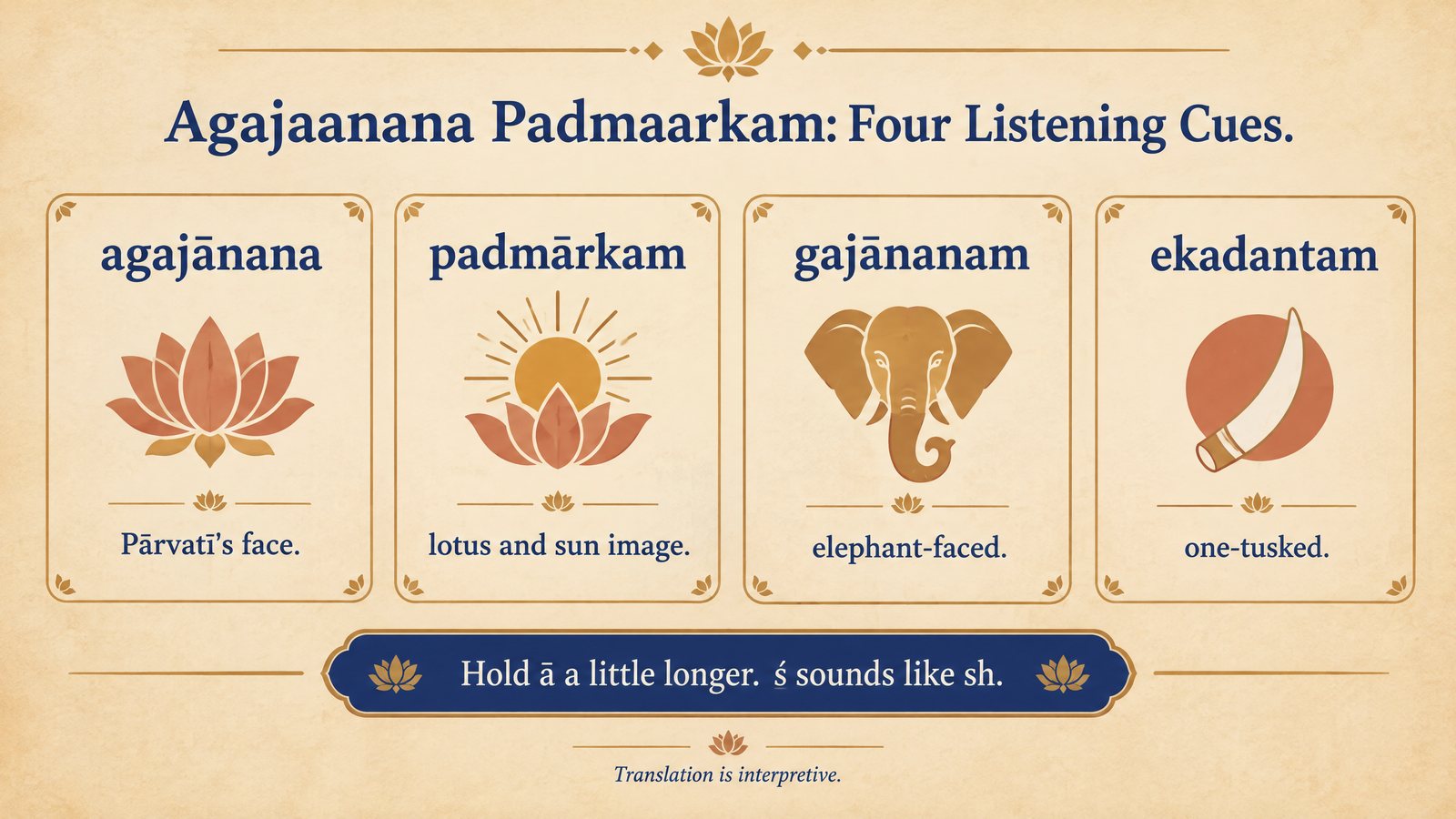
Agajānanam is a compact possessive image, while padmārkam adds sun and lotus. Together they suggest a relation, not merely a dictionary list. For a broader approach, see the portfolio’s guide to the languages of Carnatic compositions.
Pronunciation Without Rushing
Begin by hearing long and short vowels rather than by pursuing speed. In this transliteration, ā is held a little longer than a, and ś is close to “sh.” The broken prompts below are practical approximations for an English reader, not an attempt to replace a Sanskrit teacher or a speaker from your own tradition.
| Text segment | Slow speaking prompt | What to notice |
|---|---|---|
| agajānanapadmārkaṃ | a-ga-JAA-na-na pad-MAAR-kam | Let both long ā sounds remain audible. Do not turn the phrase into one English word. |
| gajānanam aharniśam | ga-JAA-na-nam a-har-NI-sham | Keep the two phrases distinct before joining them. |
| anekadantaṃ bhaktānām | a-NE-ka-dan-tam bhak-TAA-naam | First hear the printed sequence, then learn the source’s explanatory split aneka-daṃ tam. |
| ekadantam upāsmahe | e-ka-DAN-tam u-PAAS-ma-he | Give the final he its own syllable. |
A useful five-minute practice is simple. First, listen once without repeating. Second, speak the first line slowly with the transliteration in view. Third, say ekadantam upāsmahe as a separate closing gesture. Then return to the full line. Stop if the sounds blur.
This is listening and diction practice, not a performance lesson. A teacher can correct vowel length, consonant placement, pitch, and word joins. Readers can continue with How to Read Carnatic Notation for Beginners.
From a Short Shloka to Ganesha Listening
Medha Vidyabhushan’s official Short identifies itself as “Agajaanana Padmaarkam”, names it a Lord Ganesha Sanskrit shloka, and credits the vocal to Medha Vidyabhushan. It was posted on September 16, 2026. The clip does not identify historical authorship, raga, tala, or universal ritual use, so this guide does not attach those claims to it.
Begin with the official Agajaanana Padmaarkam Short. First hear the two lines, then follow the Sanskrit, then keep only the sun-and-lotus image in mind. This keeps a brief clip from becoming a rushed pronunciation exercise.
For a longer Ganesha-focused listen, Medha’s linked official video is titled Maha Ganapathim. It is a next listening choice, not proof that all Ganesha pieces share one text, form, or musical treatment. The Ganesh Chaturthi and Carnatic Music guide adds festival context. The Devotional Music Traditions and Song Meanings hubs offer further routes.
Frequently Asked Questions
What does Agajaanana Padmaarkam mean?
A careful plain-English sense is: “We meditate day and night on the elephant-faced, one-tusked Ganesha, who is the sun to the lotus-like face of Pārvatī and who gives many desired ends to devotees.” It is an interpretive sentence built from the verse’s compounds, not a replacement for the Sanskrit.
Why is Ganesha called the sun to Pārvatī’s lotus face?
The image compares Pārvatī’s face to a lotus and Ganesha to the sun that makes it bloom. Shlokam.org’s Prayer Guide excerpt explains Agajā as Pārvatī and arka as sun. The verse uses this image to frame a mother’s joy in her child.
Does anekadantam mean many-tusked?
Not in the reading used here. The source explanation divides the continuous sound as aneka-daṃ tam, meaning “him who gives many” to devotees. The next word, ekadantam, supplies the clear one-tusked name. Because online transcriptions vary, it is wise to keep a stated source beside the translation.
How do I pronounce upāsmahe?
Say it slowly as u-PAAS-ma-he. Hold the long ā slightly longer than the short vowels, and keep the final he audible. For faithful pronunciation in a learned setting, follow a Sanskrit teacher or the version taught in your musical practice.
Is Medha Vidyabhushan’s Short a full lesson on the shloka?
The official page identifies a Short performance and its vocal credit. It is a useful listening entry point, but it does not provide a complete text edition, translation, pronunciation lesson, or historical note. Use the clip together with a source-backed text and teacher guidance where needed.
Conclusion
Agajaanana Padmaarkam rewards a slow first hearing. Keep the two-line Sanskrit close, recognize the sun-and-lotus image, and let ekadantam upāsmahe settle as the shared closing gesture. Medha Vidyabhushan’s Short can begin the listening path, while careful text work keeps the shloka’s compact Sanskrit from being rushed into a single loose gloss.
Published by Medha Naada
This guide is published by Medha Naada, Medha Vidyabhushan's official portfolio. It combines the credited sources below with plain-language listening or learning prompts. Historical details, song credits, and public records are limited to the cited material.
A written guide can support listening and preparation, but a qualified teacher remains the right source for personal vocal technique, pronunciation feedback, or repertoire decisions.
How this guide is supported
This guide treats public devotional pages as text witnesses, not a critical edition. It states the padmārkam and padmākam variation, labels the English sentence interpretive, and makes no authorship, date, raga, tala, ritual, or benefit claim.
- Agajanana Padmakam. Shlokam.org, quoting Swami Dayananda Saraswati's Prayer Guide. A direct text witness and the stated interpretive explanation of Agajā, padma, arka, gajānanam, ekadantam, aharniśam, upāsmahe, and the aneka-daṃ tam reading.
- Monier-Williams Sanskrit-English Dictionary. Cologne Digital Sanskrit Lexicon, University of Cologne. University-hosted lexical context for the sun, lotus, elephant, and tooth or tusk senses used in the compact glosses.
- Ganesh. UCLA MANAS, University of California, Los Angeles. University-backed context for elephant-headed and one-tusked iconography and customary invocation at cultural beginnings.
- Ganesha. Victoria and Albert Museum. Museum documentation of a South Indian Ganesha figure described as elephant-headed and holding a broken tusk.
- Agajanana Padmarkam: Sanskrit Text with English Translation. Green Message. A second public text witness for the familiar padmārkam printed form and an English rendering.