Learning Guide · 2026-08-29 · 5 min read
How to Read Basic Carnatic Music Notation for Beginners
Learn how to read basic Carnatic music notation. This clear guide explains swara letters, ascending and descending movement, tala grouping, and why written notation needs teacher guidance and listening.
Quick Facts
- Basic Carnatic notation often uses the swara letters Sa, Ri, Ga, Ma, Pa, Dha, and Ni.
- Notation can help a student remember order, text, and rhythm.
- It cannot fully capture gamaka, voice placement, or a teacher's style.
- A written page works best beside listening and guided practice.
Table of Contents
- [What You See on the Page](#what-you-see-on-the-page)
- [The Seven Swara Letters](#the-seven-swara-letters)
- [Reading a Small Pattern](#reading-a-small-pattern)
- [Where Tala Appears](#where-tala-appears)
- [What Notation Leaves Out](#what-notation-leaves-out)
- [Read a Little, Then Return to Sound](#read-a-little-then-return-to-sound)
- [A Four-Step Reading Habit](#a-four-step-reading-habit)
- [Keep Sahitya and Swara Together](#keep-sahitya-and-swara-together)
- [Read, Then Listen Again](#read-then-listen-again)
What You See on the Page
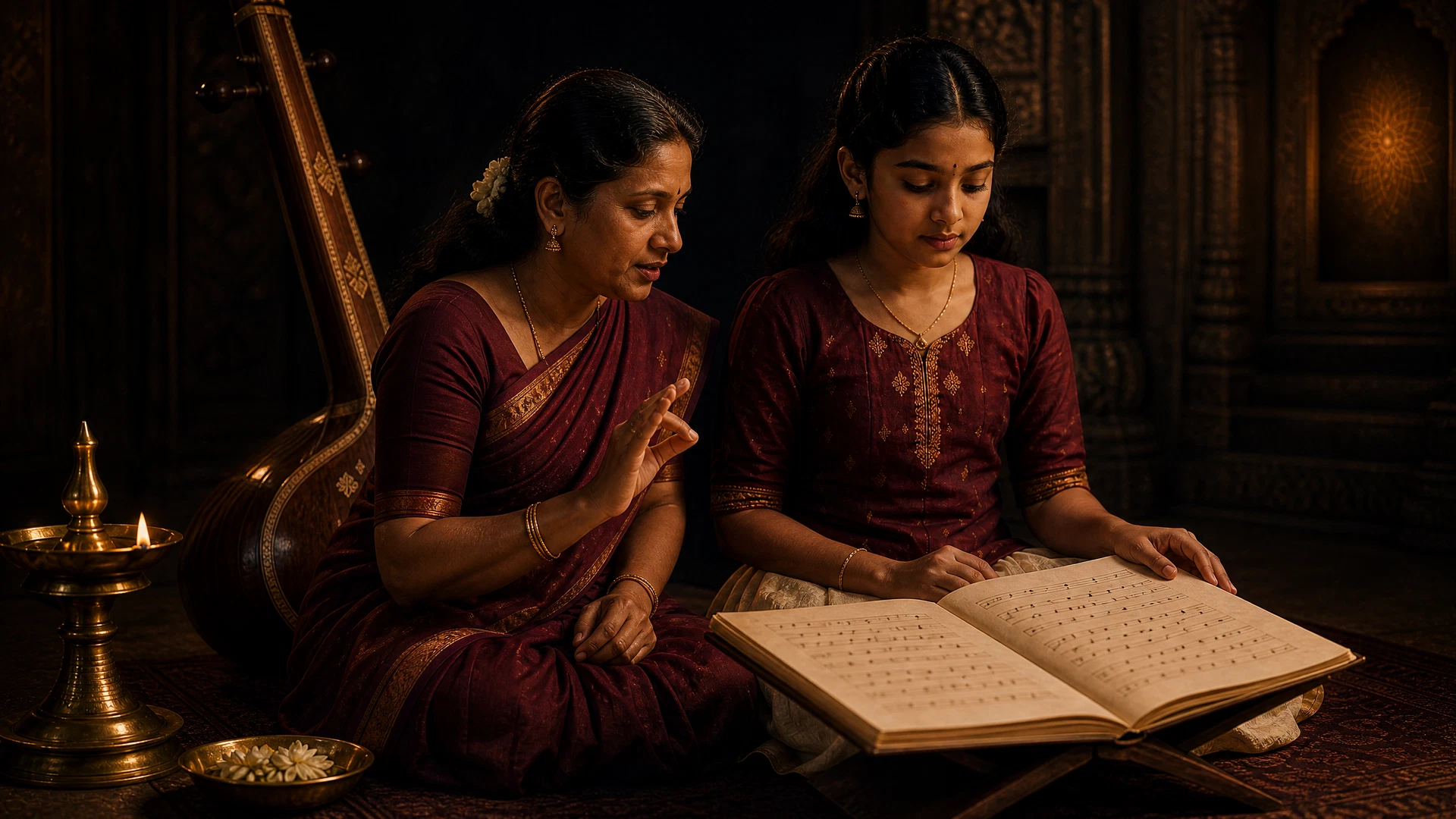
Carnatic notation is a helpful memory aid. It can show a sequence of swaras, the order of lyrics, and a basic rhythmic layout. For a learner, the first goal is not to decode a dense page. It is to connect a simple written pattern to a phrase already learned by ear.
Educational introductions to Carnatic learning place swara exercises before longer compositions. That is why Sarali Varisai is a useful place to meet notation in small pieces.
The Seven Swara Letters
| Short form | Full swara name |
|---|---|
| Sa | Shadja |
| Ri | Rishabha |
| Ga | Gandhara |
| Ma | Madhyama |
| Pa | Panchama |
| Dha | Daivata |
| Ni | Nishada |
Different texts may use small variations in spelling or symbols. Start with the system your teacher uses and do not mix formats carelessly.
Reading a Small Pattern
Take a simple line such as Sa Ri Ga Ma. Sing it slowly with shruti. Then look at the letters while you sing again. The page is not giving you a new musical answer. It is helping you see the order you are already hearing.
Move on only when the pattern feels steady. The Janta Varisai guide explains how repeated swaras add a new kind of attention.
Where Tala Appears
Notation may place swaras in groups so that a learner can follow the tala cycle. At first, use your teacher's hand count or spoken guidance. The Alankara guide explains why exercises and tala belong together.
What Notation Leaves Out
Written swaras do not automatically show the full shape of a gamaka, the exact timing of a phrase, or the weight of a syllable. That is not a flaw. It is a reminder that Carnatic music is learned through sound, demonstration, and repetition as well as writing.
Read a Little, Then Return to Sound
Notation is most helpful when it sends you back to listening. A page of swaras can show order, repetition, and rough rhythmic grouping. It cannot on its own show every nuance of voice, bowing, gamaka, or pronunciation. That is why a student should keep a teacher's version and a trusted recording close by when using written material.
| Mark on the page | A careful way to use it |
|---|---|
| Swara letters | Follow the sequence slowly while hearing the phrase |
| Dots or octave signs | Check the convention used by that book or teacher before assuming a range |
| Commas and duration marks | Use them as timing prompts, then confirm by listening |
| Tala divisions | Clap or count only in the method your teacher has taught |
A Four-Step Reading Habit
First, identify the shruti and the first swara. Second, read one small group without trying to finish the entire page. Third, sing or play it slowly with the lesson reference. Fourth, compare your attempt with the source and mark only one question for later. This keeps notation from becoming a silent decoding exercise.
Keep Sahitya and Swara Together
When a composition has lyrics, do not separate the words from the musical line for too long. Ask where a syllable begins, where the phrase breathes, and how the teacher joins text to swara. A transliteration may help a beginner follow the text, but it does not settle pronunciation or meaning by itself.
The source notes support the role of notation as a study aid within an aural tradition. The reading habit above is editorial guidance. It is not a standard notation key for every school, publication, or composition.
Frequently Asked Questions
Can I learn Carnatic music from notation alone?
Notation is useful support, but it cannot replace listening and teacher guidance.
Why do some pages show numbers or marks with swaras?
Different notation systems use signs to show rhythm, octave, duration, or other details. Ask your teacher about the exact system on your page.
Should I memorise the full swara names first?
Learn the short forms and full names gradually. The goal is to connect them to sound.
Does notation show every gamaka?
Usually not in full detail. Listen to a trusted demonstration for the movement and feel of a phrase.
What should I read after notation basics?
Continue with Geetham practice and Gamaka in Carnatic Music.
Read, Then Listen Again
Notation is most helpful when it sends you back to sound. Read one small pattern, sing it with shruti, and let your ear check the page.
Published by Medha Naada
This guide is published by Medha Naada, Medha Vidyabhushan's official portfolio. It combines the credited sources below with plain-language listening or learning prompts. Historical details, song credits, and public records are limited to the cited material.
A written guide can support listening and preparation, but a qualified teacher remains the right source for personal vocal technique, pronunciation feedback, or repertoire decisions.
How this guide is supported
This article introduces notation as a memory and study aid, not a complete performance instruction. The cited sources support basic swara terminology and the role of notation within aural learning. Examples and study prompts are Medha Naada editorial guidance.
- The Basics of Carnatic Music. Shivkumar Kalyanaraman. Basic swara names and foundational Carnatic music concepts.
- Handwritten Notation in Karnatak Music: Memory and the Mediation of Social Relations. Lara Pearson and T. K. V. Ramanujacharyulu, Brill. Sargam notation, handwritten lesson practice, oral transmission, teacher demonstration, and notation as a supporting memory prompt.