Devotional Traditions · 2026-09-22 · 7 min read
Diwali and Carnatic Music: A Thoughtful Lakshmi Listening Guide for 2026
A culturally careful Diwali listening guide with Lakshmi-focused, Krishna-focused, and concert-ambience routes, without treating one regional practice as universal.
Quick Facts
- Diwali falls on Sunday, November 8, 2026, according to India’s Ministry of Tourism.
- The ministry’s public guide includes Lakshmi puja in one five-day outline, while also describing regional observances and Hindu, Jain, Sikh, and Buddhist contexts.
- A Lakshmi-oriented listening hour is therefore one possible route, not a claim about what every household hears or observes.
- The North Carolina Museum of Art has scheduled a Diwali program with a Carnatic concert for November 6, 2026, showing a current public setting for this pairing.
- Medha Vidyabhushan’s official channel includes Lakshmi-labelled releases that can be used as optional listening examples, with the channel itself as the source for their recording credits.
Diwali and Deepavali bring music into many kinds of rooms: a household preparing for worship, a family visit, a classroom, or a quiet evening far from home. Begin with one boundary: there is no single Diwali playlist that represents everyone. The Ministry of Tourism’s overview places Lakshmi puja beside Jain, Sikh, Buddhist, Rama-centered, and Naraka Chaturdasi contexts.
This guide offers a Lakshmi-oriented route without making it a universal rule. It also leaves room for Krishna-focused listening and concert ambience. The question is not, “What must Diwali sound like?” It is, “What fits this household and this evening?”
Table of Contents
- [Start with Practice, Not a Universal Playlist](#start-with-practice-not-a-universal-playlist)
- [Why Lakshmi Listening Is One Diwali Route](#why-lakshmi-listening-is-one-diwali-route)
- [Build a Respectful Diwali Listening Hour](#build-a-respectful-diwali-listening-hour)
- [Use Medha’s Official Recordings With Clear Boundaries](#use-medhas-official-recordings-with-clear-boundaries)
- [A Gentle Way to Listen More Closely](#a-gentle-way-to-listen-more-closely)
- [Continue Through the Seasonal Library](#continue-through-the-seasonal-library)
- [Conclusion](#conclusion)
Start with Practice, Not a Universal Playlist
A listening plan works best when it follows practice already present. Consider the household puja, a preferred language, a temple or community program, and whether music is welcome at that time. In some homes, silence during worship is right. In others, one recording before or after prayer feels natural.
The Ministry’s page makes variety visible: Lakshmi puja appears in its five-day account alongside Bandi Chhor Divas, Mahavira’s nirvana, and southern observances linked with Naraka Chaturdasi. For diaspora listeners and educators, name the route plainly: “Tonight we are hearing a Lakshmi-oriented Carnatic selection.” That welcomes listeners without ranking anyone’s own practice.
Why Lakshmi Listening Is One Diwali Route
Lakshmi is associated with Diwali for many Hindu households, and the Ministry’s page describes Lakshmi puja on day three of its five-day outline. That supports a Lakshmi-centered hour. It does not make every Lakshmi composition a Diwali composition or seasonal requirement.
Indire Indu Vadane is one possible entry. Karnatik identifies it as a Kannada work by Jagannathadasa in Hindola and Adi tala; its text addresses Lakshmi through names including loka nayaki and Lakumi. Medha Vidyabhushan’s official release gives recording-specific credits to Sri Jagannatha Dasa, Dr. Vidyabhushan, and Medha Vidyabhushan. For lyric context, use the library’s Indire Indu Vadane guide.
Build a Respectful Diwali Listening Hour
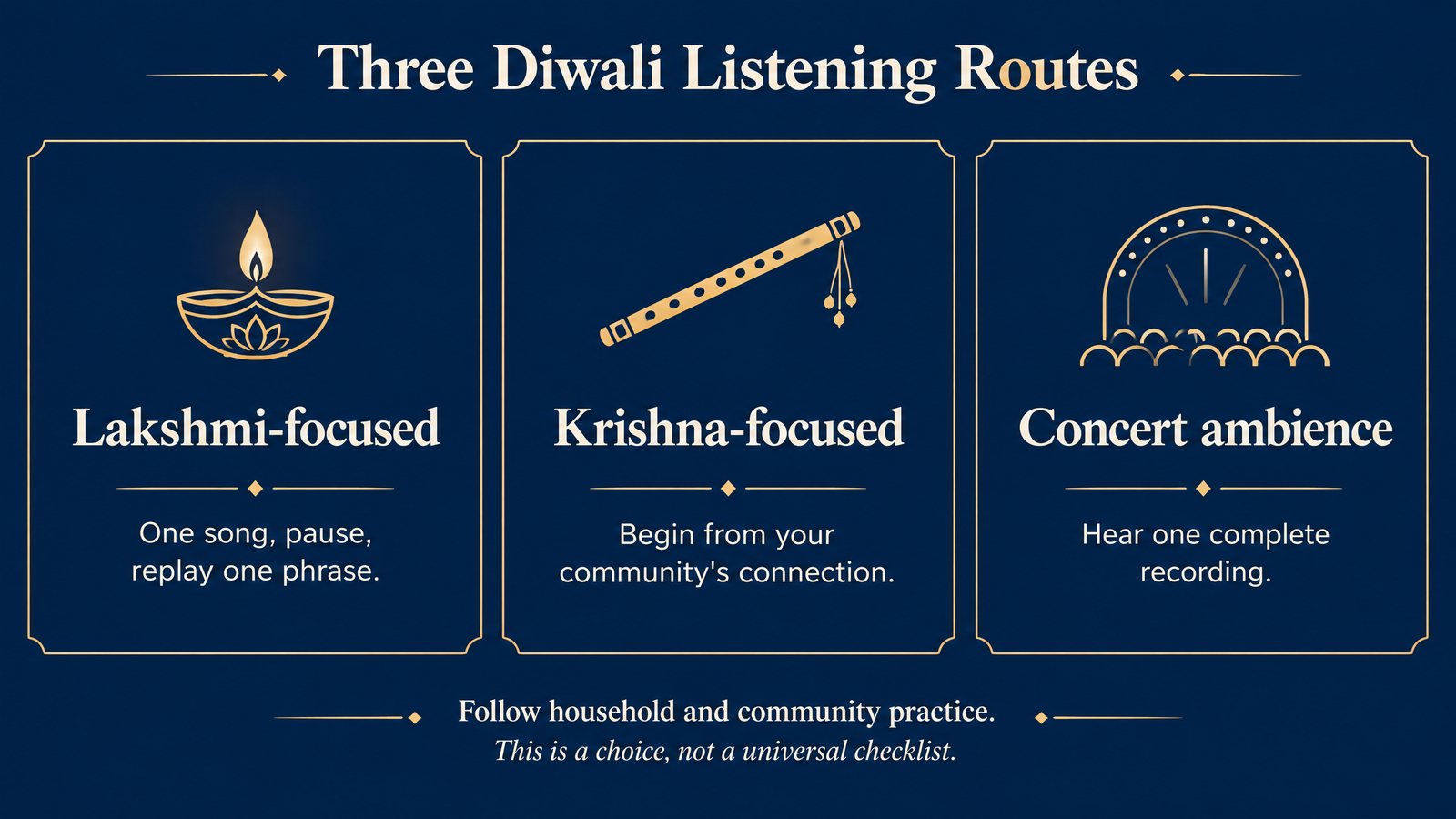
The following plan is deliberately small. It is not a puja procedure, a festival timetable, or a recommendation that every route be used. Choose one route, shorten it, or leave it aside according to household and community practice.
| Route | Listening purpose | Language note | A 20-minute shape | Respectful boundary |
|---|---|---|---|---|
| Lakshmi-focused | Make space for a Lakshmi address before or after observance | Choose a meaningful household language | One song, pause, then replay one phrase | Do not call this everyone’s Diwali repertoire |
| Krishna-focused | Connect with a relevant Naraka Chaturdasi, Krishna, or devotional association | Use a known text, or do not force translation | One song, then quiet conversation or reading | Do not use Krishna as a label for every southern practice |
| Concert ambience | Share music without assigning ritual meaning | Let the performance language remain itself | Hear one complete recording or excerpt | A concert does not stand in for worship or community tradition |
For Lakshmi listening, hear Indire Indu Vadane once, then return to one phrase. Medha’s official channel also presents Marulu Maadikondeyalle as a Lakshmi-labelled release, with credits for Sri Purandara Dasa, Dr. Vidyabhushan, and Medha Vidyabhushan. The song-meaning guide adds text context.
For a Krishna route, start with a real community connection. The Ministry notes southern traditions linked to Naraka Chaturdasi and Krishna’s victory over Narakasura. The Krishna Janmashtami guide can locate repertoire, but its seasonal frame should not be collapsed into Diwali. For concert ambience, Medha’s official Toogire Rayara page identifies her as vocalist in a live concert release. The performance guide offers a focused route into it.
Use Medha’s Official Recordings With Clear Boundaries
Use official artist pages for a recording’s release and credit context, not for broad claims about a festival or a whole tradition. The Indire Indu Vadane and Marulu Maadikondeyalle pages supply their own credits. Toogire Rayara is included for concert ambience, not as a Diwali work.
The Music Academy’s Advanced School describes guided archive-listening sessions within its practical curriculum. The useful lesson is simple: give one recording enough time. You do not need to identify every raga, tala, or lyric. Hear it once without interruption, then decide whether one return, word, or silence deserves another hearing.
A Gentle Way to Listen More Closely
Set one modest intention: hear a Lakshmi address, remember a family language, share a concert recording, or create a calm interval. On the first pass, do not translate or count. On the second, choose one return: a refrain, a divine name, a settling phrase, or an instrumental response.
Give only the explanation that helps. A title, composer, and plain sentence are often enough. Do not invent a word-by-word translation from a video description. The languages guide explains why translation opens a door without replacing the song’s language. End with a pause, so music does not become background decoration.
If several people are listening together, invite one observation after the song rather than explaining over the performance. A remembered word or returning phrase is enough.
Continue Through the Seasonal Library
Diwali is not an extension of every other autumn festival. The Navaratri Carnatic listening guide is a separate path for the nine-night festival. The Ganesh Chaturthi guide, Rama Navami guide, and Krishna Janmashtami guide also have distinct settings. Explore them through the Devotional Music Traditions hub.
Frequently Asked Questions
Is there one traditional Carnatic playlist for Diwali?
No. Diwali and Deepavali include varied regional, religious, and household practices. A Lakshmi selection may be meaningful, but it is not universal.
Can I use Lakshmi songs for a Diwali listening hour?
Yes, if that fits household or community practice. The Ministry’s outline includes Lakshmi puja, and Medha’s official channel offers optional Lakshmi-labelled examples.
What if my family observes Naraka Chaturdasi or a Krishna connection?
Begin from that practice, not a Lakshmi default. The Ministry notes southern traditions connected with Naraka Chaturdasi and Krishna’s victory over Narakasura.
Do I need to understand the song’s language before listening?
No. Start with sound and one point of attention. A short context note can help, but a full translation is not required.
Why include a concert recording in a Diwali guide?
A concert recording is a non-prescriptive shared option. Toogire Rayara is suggested for ambience, not as a Diwali composition or ritual requirement.
Conclusion
A thoughtful Diwali listening hour does not need a definitive playlist. Choose the Lakshmi route if it belongs to your practice, a Krishna route if that is the relevant connection, or a concert recording if shared attention is the goal. Keep the language, custom, and quiet of the household in view. The most respectful repertoire is the one that does not pretend to speak for every Diwali.
Published by Medha Naada
This guide is published by Medha Naada, Medha Vidyabhushan's official portfolio. It combines the credited sources below with plain-language listening or learning prompts. Historical details, song credits, and public records are limited to the cited material.
A written guide can support listening and preparation, but a qualified teacher remains the right source for personal vocal technique, pronunciation feedback, or repertoire decisions.
How this guide is supported
This is one optional Diwali listening framework, not a universal festival playlist or ritual guide. The sources support the 2026 date, diverse public contexts, one current Carnatic programme, one composition record, and the value of guided listening.
- Diwali: A Festival of Lights and Joy. Incredible India, Ministry of Tourism, Government of India. The November 8, 2026 date and a public overview of varied Hindu, Jain, Sikh, Buddhist, regional, and Naraka Chaturdasi contexts.
- A Celebration of Diwali. North Carolina Museum of Art. A November 6, 2026 public Diwali programme that includes a Carnatic concert, without defining a festival canon.
- indirE indu vadanE. karnATik. Jagannathadasa attribution, Kannada text, a listed Hindola and Adi setting, and Lakshmi address in the composition text.
- The Advanced School of Carnatic Music. The Music Academy, Madras. Institutional context for guided archive listening within practical Carnatic study.