Song Meaning · 2026-07-15 · 14 min read
Indire Indu Vadane: Meaning, Lyrics, and Jagannatha Dasa's Devotion to Goddess Lakshmi
Discover the meaning and lyrics of Indire Indu Vadane, Sri Jagannatha Dasa's beautiful prayer to Goddess Lakshmi, rendered soulfully by Medha Vidyabhushan.
Quick Facts
- This guide explains Indire Indu Vadane: Meaning, Lyrics, and Jagannatha Dasa's Devotion to Goddess Lakshmi within the site's Song Meaning learning collection.
- Factual context and practical listening or study suggestions are presented separately.
- Use the linked source notes and related guides when you want to explore the topic further.
Table of Contents
- [Introduction](#introduction)
- [The Legacy of Sri Jagannatha Dasaru](#the-legacy-of-sri-jagannatha-dasaru)
- [Understanding the Title: Indire Indu Vadane](#understanding-the-title-indire-indu-vadane)
- [The Symbolism of Goddess Lakshmi in Dvaita Philosophy](#the-symbolism-of-goddess-lakshmi-in-dvaita-philosophy)
- [Lyrical Meaning and Devotional Depth](#lyrical-meaning-and-devotional-depth)
- [Musicality and Carnatic Tradition](#musicality-and-carnatic-tradition)
- [Medha Vidyabhushan's Soulful Rendition](#medha-vidyabhushans-soulful-rendition)
- [Modern Relevance and Digital Platforms](#modern-relevance-and-digital-platforms)
- [The Haridasa Movement and Its Impact on Devotional Music](#the-haridasa-movement-and-its-impact-on-devotional-music)
- [The Ankita Nama Tradition](#the-ankita-nama-tradition)
Introduction
The rich tapestry of Carnatic music and the Haridasa tradition of Karnataka is adorned with countless gems that continue to inspire devotion, spiritual awakening, and cultural pride. Among these timeless treasures is the profound composition "Indire Indu Vadane," a beautiful and evocative prayer dedicated to Goddess Lakshmi. Composed by the illustrious Haridasa saint Sri Jagannatha Dasaru, this song is a masterful blend of poetic brilliance, philosophical depth, and unwavering devotion.
In the landscape of Indian classical music, compositions dedicated to the Divine Mother hold a special place. They evoke the Karuna Rasa (compassion) and Bhakti Rasa (devotion), drawing the listener into a state of meditative tranquility. "Indire Indu Vadane" is a shining example of this tradition. In this comprehensive article, we will explore the meaning, lyrics, and historical context of this magnificent piece. We will delve into the fascinating life of its creator, Sri Jagannatha Dasaru, and examine the song's significance within the Madhwa and Dvaita philosophical traditions. Furthermore, we will look at how modern artists, particularly the talented Medha Vidyabhushan, are breathing new life into these ancient classics, bringing them to contemporary audiences across the globe.
The Legacy of Sri Jagannatha Dasaru
To truly appreciate the depth of "Indire Indu Vadane," one must first understand the towering figure behind its creation. Sri Jagannatha Dasaru (1728–1809) is celebrated as one of the greatest Haridasa poets in the history of Karnataka. Born as Srinivasacharya in the town of Byagawat in the Raichur district, he was initially a highly respected and somewhat arrogant scholar of Sanskrit and Dvaita philosophy.
"The Haridasa movement was not merely a musical tradition; it was a profound spiritual revolution that sought to make complex Vedic truths accessible to the common people through the medium of regional languages and soulful melodies."
Legend has it that Srinivasacharya's transformation from a proud academic to a humble Haridasa was triggered by a severe illness. Despite his vast knowledge, he could not cure himself. It was only through the divine intervention and grace of another great saint, Sri Gopala Dasaru, that he was healed. This humbling experience opened his eyes to the limitations of mere intellectual scholarship and the supreme power of devotion. Upon his initiation into the Haridasa fold, he was bestowed with the ankita nama (pen name or signature) "Jagannatha Vittala," which adorns all his musical compositions.
Jagannatha Dasaru is perhaps best known for his magnum opus, the Harikathamrutasara, a monumental poetic work in Kannada that encapsulates the entire essence of Madhwa philosophy. His ability to distill complex theological concepts into accessible, melodious Kannada poetry made him a beloved figure among the masses. For more context on this spiritual lineage and its impact on South Indian culture, you can read about the Haridasa movement in Karnataka's history and explore what Dasarapadas are. You can also learn about his contemporaries by reading about Vadirajaru's compositions, life, and legacy. The Haridasa tradition is also closely linked with the worship of great saints like Sri Raghavendra Swamy. Devotees often undertake spiritual journeys to connect with this heritage, which you can read more about in our Mantralayam Raghavendra Swamy pilgrimage guide.
Understanding the Title: Indire Indu Vadane
The title of the composition, "Indire Indu Vadane," is a poetic and deeply symbolic invocation of Goddess Lakshmi, the Hindu deity of wealth, prosperity, and divine grace. In Sanskrit and Kannada literary traditions, the choice of words carries immense weight, often conveying multiple layers of meaning.
- Indire: You are looking at a classical name for Goddess Lakshmi. It signifies her radiant, resplendent nature. The name is often associated with her supreme beauty and her status as the source of all auspiciousness, royal splendor, and spiritual wealth.
- Indu Vadane: "Indu" translates to the moon, and "Vadane" means face. Together, the phrase translates to "the one with a face as beautiful, luminous, and soothing as the moon."
This imagery is not merely aesthetic; it conveys the compassionate and nurturing nature of the Goddess. Just as the moon provides gentle, cooling light in the darkness of the night, Goddess Lakshmi provides solace, grace, and guidance to souls navigating the darkness of worldly existence (Samsara). The moon is also a symbol of the mind and emotions in Vedic thought, suggesting that meditating upon her moon-like face brings peace to the restless human mind.
The Symbolism of Goddess Lakshmi in Dvaita Philosophy
In the Madhwa or Dvaita philosophy propounded by Sri Madhwacharya, the relationship between the Supreme Lord (Vishnu or Narayana) and Goddess Lakshmi is of paramount importance and is distinct from other philosophical schools. Unlike all other souls (Jivas), who are subject to the cycle of birth and death, Lakshmi is considered Nitya Mukta (eternally liberated). She is the eternal, inseparable consort of Lord Vishnu.
In this tradition, Goddess Lakshmi is the personification of the Lord's divine grace. She is the mediatrix through whom devotees can attain the Lord's blessings. She is completely dependent on Lord Vishnu, yet she is superior to all other deities, including Brahma and Vayu.
Jagannatha Dasaru, being a staunch and erudite follower of the Dvaita tradition, infuses "Indire Indu Vadane" with these subtle philosophical nuances. The song does not merely praise Lakshmi for material wealth -a common misconception about prayers to Lakshmi. Instead, it seeks her grace for spiritual upliftment and ultimate liberation (Moksha). She is depicted as the divine mother who intercedes on behalf of her children. Her divine beauty, as described in the song, is a reflection of her inner purity, her infinite auspicious qualities, and her eternal bond with the Supreme Lord.
Lyrical Meaning and Devotional Depth
The lyrics of "Indire Indu Vadane" are a testament to Jagannatha Dasaru's mastery over the Kannada language and his profound, unshakeable devotion. While the exact verses and their arrangements can vary slightly in different musical renditions, the core theme remains a heartfelt, poetic plea to the Goddess.
The composer begins by describing her unparalleled physical and spiritual beauty. She is adorned with divine, glowing ornaments and seated on a pristine, blooming lotus -a symbol of purity and spiritual awakening. He praises her as the beloved of Lord Narayana, highlighting that her true glory and power stem from her unwavering devotion to Him.
"O Moon-faced Indire, the bestower of all auspiciousness, cast your merciful glance upon us. You are the eternal companion of the Lord of the Universe, the compassionate mother of all creation."
The song intricately weaves mythological references, recalling how she emerged from the churning of the cosmic ocean (Samudra Manthana) and purposefully chose Lord Vishnu as her eternal consort, recognizing His supreme nature. Through these verses, Jagannatha Dasaru expresses a deep sense of Sharanaagati (complete surrender). He acknowledges human frailties, the distractions of the material world, and begs for her unconditional love and protection to stay on the righteous path.
The use of his ankita, "Jagannatha Vittala," in the concluding stanza serves as a seal of his personal devotion. It is a reminder that all prayers directed to Lakshmi ultimately reach and please the Supreme Lord, Jagannatha (the Lord of the Universe).
Musicality and Carnatic Tradition
The Haridasa compositions, widely known as Devaranamas or Dasarapadas, form a crucial and deeply emotional pillar of Carnatic music. "Indire Indu Vadane" is typically rendered in ragas that evoke a profound sense of devotion (Bhakti) and tranquility. Depending on the musical lineage (Patanthara) of the performer, it might be sung in ragas like Kalyani, Bhairavi, or other melodious scales that highlight the lyrical beauty of the piece. For an understanding of how specific ragas evoke emotions, you can read our guide on Raga Kapi explained.
The structure of the song follows the traditional format of a Pallavi (refrain), Anupallavi (sub-refrain), and multiple Charanas (stanzas). This structured yet flexible format allows the singer to explore the emotional depth of the lyrics through intricate melodic improvisations, known as Sangatis. The rhythmic cycles (Talas) used for such devotional pieces are usually steady, unhurried, and meditative, allowing the listener to absorb the profound meaning of each word without being distracted by overly complex rhythmic mathematics.
To understand more about the foundational figures who shaped this musical structure and integrated these devotional songs into the classical repertoire, one can look into the life of Purandaradasa, the father of Carnatic music, or explore the legacy of Kanakadasa's life and compositions. Listeners who enjoy the deep devotional aspect of such pieces might also appreciate exploring the meaning, history, and lyrics of Toogire Rayara or the vibrant devotion found in Kanada Raja Pandharicha.
Medha Vidyabhushan's Soulful Rendition
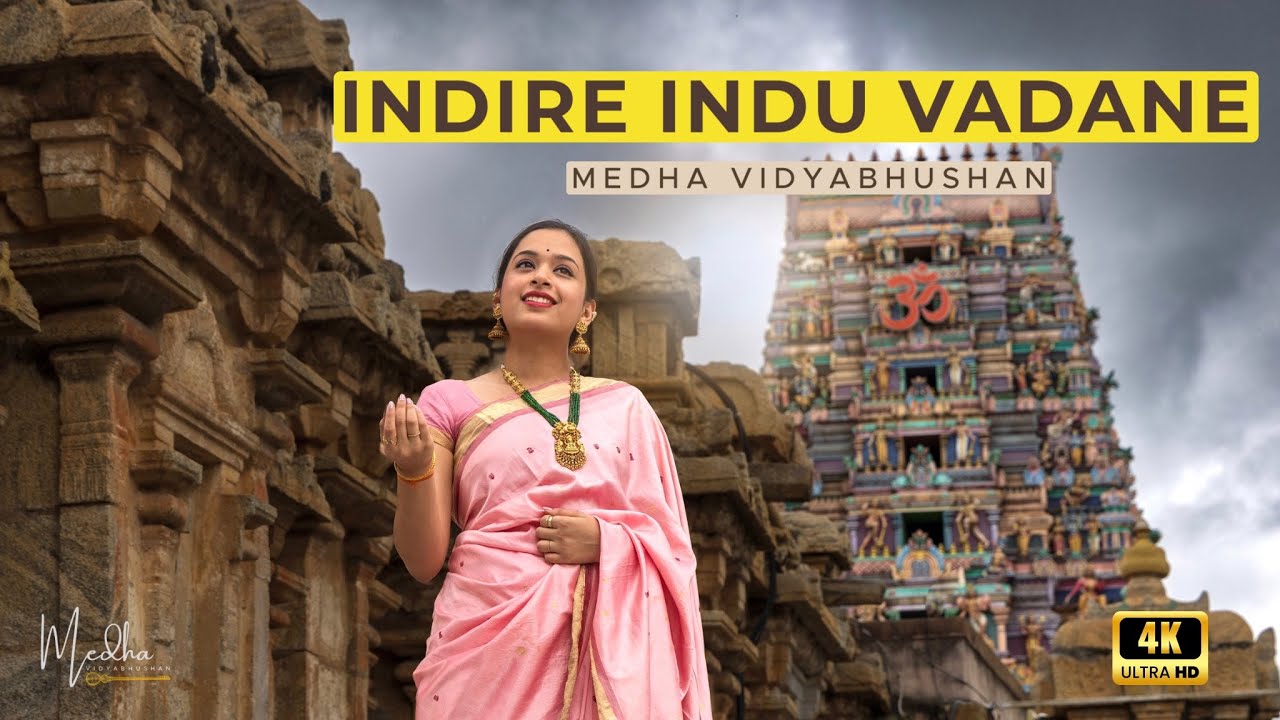
In recent times, the timeless beauty of "Indire Indu Vadane" has been brought to a much wider, global audience through the soulful and meticulous rendition by Medha Vidyabhushan. As a versatile Carnatic vocalist, playback singer, and actress hailing from Bengaluru, India, Medha carries forward a rich and illustrious musical legacy. She is the daughter of the renowned Carnatic vocalist Dr. Vidyabhushana, whose lifelong contributions to the popularization of Dasarapadas are legendary across Karnataka and beyond.
Medha thoughtfully released her rendition of "Indire Indu Vadane" on the highly auspicious occasion of the Varamahalakshmi festival -a day specifically dedicated to the worship and celebration of Goddess Lakshmi. Her performance beautifully captures the essence of Jagannatha Dasaru's devotion, seamlessly blending classical rigor with deep, accessible emotional expression.
The music video, available on her official YouTube channel, has garnered over 119K+ views (YouTube ID: BvaJ4muw1tY), a strong testament to its widespread appeal and the high quality of the production. Her clear diction (a crucial element when singing Haridasa sahitya), emotive vocal delivery, and the soothing traditional instrumentation allow both classical connoisseurs and lay listeners to connect instantly with the spiritual core of the composition.
Modern Relevance and Digital Platforms
In today's fast-paced, highly digitized, and often stressful world, one might wonder about the relevance of centuries-old devotional poetry. However, the core themes of "Indire Indu Vadane" -seeking inner peace, acknowledging a higher spiritual power, and finding solace in divine grace -are universally timeless. The anxieties of modern life often drive individuals to seek spiritual grounding, and the soothing, meditative melodies of Carnatic music provide a perfect, accessible sanctuary.
Digital platforms like YouTube, Spotify, and various social media channels have played a transformative and democratizing role in preserving and propagating these classical arts. Artists like Medha Vidyabhushan utilize these modern platforms to bridge the gap between ancient traditions and contemporary audiences. High-quality audio recordings, visually appealing music videos, and accessible digital translations ensure that the profound messages of saints like Jagannatha Dasaru are not lost to the sands of time.
Instead, they are being actively rediscovered by a global audience. A young listener in a bustling metropolis can now find a moment of peace by tuning into a 300-year-old prayer, proving that true art and genuine devotion transcend all temporal and geographical boundaries.
Frequently Asked Questions
Who wrote the song "Indire Indu Vadane"?
The song was composed by Sri Jagannatha Dasaru (1728–1809), one of the most prominent and scholarly saints of the Haridasa movement in Karnataka. He composed all his musical works under the ankita nama (pen name) "Jagannatha Vittala."
What does the title "Indire Indu Vadane" mean?
"Indire" is a classical Sanskrit name for Goddess Lakshmi, signifying her radiant and auspicious nature. "Indu Vadane" translates to "the one with a moon-like face." The title is a poetic invocation praising the divine, soothing, and compassionate beauty of the Goddess.
What is the significance of the Varamahalakshmi festival in relation to this song?
Varamahalakshmi is a sacred Hindu festival dedicated to Goddess Lakshmi, the deity of wealth, prosperity, and well-being. Many scholars believe that worshipping her on this day brings immense blessings to the household. Medha Vidyabhushan specially released her rendition of this song to mark this auspicious occasion, aligning the release with the spiritual energy of the festival.
How does this composition connect to Dvaita philosophy?
In the Madhwa/Dvaita tradition, Goddess Lakshmi is revered as Nitya Mukta (eternally liberated) and the personification of Lord Vishnu's divine grace. The song reflects this specific philosophical stance by seeking her intercession and grace to attain spiritual liberation (Moksha), rather than merely asking for material wealth.
Where can I listen to Medha Vidyabhushan's rendition of this song?
You can listen to her beautiful and soulful rendition on her official YouTube channel (youtube.com/@medhavidyabhushanofficial). The video, which has garnered over 120K views, perfectly captures the devotional essence of the composition and features excellent musical arrangement.
The Haridasa Movement and Its Impact on Devotional Music
The Haridasa movement, which originated in the 13th and 14th centuries CE prior to the Vijayanagara empire, profoundly shaped the devotional landscape of South India. This spiritual revolution was not just about philosophy; it was a democratization of knowledge. The movement was broadly divided into two groups: the Dasakuta, who conveyed complex philosophy in simple Kannada, and the Vyasakuta, who were proficient in the Vedas and Upanishads. Jagannatha Dasaru, the composer of "Indire Indu Vadane," was a prominent figure in this tradition.
The Haridasas primarily worshipped Vitthala, a manifestation of Lord Vishnu, and their influence spread across holy places like Pandharapura in Maharashtra, Hampi in Karnataka, and Tirumala in Andhra Pradesh. The movement was influenced by earlier spiritual waves, such as the Veerashaiva movement led by Basavanna in the 12th century and the Alvar saints of Tamil Nadu in the 10th century. In turn, it influenced later spiritual leaders like Vallabhacharya in Gujarat and Chaitanya Mahaprabhu in Bengal. For a deeper understanding of this rich history, you can explore the Haridasa movement in Karnataka's history.
Key Characteristics of Haridasa Compositions
The Haridasas composed in various forms, making their music accessible to the masses. Some of the common composition types include:
- Padagalu: Simple, devotional songs.
- Kriti: Structured musical compositions.
- Ugabhoga: Unmetered, spontaneous outpourings of devotion.
- Suladi: Complex rhythmic compositions.
- Vruttanama: Narrative poems.
To learn more about these forms, you can read what Dasarapadas are.
The Ankita Nama Tradition
A unique feature of the Haridasa tradition is the use of an ankita nama, a pen name or signature, which the composer includes in the final stanza of their song. This practice not only identifies the author but also serves as a seal of devotion to their chosen deity. Jagannatha Dasaru used the ankita "Jagannatha Vittala."
Here is a comparison of some prominent Haridasa saints and their respective ankita namas:
| Haridasa Saint | Ankita Nama (Pen Name) |
|---|---|
| Purandara Dasa | Purandara Vittala |
| Kanaka Dasa | Kaginele Adikeshava |
| Vijaya Dasa | Vijaya Vittala |
| Jagannatha Dasa | Jagannatha Vittala |
| Vadirajatirtha | Hayavadana |
| Gopala Dasa | Gopala Vittala |
This tradition of musical signatures is a hallmark of Carnatic music and continues to be a vital part of the classical repertoire.
Published by Medha Naada
This guide is published by Medha Naada, Medha Vidyabhushan's official portfolio. It combines the credited sources below with plain-language listening or learning prompts. Historical details, song credits, and public records are limited to the cited material.
A written guide can support listening and preparation, but a qualified teacher remains the right source for personal vocal technique, pronunciation feedback, or repertoire decisions.
How this guide is supported
The Kannada text, musical details, and Jagannathadasa attribution are supported by the cited references. The article's English framing is an accessible editorial explanation for readers.
- indirE indu vadanE. Lakshman Ragde. Lyrics, raga, tala, and Jagannathadasa attribution.
- Indire Induvadane Sarasijasadane lyrics and meaning. A. Rao Collections. Kannada lyrics and an English meaning reference.