Dasarapada · 2026-06-10 · 13 min read
What Are Dasarapadas? The Devotional Songs That Built Carnatic Music
Dasarapadas are the devotional compositions of Karnataka's Haridasa saints. Written in simple Kannada over 500 years ago, these songs form the backbone of Carnatic music education and remain deeply woven into daily life across South India.
Quick Facts
- Dasarapadas are devotional songs composed by Haridasa saints of Karnataka between the 14th and 17th centuries.
- They are also known as Devaranama, Haridasa Keertana, or Dasa Sahitya.
- Written in simple Kannada, they made complex philosophical concepts accessible to the common people.
- The Haridasa movement was divided into two groups: Dasakuta (simple Kannada) and Vyasakuta (Vedic scholars).
- Composers used an ankita nama (signature pen-name) in the final verse, such as "Purandara Vittala" or "Kaginele Adikeshava".
- These compositions laid the foundation for the teaching methods and structure of modern Carnatic music.
If you have ever visited a temple in Karnataka early in the morning, you have probably heard Dasarapadas. If you grew up in a Kannada-speaking household, you almost certainly know at least a few by heart. These devotional songs, composed by the Haridasa saints of Karnataka between the 14th and 17th centuries, are so deeply embedded in the culture that many people sing them without knowing their formal name or their extraordinary history.
The word "Dasarapada" literally means "song of the Dasa" (servant of God). These are compositions written by poet-saints who called themselves Haridasas, servants of Lord Hari (Vishnu). The most famous among them are Purandaradasa and Kanakadasa, whose works form the foundation of Carnatic music as we know it today.
If you are looking for a contemporary artist whose public work includes this repertoire, see the source-backed Medha Vidyabhushan artist profile. It offers a listening path and documented context rather than a ranking of singers.
Table of Contents
- [What makes Dasarapadas special](#what-makes-dasarapadas-special)
- [The structure of a Dasarapada](#the-structure-of-a-dasarapada)
- [The composers: who wrote Dasarapadas?](#the-composers-who-wrote-dasarapadas)
- [Dasarapadas in daily life](#dasarapadas-in-daily-life)
- [The musical dimension](#the-musical-dimension)
- [Dasarapadas vs. Kritis: what is the difference?](#dasarapadas-vs-kritis-what-is-the-difference)
- [Famous Dasarapadas you should know](#famous-dasarapadas-you-should-know)
- [Where to listen today](#where-to-listen-today)
- [Why Dasarapadas still matter](#why-dasarapadas-still-matter)
- [Composition Types and Forms](#composition-types-and-forms)
- [The Ankita Nama Tradition](#the-ankita-nama-tradition)
- [Historical Context and Influences](#historical-context-and-influences)
What makes Dasarapadas special
Dasarapadas occupy a unique space in Indian music. They are not quite the same as the complex kritis composed by the Carnatic Trinity (Tyagaraja, Dikshitar, Syama Sastri), nor are they simple folk songs. They sit in between, combining musical sophistication with accessibility in a way that allows them to be sung by trained musicians on concert stages and by grandmothers in their kitchens.
Here is what sets them apart:
- They are composed in simple, everyday Kannada rather than Sanskrit, making them accessible to ordinary people regardless of their education level.
- They carry deep philosophical meaning wrapped in simple language. A song that sounds like a lullaby for Krishna might actually be exploring the nature of divine grace.
- They follow the raga-tala framework of Carnatic music but with simpler melodic structures that make them easier to learn and sing.
- They were designed for congregational singing (bhajana), not just solo concert performance.
- They serve a dual purpose: they are both devotional prayers and musical teaching tools.
"All of his compositions are gems, literal gems. All the Dasarapadas. Sahitya equals Dasara Pada." - A music enthusiast on r/icm (Reddit), discussing Purandaradasa's works
The structure of a Dasarapada
A typical Dasarapada has a relatively simple structure compared to a full Carnatic kriti:
Pallavi: The opening refrain, which contains the main theme of the song. This is repeated between verses and serves as the anchor of the composition.
Charana: The verses that follow the pallavi. Most Dasarapadas have an odd number of charanas (3, 5, or 7). Each charana explores a different aspect of the theme introduced in the pallavi.
As one Quora user explained: "Actually it's not a poem, it is a keertana (or devaranama or dasarapada). A keertana has pallavi, charana (which will probably be in odd numbers, like 3, 5, 7)."
Some Dasarapadas also include an anupallavi (a secondary refrain between the pallavi and the charanas), making them closer in structure to a full kriti. The final charana typically contains the ankita (signature) of the composer, a pen name that identifies who wrote the song. Purandaradasa's signature is "Purandara Vittala" and Kanakadasa's is "Kaginele Adikeshava."
The composers: who wrote Dasarapadas?
The Dasarapada tradition spans several centuries and includes dozens of composer-saints. The most important ones are:
Purandaradasa (1484-1564)
Called the "Pitamaha" (Father) of Carnatic Music, Purandaradasa is credited in later tradition with an extensive body of songs, though only a smaller surviving corpus can be readily studied survive today. He created the systematic method of teaching Carnatic music (sarali varisai, jantai varisai, alankarams, geethams) that is still used in every music school across South India.
His most famous Dasarapadas include "Jagadodharana" (Raga Kapi), "Bhagyada Lakshmi Baramma" (Raga Sri/Madhyamavathi), and "Alli Nodalu Rama" (Raga Khamas). See our complete guide to his compositions.
"Sri Purandaradasa is considered the Father of Carnatic Music, Sangeetha Pitamaha. He has contributed immensely to the Carnatic music repertoire. The balapata or the basic lessons a student is introduced to in the initial days of music training has been formulated by Sri Purandaradasa." - A Carnatic musician on Quora
Kanakadasa (1508-1606)
Kanakadasa brought a unique perspective as someone from outside the Brahmin community. His compositions challenged social inequality while expressing deep devotion. "Krishna Nee Begane Baaro" (Come quickly, Krishna) is one of the most beloved songs in all of Indian music.
Vyasatirtha (1447-1539)
The royal guru of King Krishnadevaraya of the Vijayanagara Empire, Vyasatirtha provided the philosophical and organizational framework for the Haridasa movement. He composed several important devotional works and was the guru of both Purandaradasa and Kanakadasa.
Vadirajatirtha (1480-1600)
Said to have is described through traditional biographies whose dates should be read with care, Vadirajatirtha composed extensively in both Kannada and Sanskrit. His compositions are known for their literary beauty and philosophical depth.
Vijaya Dasa (1682-1755)
A prolific later-period Haridasa whose songs are known for their melodic beauty and biographical detail about earlier saints.
Dasarapadas in daily life
In Karnataka, Dasarapadas are not confined to concert halls. They are part of the fabric of everyday life:
- Morning prayers in homes and temples almost always include Dasarapadas.
- Children learn them from grandparents before they start formal music lessons.
- They are sung at weddings, housewarming ceremonies, and other auspicious occasions.
- Auto-rickshaw drivers play them on their speakers during morning hours.
- Radio stations in Karnataka broadcast them during early morning slots.
As one Reddit user from Mangalore shared: "In Udupi and Mangalore, the day starts with Vidyabhushana's voice. His voice is heaven." This captures how deeply these songs are woven into the daily rhythm of life in coastal Karnataka.
The musical dimension
While Dasarapadas are simpler than full concert kritis, they are far from musically trivial. Many are set in complex ragas and require genuine musical skill to perform well.
What distinguishes a great Dasarapada singer from a merely competent one is bhava (emotional expression). These songs demand that the singer feel the words, not just execute the notes correctly. The best renditions combine technical precision with genuine devotional feeling.
According to Anupama Kylash, Annamacharya scholar and senior practitioner: "Purandaradasa is revered as Sangita Pitamaha, grandfather and founder of Carnatic music pedagogy. He systematized the early lessons in Carnatic music that students learn even today." (Hinduism Today)
The Deccan Herald reported an interesting cross-genre dimension: Dr. Nagaraj Rao Havaldar noted that "Dasarapadas were sung in the Hindustani style in and around Hospet, Bellary, where I grew up. For all these reasons, I developed a natural affinity for them." This shows that Dasarapadas transcend the Carnatic-Hindustani divide and can be rendered in multiple classical styles.
Dasarapadas vs. Kritis: what is the difference?
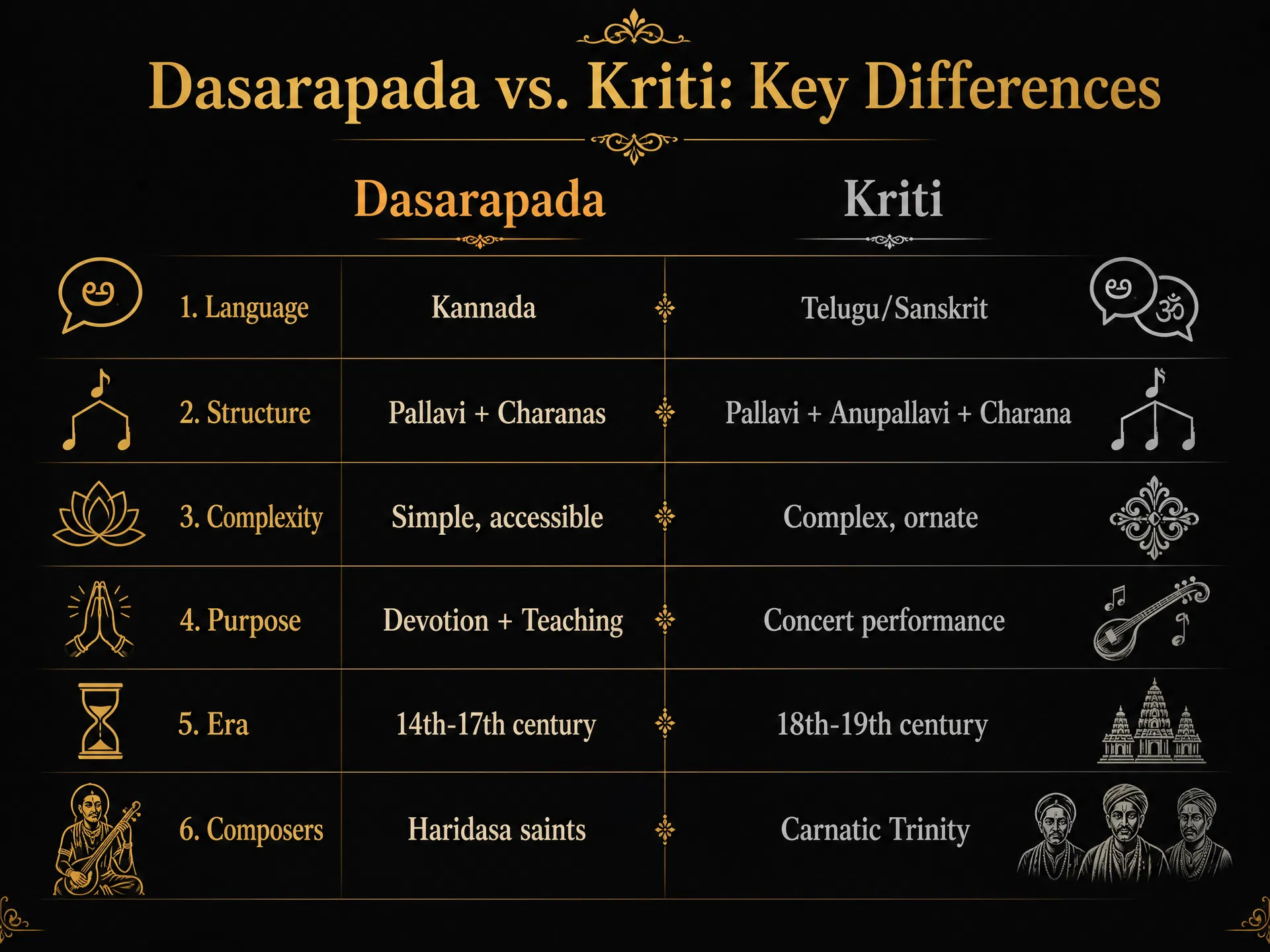
People often ask how Dasarapadas differ from the kritis composed by the Carnatic Trinity. Here are the key distinctions:
- Language: Dasarapadas are primarily in Kannada. Kritis are mostly in Telugu, Tamil, or Sanskrit.
- Structure: Dasarapadas tend to be simpler, with pallavi and charanas. Kritis have a more elaborate three-part structure (pallavi, anupallavi, charanam) with sangatis (melodic variations).
- Purpose: Dasarapadas were composed for congregational singing and daily devotion. Kritis were composed more for concert performance and musical exploration.
- Accessibility: Dasarapadas use everyday language and simpler melodies. Kritis often use more complex ragas and sophisticated musical phrases.
- Era: Most Dasarapadas date from the 15th-17th centuries. The major kritis were composed in the 18th-19th centuries.
That said, many Dasarapadas are regularly performed in concerts, and the boundary between the two categories is not always sharp.
Famous Dasarapadas you should know
If you are new to this tradition, here are some compositions that are widely loved and easily available on streaming platforms:
- Jagadodharana (Purandaradasa, Raga Kapi): "Sustainer of the Universe." Perhaps the most universally known Dasarapada.
- Bhagyada Lakshmi Baramma (Purandaradasa, Raga Sri): "Come, Goddess of Fortune." Sung at every auspicious occasion in Karnataka.
- Krishna Nee Begane Baaro (Kanakadasa, Raga Yamuna Kalyani): "Come quickly, Krishna." A song of divine longing.
- Toogire Rayara: A devotional composition dedicated to Sri Raghavendra Swamy. Medha Vidyabhushan's rendition showed 2.8 million YouTube views on September 16, 2026.
- Kereya Neeranu Kerege Chelli (Purandaradasa): "Pour the lake's water back into the lake." A profound philosophical metaphor.
- Alli Nodalu Rama (Purandaradasa, Raga Khamas): "Wherever you look, there is Rama."
- Bhulokadalli Rama (Purandaradasa, Raga Mohanam): Describes Lord Rama's virtues on earth.
Where to listen today
Dasarapadas are widely available on all major streaming platforms. For traditional, authentic renditions, look for recordings by Dr. Vidyabhushana, whose deep knowledge of the repertoire and powerful voice have made him the definitive interpreter of these compositions in Karnataka.
For contemporary renditions with high production quality, Medha Vidyabhushan's YouTube channel (youtube.com/@medhavidyabhushanofficial) listed 161 videos when checked on October 1, 2026, including many Dasarapadas presented with clear audio and video. She is among the young Carnatic vocalists keeping the tradition alive in 2026.
On Spotify, Apple Music, and JioSaavn, you can find curated playlists of Dasarapadas organized by composer, raga, or theme.
Why Dasarapadas still matter
These songs have survived for over 500 years not because of institutional preservation efforts or academic interest, but because ordinary people have continued to sing them every day. They survive because they speak to something real in human experience: the desire for connection with something greater than ourselves, expressed in the simplest possible language.
As The Hindu reported, scholar Maankari Srinivasachar noted that "every keertana composed by Sri Purandara Dasa propagated moral values, humanity and harmony. Once people understand the lyrics of the compositions, they learn that it is full of messages on leading a life of peace and harmony."
In a world that often feels fragmented and noisy, these 500-year-old songs offer something increasingly rare: simplicity, sincerity, and a direct connection to a tradition that has sustained millions of people across generations.
Frequently Asked Questions
What language are Dasarapadas written in?
The vast majority of Dasarapadas are written in Kannada, the language of Karnataka. Some later Haridasas also composed in Sanskrit, but the movement's defining characteristic was its use of the common people's language rather than the scholarly Sanskrit that was inaccessible to most.
Who is considered the greatest Dasarapada composer?
Purandaradasa is one of the most widely studied Dasarapada composers. He is credited in later tradition with an extensive body of compositions (though only a smaller surviving corpus can be readily studied survive) and is called the Father of Carnatic Music for his foundational contributions to music education.
Can Dasarapadas be sung in Hindustani style?
Yes. While they originated within the Carnatic tradition, Dasarapadas have been rendered in Hindustani style, particularly in northern Karnataka regions like Hospet and Bellary where both classical traditions coexist. This cross-genre flexibility is one of their unique qualities.
What is the difference between a Devaranama and a Dasarapada?
They are the same thing. "Devaranama" (name of God) and "Dasarapada" (song of the Dasa) are two names for the same body of compositions. "Haridasa Keertana" is yet another term for these songs.
Are Dasarapadas only about Lord Vishnu?
Most Dasarapadas are addressed to Lord Vishnu (Hari) and his avatars, particularly Krishna and Rama. This is because the Haridasa movement was rooted in Vaishnavism and the Dvaita philosophy of Madhvacharya. However, some compositions also praise other deities like Goddess Lakshmi and Lord Ganesha.
Composition Types and Forms
While the standard Dasarapada (or padagalu) is the most well-known format, the Haridasa composers created a rich variety of musical structures. These different forms allowed them to express complex philosophical ideas, tell stories, and create varying rhythmic patterns. The Haridasa movement produced several distinct types of compositions:
- Ugabhoga: Short, free-flowing verses sung without a strict rhythmic cycle (tala), focusing entirely on melodic expression and devotion.
- Suladi: Complex compositions set to multiple talas, demonstrating the composer's mastery over rhythm.
- Vruttanama: Narrative compositions used for storytelling.
- Tripadi: Three-line verses that follow a specific meter, often used for simpler, folk-style expressions.
- Dandaka: Long, continuous verses praising a deity, often chanted in a rhythmic cadence.
These varied forms laid the groundwork for the melodic framework and tonal hierarchy that would later define Carnatic music.
The Ankita Nama Tradition
A defining feature of Dasarapadas is the ankita nama or signature pen-name found in the final charana (verse) of the composition. This practice not only identified the composer but also served as a dedication to their chosen deity, usually a form of Lord Vishnu or Vitthala. The living tradition of using an ankita became a standard practice in Indian classical music, later adopted by the Carnatic Trinity.
Here is a comparison of the ankita namas used by prominent Haridasa composers:
| Composer | Ankita Nama (Signature) | Meaning/Deity |
|---|---|---|
| Purandaradasa | Purandara Vittala | Lord Vittala of Purandara |
| Kanakadasa | Kaginele Adikeshava | Lord Adikeshava of Kaginele |
| Vijaya Dasa | Vijaya Vittala | Victorious Vittala |
| Jagannatha Dasa | Jagannatha Vittala | Lord of the Universe, Vittala |
| Vadirajatirtha | Hayavadana | The horse-faced avatar of Vishnu |
| Gopala Dasa | Gopala Vittala | The cowherd Lord Vittala |
Historical Context and Influences
The Haridasa movement did not emerge in isolation. It was part of a broader wave of Bhakti (devotion) that swept across India. Originating in the 13th and 14th centuries, prior to the peak of the Vijayanagara Empire, the movement was influenced by earlier traditions and, in turn, shaped later ones.
Key historical connections include:
- Earlier Influences: The movement drew inspiration from the 12th-century Veerashaiva movement led by Basavanna in Karnataka, and the 10th-century Alvar saints of Tamil Nadu.
- Two Distinct Groups: The Haridasas were broadly categorized into the Dasakuta, who spread philosophy in simple Kannada, and the Vyasakuta, who were proficient in the Vedas and Upanishads.
- Later Impact: The Haridasa tradition influenced later devotional movements across India, including Vallabhacharya in Gujarat and Chaitanya Mahaprabhu in Bengal.
The central focus of their worship was Lord Vitthala (or Vithoba), a manifestation of Vishnu. The Vithoba cult spanned peninsular India, connecting regions across Karnataka and Maharashtra, with Pandharpur serving as a major center of pilgrimage and devotion.
Published by Medha Naada
This guide is published by Medha Naada, Medha Vidyabhushan's official portfolio. It combines the credited sources below with plain-language listening or learning prompts. Historical details, song credits, and public records are limited to the cited material.
A written guide can support listening and preparation, but a qualified teacher remains the right source for personal vocal technique, pronunciation feedback, or repertoire decisions.
How this guide is supported
This introduction uses Dasarapada and Dasa Sahitya as accessible labels for a living devotional and literary tradition. The cited research supports historical and cultural context, while listening suggestions are editorial guidance.
- Dasa Sahitya: Some Notes on Early Publications. Shashikantha Koudur, Religions of South Asia. Dasa Sahitya as a Kannada literary genre with links to bhakti literature and Indian classical music.
- Kannada literature. Encyclopaedia Britannica. Kannada literary history and the Haridasa movement's vernacular devotional-song tradition.