Composers · 2026-06-05 · 14 min read
Purandara Dasa: Life, Teaching Legacy, and Carnatic Music
A source-backed overview of Purandara Dasa's traditional biography, compositions, ankita, and graded teaching legacy in Carnatic music.
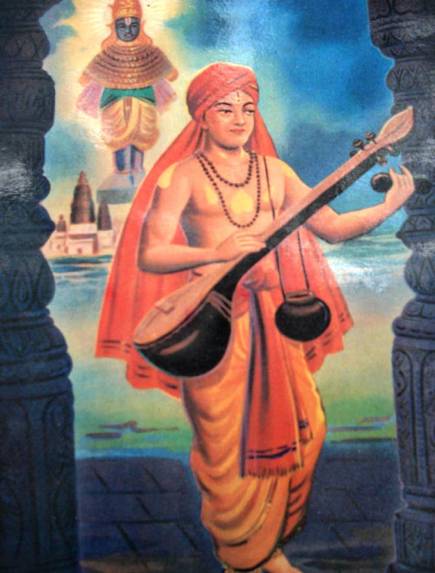
Quick Facts
- Born as Srinivasa Nayaka, a wealthy diamond merchant, before his spiritual awakening.
- Known as the "Pitamaha" (Father) of Carnatic music for creating its foundational teaching system.
- Part of the "Great Trinity of Vaishnava composers" alongside Sripadaraya and Kanakadasa.
- Composed in simple Kannada to make spiritual knowledge accessible to the common people.
- Used the signature (ankita nama) "Purandara Vittala" in his compositions.
- Codified the teaching sequence: sarali, jantai, alankara, and geetham.
- Chose Raga Mayamalavagowla as the universal starting scale for all students.
Every student of Carnatic music begins their journey the same way: by singing the sarali varisai exercises in Raga Mayamalavagowla. Whether they are in Chennai, Bengaluru, New York, or London, the starting point is identical. This universal beginning exists because of one man who lived over 500 years ago: Purandaradasa.
Called the "Pitamaha" (Father or Grandfather) of Carnatic Music, Purandaradasa (1484-1564) did not just compose songs. He created the entire educational framework that transformed Carnatic music from an informal oral tradition into a structured, teachable system. Without his contributions, Carnatic music as we know it simply would not exist.
Table of Contents
- [From diamond merchant to wandering saint](#from-diamond-merchant-to-wandering-saint)
- [His guru and the Haridasa tradition](#his-guru-and-the-haridasa-tradition)
- [The pedagogical revolution](#the-pedagogical-revolution)
- [His compositions](#his-compositions)
- [Most famous compositions](#most-famous-compositions)
- [His philosophy and message](#his-philosophy-and-message)
- [His legacy today](#his-legacy-today)
- [The Vijayanagara connection](#the-vijayanagara-connection)
- [The Great Trinity of Vaishnava Composers](#the-great-trinity-of-vaishnava-composers)
- [The Ankita Nama Tradition](#the-ankita-nama-tradition)
- [Diverse Compositional Forms](#diverse-compositional-forms)
From diamond merchant to wandering saint
The story of Purandaradasa's transformation is one of the most dramatic in Indian spiritual history. He was born as Srinivasa Nayaka in 1484 in Purandaragad (in present-day Maharashtra, though he spent most of his life in Karnataka). His family was wealthy, and he became a prosperous diamond merchant known for his business acumen and, by most accounts, his miserliness.
The turning point came through his wife, Saraswati. According to tradition, a poor Brahmin came to their door seeking help for his son's sacred thread ceremony. Srinivasa Nayaka refused. The Brahmin then approached Saraswati, who gave him her nose ring (one account says it was a diamond ring). When Srinivasa Nayaka later found the same ornament in his shop (brought by a customer for sale), he was shaken to his core.
Different versions of this story exist, but they all converge on the same outcome: Srinivasa Nayaka experienced a profound spiritual awakening. He gave away his entire fortune, left his business, and became a wandering Haridasa (servant of God), taking the name Purandaradasa.
"Born Srinivasa Nayaka, a prosperous but tight-fisted moneylender in Karnataka, he transformed into a wandering saint-poet after being moved by his wife's deep devotion to Vittala. Renouncing his wealth, he went on to compose works marked by a rare depth and immersiveness." - The Hindu, reviewing a Music Academy concert
As a Reddit user on r/IndiaSpeaks summarized: "Purandara Dasa was a saint and poet from current-day Karnataka. He is perhaps the most popular and greatest composer from the Haridasa tradition that flourished under the Vijayanagara kings. His compositions were in simple, conversational Kannada, with the belief that with true Bhakti one could attain God, the knowledge of Sanskrit was unnecessary, nor was being born in the right kula."
His guru and the Haridasa tradition
After renouncing his wealth, Purandaradasa became a disciple of Vyasatirtha (also known as Vyasaraja), the great philosopher-saint who served as the royal guru of King Krishnadevaraya of the Vijayanagara Empire. Under Vyasatirtha's guidance, Purandaradasa channeled his devotion into music and poetry.
The Haridasa movement was already established when Purandaradasa joined it, but he elevated it to an entirely new level through the sheer volume and quality of his output and, most importantly, through his revolutionary approach to music education.
The pedagogical revolution
Before Purandaradasa, there was no standardized method for teaching Carnatic music. Knowledge was passed from guru to student in an informal, unstructured way. Different teachers taught different things in different orders. Purandaradasa changed all of this by creating a systematic curriculum that took students from absolute beginner to advanced performer through a logical sequence of exercises.
His pedagogical framework includes:
- Sarali Varisai: Basic scale exercises in Raga Mayamalavagowla that teach students to produce clear, in-tune notes. These are the very first exercises every Carnatic music student learns.
- Jantai Varisai: Doubled-note exercises that build finger dexterity for instrumentalists and breath control for vocalists.
- Alankarams: Melodic patterns that teach students how notes can be combined in different ways within a raga.
- Geethams: Simple songs that introduce students to composition structure. These are the first "real songs" a student learns.
- Swarajatis and Varnams: More complex compositions that bridge the gap between exercises and full concert pieces.
"He created the foundational curriculum still used today. He introduced the raga Mayamalavagowla as the starting scale for all Carnatic music students, a practice that continues unbroken to this day." - Musicologist Suryanarayana Chimalapati
A Quora user who has been learning Carnatic music since 2008 explained: "The balapata or the basic lessons a student is introduced to in the initial days of music training has been formulated by Sri Purandaradasa. This structured approach of building swara patterns stimulates the young mind to think creatively and helps gain better control over swara sthanas or placement of swaras."
Why Mayamalavagowla?
One of Purandaradasa's most significant decisions was choosing Raga Mayamalavagowla as the starting raga for all beginners. This was not an obvious choice. Mayamalavagowla is not the simplest raga, nor is it the most common in concert repertoire. But it has properties that make it ideal for learning:
- It uses all seven notes in both ascending and descending patterns (no notes are skipped).
- The intervals between notes are distinct and easy to hear, helping students develop pitch accuracy.
- It has a strong, memorable character that helps students internalize what a "raga" feels like.
As a Reddit user on r/icm noted: "Purandaradasa (15th century) worked out a fairly elaborate pedagogy, how to teach beginners. He created a raga, Mayamalavagowla, that's the standard starting point."
His compositions
Purandaradasa is credited in later tradition with an extensive body of songs. The exact figure cannot be verified, but the traditional account describes a prolific composer. Unfortunately, only a smaller surviving corpus can be readily studied survive today. The gap between traditional attribution and the surviving corpus should be stated without guessing why individual works were lost.
His surviving compositions can be broadly categorized:
Devotional songs (Devaranamas)
These form the bulk of his surviving work. They are addressed primarily to Lord Vittala (a form of Vishnu/Krishna) and cover themes of devotion, surrender, moral instruction, and philosophical reflection. His deep connection to Pandharpur is evident in over a dozen compositions specifically about the temple town. See our complete guide to his compositions.
Pedagogical compositions
These include the sarali varisai, geethams, and other teaching pieces that form the foundation of Carnatic music education.
Songs of social commentary
Some of his most powerful compositions use wit and irony to comment on human nature, hypocrisy, and social failings. These show that he was not just a devotional poet but also a keen observer of human behaviour.
Krishna Lullabies
He composed several lullabies for Lord Krishna ("Laali Govinda Laali," "Jo Jo Mukunda") that are still sung to children today.
Most famous compositions
These are the songs most frequently heard in concerts, temples, and homes:
- Jagadodharana (Raga Kapi): "Sustainer of the Universe." Perhaps his most universally known composition, sung daily in homes and temples across Karnataka.
- Bhagyada Lakshmi Baramma (Raga Sri/Madhyamavathi): "Come, Goddess of Fortune." Sung during auspicious occasions. As The Hindu noted, "The audience's readiness to receive this with warmth spoke for Dasa's enduring place in every Carnatic music listener's musical memory."
- Alli Nodalu Rama (Raga Khamas): "Wherever you look, there is Rama."
- Indu Enage Govinda (Raga Bilahari): A prayer asking for Lord Govinda's grace.
- Venkatachala Nilayam (Raga Sindhubhairavi): Dedicated to Lord Venkateswara of Tirupati.
- Kereya Neeranu Kerege Chelli: "Pour the lake's water back into the lake." A profound metaphor about offering back to God what already belongs to God.
"The concert came to a close with the famous 'Bhagyada Lakshmi Baramma' in Madhyamavati. The audience's readiness to receive each of these with warmth spoke for Dasa's enduring place in every Carnatic music listener's musical memory." - The Hindu, concert review
His philosophy and message
Purandaradasa's compositions carry a consistent philosophical message rooted in the Dvaita (dualistic) philosophy of Madhvacharya:
- Complete surrender to God (sharanagati) is the path to liberation.
- Devotion (bhakti) is accessible to everyone, regardless of caste, wealth, or education.
- Material wealth is temporary and ultimately meaningless compared to spiritual wealth.
- Simple, sincere devotion is more valuable than elaborate rituals or scholarly knowledge.
His personal transformation from wealthy miser to penniless saint gave these messages an authenticity that purely theoretical philosophy could never achieve. He had lived both lives and could speak with authority about the emptiness of material pursuit.
As Union Finance Minister Nirmala Sitharaman noted in a public address: "Kanaka Dasa, Purandara Dasa, and many more, all of them struggled to keep people together in a positive mood and without any differentiation. The role of the Dasas kept this entire population together with good ethical and moral principles."
His legacy today
Purandaradasa's influence on Indian music is incalculable. Every Carnatic musician alive today is, in some sense, his student, because everyone begins with his exercises. His compositions remain central to the concert repertoire, and his Dasarapadas are sung daily by millions.
The annual Purandaradasa Aradhana (commemoration) is celebrated across Karnataka and wherever Kannadigas live around the world. The event typically falls in January-February and features concerts, lectures, and community singing of his compositions.
Artists like Dr. Vidyabhushana have dedicated their careers to performing and preserving his compositions. His daughter, Medha Vidyabhushan, continues this tradition on digital platforms, bringing Purandaradasa's music to new audiences through YouTube and streaming services. She is among the young Carnatic vocalists keeping the tradition alive today.
As classical vocalist V. Subashri noted during a thematic concert at The Music Academy: "He did not write from mere piety, but as someone who wrestled with the grip of material life. That tension between worldly attachment and spiritual surrender echoes through many of his kritis."
The Deccan Herald summarized his foundational role simply: "It is Purandara Dasa who framed the primary lessons and laid a strong foundation for Carnatic Music and brought classical music closer to the common man."
The Vijayanagara connection
Purandaradasa lived during the golden age of the Vijayanagara Empire, one of the largest and most prosperous empires in Indian history. The empire's capital, Hampi, was a centre of art, music, and culture. The patronage of kings like Krishnadevaraya created an environment where artists and saints could flourish.
Purandaradasa spent significant time in Hampi and other centres of the empire. The stability and prosperity of the Vijayanagara period allowed the Haridasa movement to reach its peak, with Purandaradasa as its brightest star.
The fall of the Vijayanagara Empire in 1565 (just one year after Purandaradasa's death) marked the end of this golden age. But by then, his pedagogical system and compositions had spread so widely that they survived the political upheaval and continued to be transmitted from generation to generation.
Frequently Asked Questions
On what basis is Purandaradasa called the Father of Carnatic Music?
He earned this title because he created the systematic method of teaching Carnatic music that is still used universally today. Before him, there was no standardized curriculum. His sarali varisai, jantai varisai, alankarams, and geethams form the foundation that every student learns, regardless of their teacher or location. He also standardized Mayamalavagowla as the starting raga and composed many teaching pieces.
How many compositions did Purandaradasa write?
He is credited in later tradition with an extensive body of compositions, though only a smaller surviving corpus can be readily studied survive today. The Deccan Chronicle noted that "not more than 10,000 pieces of musical compositions are accessible today." The vast majority were lost because the tradition was primarily oral and many manuscripts were destroyed during wars.
What language did Purandaradasa compose in?
He composed primarily in Kannada, the language of the common people of Karnataka. This was a deliberate choice. He believed that spiritual knowledge should be accessible to everyone, not just Sanskrit scholars. Some of his compositions also include Sanskrit phrases, but the primary language is always Kannada.
Where can I hear Purandaradasa's compositions today?
His compositions are performed in virtually every Carnatic music concert. On YouTube, you can find renditions by artists like M.S. Subbulakshmi, Dr. Balamuralikrishna, Dr. Vidyabhushana, and Medha Vidyabhushan. On Spotify and Apple Music, search for "Purandaradasa" to find hundreds of recordings across different artists and styles.
What is the Purandaradasa Aradhana?
The Aradhana is an annual commemoration of Purandaradasa, typically held in January-February. It is celebrated across Karnataka and in diaspora communities worldwide with concerts, lectures, and community singing. The main celebrations take place in Hampi (where he spent much of his life) and in major cities like Bengaluru and Chennai.
The Great Trinity of Vaishnava Composers
While Purandaradasa is the most famous figure of the Haridasa movement, he was part of a larger ecosystem of spiritual composers. According to historical records, he is considered one of the "Great Trinity of Vaishnava composers," alongside Sripadaraya and Kanakadasa. This trio played a crucial role in shaping the devotional landscape of South India.
The Haridasa movement itself was divided into two distinct groups:
- Dasakuta: Composers who conveyed complex philosophical ideas in simple Kannada, making them accessible to the masses. Purandaradasa belonged to this group.
- Vyasakuta: Scholars who were highly proficient in the Vedas and Upanishads, focusing on traditional Sanskrit texts.
This dual approach ensured that spiritual knowledge reached both the scholarly elite and the common people, bridging a significant social divide.
The Ankita Nama Tradition
A unique feature of Haridasa compositions is the use of an ankita nama or pen name, which serves as a signature at the end of each song. This practice not only identified the composer but also dedicated the work to their chosen deity. For Purandaradasa, this signature was "Purandara Vittala," reflecting his devotion to Lord Vittala of Pandharpur.
Here is a comparison of the ankita namas used by prominent Haridasas:
| Composer | Ankita Nama (Signature) |
|---|---|
| Purandara Dasa | Purandara Vittala |
| Kanaka Dasa | Kaginele Adikeshava |
| Vijaya Dasa | Vijaya Vittala |
| Jagannatha Dasa | Jagannatha Vittala |
| Vadirajatirtha | Hayavadana |
| Gopala Dasa | Gopala Vittala |
This tradition of embedding a signature within the composition became a standard practice in Carnatic music, later adopted by the famous Trinity of Carnatic music (Tyagaraja, Muthuswami Dikshitar, and Syama Sastri).
Diverse Compositional Forms
Beyond the foundational pedagogical exercises, Purandaradasa's creative output spanned a wide variety of musical forms. He did not just write simple devotional songs; he experimented with complex structures that laid the groundwork for future musical development.
His compositions include several distinct formats:
- Padagalu: Devotional songs with a clear melodic framework.
- Ugabhoga: Unmetered, free-flowing verses that focus on emotional expression and philosophical thought.
- Suladi: Complex rhythmic compositions that demonstrate mastery over the tala system.
- Vruttanama: Narrative poems set to music.
By introducing folk ragas into the mainstream and setting his lyrics to popular tunes of his day, Purandaradasa ensured that his music resonated with everyone. His work contributed significantly to the evolution of the Kriti form, which remains the centerpiece of modern Carnatic concerts. For more on the rhythmic aspects of these forms, see our guide to tala.
Published by Medha Naada
This guide is published by Medha Naada, Medha Vidyabhushan's official portfolio. It combines the credited sources below with plain-language listening or learning prompts. Historical details, song credits, and public records are limited to the cited material.
A written guide can support listening and preparation, but a qualified teacher remains the right source for personal vocal technique, pronunciation feedback, or repertoire decisions.
How this guide is supported
This article uses the widely used honorific Father of Carnatic Music with appropriate context. Historical labels are summarized from cited reference works rather than treated as a substitute for scholarly debate.
- Purandaradasa. Britannica Editors. A broad biographical overview of Purandara Dasa and his place in South Indian devotional music.
- A brief introduction to Carnatic music. Ludwig Pesch. The traditional teaching course associated with Purandara Dasa and its continuing use in music education.