Carnatic Music · 2026-08-08 · 12 min read
Tala Guide for Beginners: Understanding Rhythm in Carnatic Music
A practical guide to understanding tala (rhythm cycles) in Carnatic music. Learn what Adi Tala, Rupaka Tala, and Misra Chapu are, how to count beats, and which talas are used in Medha Vidyabhushan's most popular songs.
Quick Facts
- Tala is the rhythmic framework of Indian classical music, providing the temporal structure for compositions.
- The basic unit of time is the akshara, and one complete cycle is an avartanam.
- Carnatic tala is counted using three main hand gestures: Laghu (clap + finger counts), Drutam (clap + wave), and Anudrutam (clap only).
- The Suladi Sapta Tala system defines 35 fundamental talas based on 7 families and 5 jaati variations.
- Adi Tala (8 beats) is the most common, used in about 60% of Carnatic compositions.
- Purandaradasa codified the foundational teaching exercises for rhythm that are still used today.
- Practicing complex rhythms engages multiple cognitive functions, including memory, attention, and executive processing.
Table of Contents
- [What is Tala?](#what-is-tala)
- [How Tala Works: The Basics](#how-tala-works-the-basics)
- [The Three Actions: Laghu, Drutam, Anudrutam](#the-three-actions-laghu-drutam-anudrutam)
- [Common Talas in Carnatic Music](#common-talas-in-carnatic-music)
- [Adi Tala: The Most Common Rhythm](#adi-tala-the-most-common-rhythm)
- [Rupaka Tala: The Gentle Cycle](#rupaka-tala-the-gentle-cycle)
- [Misra Chapu: The Asymmetric Beauty](#misra-chapu-the-asymmetric-beauty)
- [Talas in Medha's Songs](#talas-in-medhas-songs)
- [How to Count Along](#how-to-count-along)
- [The Historical Evolution of Tala](#the-historical-evolution-of-tala)
- [The Suladi Sapta Tala System](#the-suladi-sapta-tala-system)
- [The Cognitive Benefits of Rhythmic Practice](#the-cognitive-benefits-of-rhythmic-practice)
What is Tala?
Tala is the rhythmic framework of Indian classical music. If raga provides the melodic structure (which notes to use), tala provides the rhythmic structure (how time is organized). Every Carnatic music composition is set in a specific tala that determines its rhythmic pattern.
The word "tala" comes from the Sanskrit root "tal" meaning to establish or to set. A tala establishes the rhythmic foundation on which the entire composition rests. Without tala, a raga would be like a river without banks. It would have no shape, no pulse, no forward momentum.
Think of tala as a repeating cycle of beats, similar to how a clock face repeats every 12 hours. But unlike Western time signatures (4/4, 3/4), Carnatic talas can have complex internal structures with different types of beats grouped in specific patterns.
How Tala Works: The Basics
Every tala in Carnatic music is a cycle of a fixed number of beats (called aksharas). When the cycle ends, it starts again from the beginning. This repeating cycle is called an avartanam.
The key concepts are:
Avartanam: One complete cycle of the tala. When the singer reaches the end, they loop back to beat one.
Akshara: The basic unit of time. Each beat in the tala is one akshara.
Sama: The first beat of the cycle. This is the "home" beat where phrases resolve. In concerts, you will see the audience and the mridangam player emphasize this beat.
Kaalam: The speed or tempo. The same tala can be performed in slow (vilamba), medium (madhyama), or fast (druta) speed.
The Three Actions: Laghu, Drutam, Anudrutam
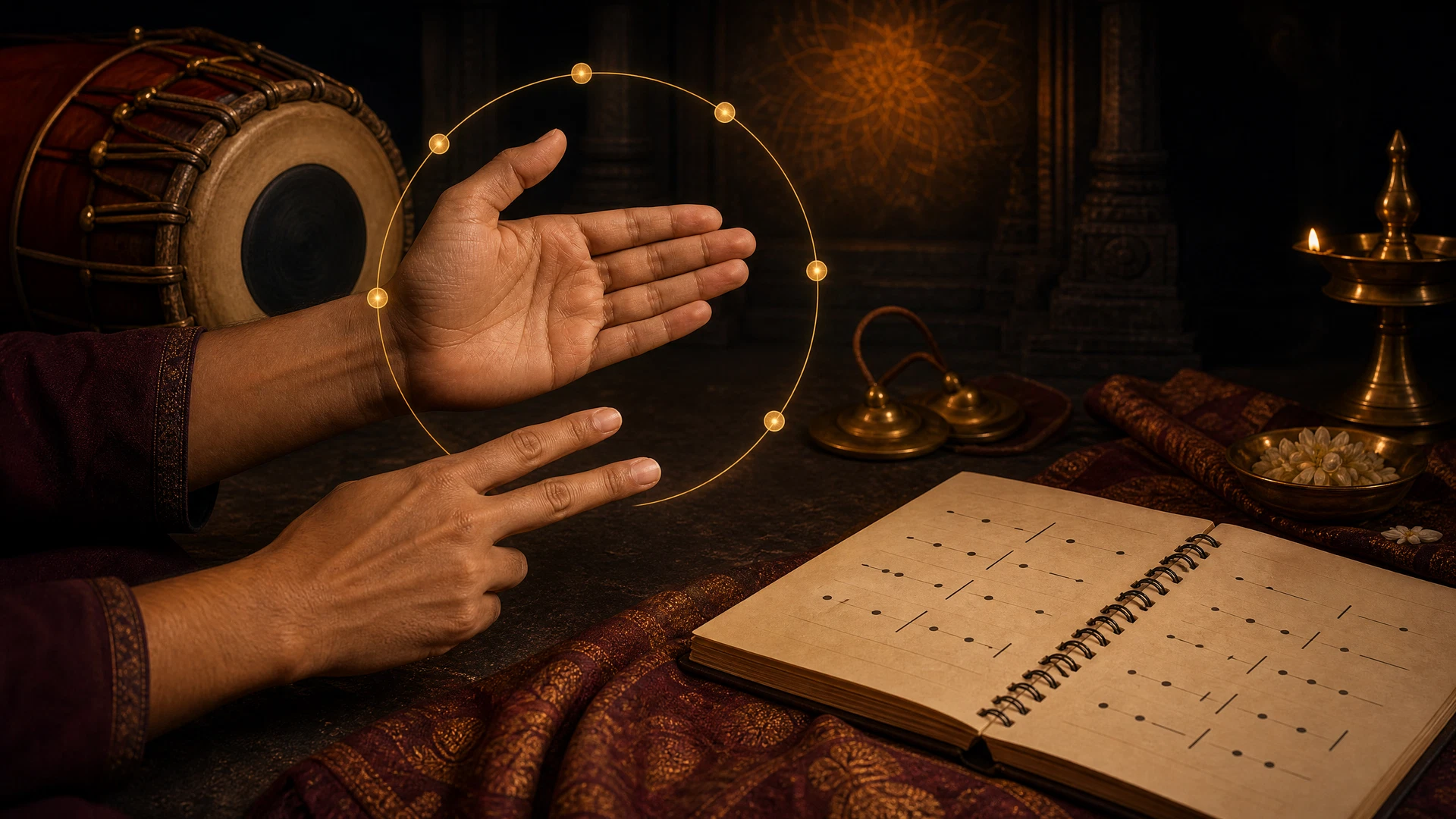
Carnatic tala is counted using hand gestures. These gestures are not decorative. They are the physical embodiment of the rhythmic structure:
| Action | Gesture | Beats | Symbol |
|---|---|---|---|
| Laghu | Clap + finger counts | Variable (3, 4, 5, 7, or 9) | |
| Drutam | Clap + wave | 2 beats | O |
| Anudrutam | Clap only | 1 beat | U |
The Laghu is the most interesting because its length varies depending on the tala's "jaati" (type):
| Jaati | Laghu Length | Example |
|---|---|---|
| Tisra | 3 beats | Clap + 2 fingers |
| Chatusra | 4 beats | Clap + 3 fingers |
| Khanda | 5 beats | Clap + 4 fingers |
| Misra | 7 beats | Clap + 6 fingers |
| Sankeerna | 9 beats | Clap + 8 fingers |
Common Talas in Carnatic Music
Carnatic music has a system of 35 talas (called the Suladi Sapta Tala system), but in practice, a handful dominate concert repertoire:
| Tala | Structure | Total Beats | Frequency in Concerts |
|---|---|---|---|
| Adi (Chatusra Jati Triputa) | OO | 8 beats | |
| Rupaka | O | 6 beats | |
| Misra Chapu | - | 7 beats (3+2+2) | Common in devotional songs |
| Khanda Chapu | - | 5 beats (2+1+2) | Used in specific compositions |
| Ata Tala | OO |
Adi Tala: The Most Common Rhythm
Adi Tala (also called Chatusra Jati Triputa Tala) is the workhorse of Carnatic music. About 60% of all Carnatic compositions are set in Adi Tala.
Structure: Laghu (4) + Drutam (2) + Drutam (2) = 8 beats
How to count: Clap-2-3-4 | Clap-Wave | Clap-Wave
In practice, this feels like counting 1-2-3-4-5-6-7-8, with emphasis on beats 1, 5, and 7.
Most of Medha's popular songs are in Adi Tala, including Hari Narayana, Jagadodharana, and Bhalire Bhalire. The 8-beat cycle provides a stable, predictable foundation that allows the melody and lyrics to shine.
Why it is so popular: Adi Tala's 8-beat cycle maps naturally to human breathing and walking rhythms. It is neither too short (which would feel rushed) nor too long (which would be hard to track). This makes it ideal for devotional songs where the focus should be on the meaning of the words, not on complex rhythmic gymnastics.
Rupaka Tala: The Gentle Cycle
Rupaka Tala is the second most common tala in Carnatic music. Its shorter cycle gives compositions a gentler, more flowing quality.
Structure: Drutam (2) + Laghu (4) = 6 beats
How to count: Clap-Wave | Clap-2-3-4
The 6-beat cycle creates a lilting, swaying feel that is particularly suited to lullabies, love songs, and gentle devotional compositions. Laali Govinda Laali and Indire Indu Vadane are set in Rupaka Tala, and you can feel how the shorter cycle creates a rocking, cradle-like rhythm.
Why it works for lullabies: The 6-beat cycle naturally creates a 3+3 or 2+2+2 subdivision that mimics the gentle rocking of a cradle. This is not a coincidence. Composers deliberately chose Rupaka Tala for lullabies because the rhythm itself induces a sense of calm repetition.
Misra Chapu: The Asymmetric Beauty
Misra Chapu is one of the most distinctive talas in Carnatic music because it is asymmetric. Unlike Adi (8 beats) or Rupaka (6 beats) which divide evenly, Misra Chapu has 7 beats grouped as 3+2+2.
Structure: 3 + 2 + 2 = 7 beats
How to count: Clap-2-3 | Clap-2 | Clap-2
This asymmetry gives Misra Chapu a unique "limping" quality that creates forward momentum. The phrase never quite settles. It always pushes toward the next cycle. This makes it perfect for songs with urgency, longing, or dynamic energy.
Toogire Rayara uses Misra Chapu, and you can feel how the asymmetric rhythm creates a gentle urgency that suits the devotional intensity of the lullaby for Sri Raghavendra Swamy. The 2.5 million views on this video suggest that audiences respond strongly to this rhythmic pattern even if they cannot name it.
Why asymmetric talas feel special: Our brains expect symmetry. When a rhythm is slightly "off" from what we expect, it creates a pleasant tension that keeps us engaged. Misra Chapu exploits this by grouping 7 beats as 3+2+2 instead of the "expected" 4+3 or 3+4.
Talas in Medha's Songs
Here is a reference table showing the tala used in each of Medha's most popular songs:
| Song | Tala | Beats | Raga | Views |
|---|---|---|---|---|
| Hari Narayana | Adi | 8 | Revati | 381K |
| Jagadodharana | Adi | 8 | Kapi | 114K |
| Bhalire Bhalire | Adi | 8 | Kambhoji | 298K |
| Laali Govinda Laali | Rupaka | 6 | Neelambari | 141K |
| Indire Indu Vadane | Rupaka | 6 | Kalyani | 125K |
| Toogire Rayara | Misra Chapu | 7 | Anandabhairavi | 2.8M |
| Eesha Ninna Charana Bhajane | Adi | 8 | Hamsadhwani | 59K |
| Marulu Maadikondeyalle | Adi | 8 | Brindavana Saranga | 1M |
Notice the pattern: Adi Tala dominates for straightforward devotional songs, Rupaka appears in gentler compositions about beauty and lullabies, and Misra Chapu is reserved for songs with special emotional intensity.
How to Count Along
Here is a practical exercise for beginners who want to start feeling the tala while listening to Medha's songs:
Step 1: Start with Adi Tala (Hari Narayana)
Play Hari Narayana and try counting 1-2-3-4-5-6-7-8 repeatedly. The "1" (sama) should fall on the strongest beat you hear. It may take a few cycles to find it, but once you lock in, you will feel the entire song click into place.
Step 2: Try Rupaka Tala (Laali Govinda Laali)
Play Laali Govinda Laali and count 1-2-3-4-5-6. Notice how the shorter cycle creates a rocking, lullaby feel compared to the more grounded Adi Tala.
Step 3: Feel Misra Chapu (Toogire Rayara)
Play Toogire Rayara and try to feel the 3+2+2 grouping. Count "1-2-3, 1-2, 1-2" and notice how the asymmetry creates a forward-leaning momentum that never quite resolves.
Tips for success:
- Do not try to count on your first listen. Just enjoy the song.
- On the second listen, tap your hand gently and try to find the repeating pattern.
- Watch concert videos where you can see the artist or the mridangam player keeping tala with hand gestures.
- Use the Sahitya Cards on this website to see the tala listed for each song.
Frequently Asked Questions
What is the difference between tala and time signature?
A Western time signature (like 4/4 or 3/4) tells you how many beats per measure and which note gets one beat. A Carnatic tala is more complex. It specifies not just the number of beats but also how those beats are grouped internally (using laghu, drutam, and anudrutam), creating a richer rhythmic structure.
Why do Carnatic musicians move their hands while singing?
The hand movements (claps, finger counts, and waves) are how musicians keep track of where they are in the tala cycle. This is not a performance gesture. It is a functional tool. Even in practice, musicians count tala with their hands to maintain rhythmic accuracy.
Can the same composition be sung in different talas?
Rarely. Unlike ragas (where a song can sometimes be rendered in a different raga), the tala is usually fixed for a composition because the rhythmic structure is built into the melody and lyrics. Changing the tala would require recomposing the song.
What instrument keeps the tala in a concert?
The mridangam (a double-headed drum) is the primary rhythmic accompaniment in Carnatic music. The mridangam player follows the tala cycle and provides rhythmic patterns that complement the singer. In devotional concerts like Bhaja Mana, a tabla or khol may also be used.
How many talas are there in Carnatic music?
The Suladi Sapta Tala system defines 7 basic tala families, each with 5 jaati variations, giving 35 talas. However, with additional variations in speed and structure, the theoretical number is much larger. In practice, about 5-6 talas account for over 90% of concert repertoire.
The Historical Evolution of Tala
The rhythmic framework of Indian classical music has deep historical roots, tracing back to the ancient Vedic period (5000-2000 BC). While the melodic framework (raga) focuses on tonal hierarchy and ascending/descending patterns, the tala system evolved to provide a structured temporal foundation. The concept of tala was formalized over centuries, moving from simple folk rhythms to the sophisticated Suladi Sapta Tala system we use today.
The great saint-composer Purandaradasa, often called the father of Carnatic music, played a crucial role in standardizing this system. He codified the teaching methods, including the foundational exercises like sarali, jantai, thattu varisai, and alankara, which are still used by students today. His work ensured that the complex rhythmic structures were accessible to learners, bridging the gap between intricate theory and practical performance.
The Suladi Sapta Tala System
The foundation of Carnatic rhythm is the Suladi Sapta Tala system, which defines seven basic tala families. Each family can be modified by five jaati (type) variations, resulting in 35 fundamental talas. This mathematical approach to rhythm allows for immense variety and complexity.
Here is a breakdown of the seven basic tala families and their structures:
| Tala Family | Structure | Default Jaati | Total Beats (Default) |
|---|---|---|---|
| Dhruva | O | ||
| Matya | O | ||
| Rupaka | O | Chatusra (4) | |
| Jhampa | U O | Misra (7) | |
| Triputa | O O | Tisra (3) | |
| Ata | O O | ||
| Eka | Chatusra (4) |
Understanding these families helps musicians navigate the intricate rhythmic cycles. For instance, Adi Tala is technically a variation of the Triputa family (Chatusra Jati Triputa), demonstrating how these foundational structures are adapted for performance.
The Cognitive Benefits of Rhythmic Practice
Engaging with complex rhythmic structures like tala offers significant cognitive benefits. Recent studies in music therapy and neurocognitive resilience highlight how musical performance, including keeping tala, engages multiple brain functions.
Key cognitive areas activated by rhythmic practice include:
- Information Processing: Tracking the avartanam (cycle) requires continuous mental calculation.
- Attention and Focus: Maintaining the kaalam (tempo) demands sustained concentration.
- Memory: Recalling the specific sequence of laghu, drutam, and anudrutam strengthens working memory.
- Executive Functions: Coordinating hand gestures with vocal performance enhances multitasking abilities.
Furthermore, participating in devotional music, such as the compositions of the Haridasa movement, has been shown to reduce stress and anxiety. The structured repetition of tala, combined with the emotional expression of the raga, activates the brain's reward centers, promoting a sense of peace and well-being. This makes Carnatic music not just an art form, but a powerful tool for mental health. For more on this, read about devotional music and mental peace.
Published by Medha Naada
This guide is published by Medha Naada, Medha Vidyabhushan's official portfolio. It combines the credited sources below with plain-language listening or learning prompts. Historical details, song credits, and public records are limited to the cited material.
A written guide can support listening and preparation, but a qualified teacher remains the right source for personal vocal technique, pronunciation feedback, or repertoire decisions.
How this guide is supported
This rhythm guide is Medha Naada editorial content. Counting exercises are simplified for beginners and should be used as a listening aid alongside a teacher or performer demonstration.
- Keeping tala with hand gestures: Adi and Misra chapu. Ludwig Pesch, with Kalaimamani Sri TR Sundaresan. Public practice examples for Adi tala and Misra Chapu tala.
- A brief introduction to Carnatic music. Ludwig Pesch. Tala as rhythmic order in a Carnatic learning context.