Concert Series · 2026-08-08 · 10 min read
Bhaja Mana: What Makes Father-Daughter Carnatic Performances Unique
Discover the Bhaja Mana concert series by Dr. Vidyabhushana and Medha Vidyabhushan. Learn what makes father-daughter performances in Carnatic music special, the guru-shishya parampara, and why audiences find these concerts deeply moving.
Quick Facts
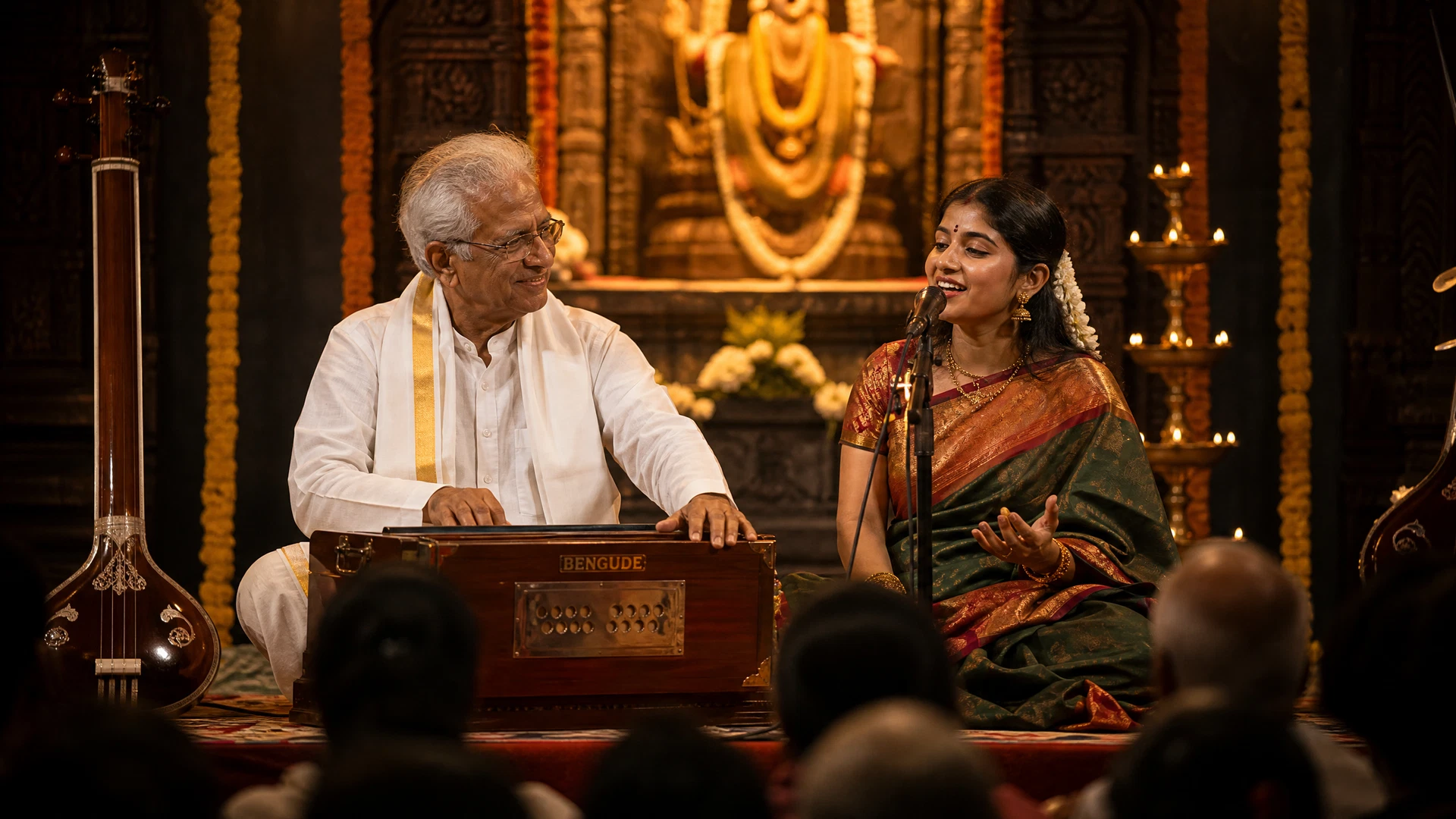
- The Bhaja Mana concert series features Dr. Vidyabhushana and his daughter Medha performing Carnatic and devotional music together.
- The name "Bhaja Mana" translates to "O mind, worship!" or "O mind, sing!" in Sanskrit.
- The concerts focus on the Haridasa tradition, featuring compositions by saints like Purandaradasa and Kanakadasa.
- Unlike traditional Carnatic concerts, Bhaja Mana encourages active audience participation and communal singing.
- A unique pre-concert workshop allows attendees to learn the compositions, their meanings, and basic raga structures before the live performance.
- The father-daughter dynamic brings a deep emotional resonance and a visible demonstration of the guru-shishya parampara (teacher-student tradition).
Table of Contents
- [What is Bhaja Mana?](#what-is-bhaja-mana)
- [The Meaning Behind the Name](#the-meaning-behind-the-name)
- [Dr. Vidyabhushana: A Living Legend](#dr-vidyabhushana-a-living-legend)
- [Why Father-Daughter Performances Are Special](#why-father-daughter-performances-are-special)
- [The Guru-Shishya Parampara in Their Music](#the-guru-shishya-parampara-in-their-music)
- [What Happens at a Bhaja Mana Concert](#what-happens-at-a-bhaja-mana-concert)
- [Songs They Perform Together](#songs-they-perform-together)
- [The Pre-Concert Workshop](#the-pre-concert-workshop)
- [The Historical Roots of the Haridasa Tradition](#the-historical-roots-of-the-haridasa-tradition)
- [The Ankita Nama Tradition](#the-ankita-nama-tradition)
What is Bhaja Mana?
Bhaja Mana is a devotional concert series featuring Dr. Vidyabhushana and his daughter Medha Vidyabhushan, performing together on stage in Bengaluru. The concert brings together two generations of Carnatic and devotional music, with the father and daughter singing Dasarapadas, bhajans, and classical compositions side by side.
The August 2026 edition of Bhaja Mana was held at the Mangala Mantapa Auditorium, NMKRV College, Jayanagar, Bengaluru. It was preceded by a two-day pre-concert workshop where attendees learned compositions directly from the artists before experiencing them live on stage.
What sets Bhaja Mana apart from a typical Carnatic concert is its intimate, participatory nature. The audience is not just listening. They are singing along, learning, and experiencing the devotional tradition as a community rather than as passive spectators.
The Meaning Behind the Name
"Bhaja Mana" comes from Sanskrit. "Bhaja" means to worship, to chant, or to sing the praises of the divine. "Mana" means mind. Together, "Bhaja Mana" is a call to the mind: "O mind, worship! O mind, sing!"
This phrase appears across devotional literature in India. It is found in bhajans like "Bhaja Mana Ram" (O mind, chant the name of Rama) and in the compositions of the Haridasa saints who urged people to turn their minds toward God through music.
The name perfectly captures the concert's philosophy. It is not about technical virtuosity or performance for applause. It is about turning the collective mind of the audience toward devotion through the power of shared singing.
Dr. Vidyabhushana: A Living Legend
Dr. Vidyabhushana is one of Karnataka's most beloved devotional singers. Over a career spanning more than four decades, he has performed thousands of concerts across India and abroad. His voice is synonymous with the Haridasa tradition in Karnataka. Compositions by Purandaradasa, Kanakadasa, Vadirajaru, and Jagannatha Dasaru come alive in his renditions.
What makes Dr. Vidyabhushana unique among Carnatic artists is his ability to connect with audiences who may not have formal musical training. His concerts are not academic recitals. They are devotional gatherings where the music serves as a bridge between the listener and the divine.
His recordings have sold millions of copies across Karnataka, and his voice has been a constant presence in temples, homes, and cultural festivals for decades. When he performs with Medha, audiences witness something rare: a living tradition being passed from one generation to the next, right there on stage.
Why Father-Daughter Performances Are Special
In Carnatic music, the guru-shishya (teacher-student) relationship is sacred. But when the guru is also the father, the bond carries an additional emotional depth that audiences can feel immediately.
Here is what makes father-daughter Carnatic performances different from other collaborations:
| Aspect | Regular Collaboration | Father-Daughter Performance |
|---|---|---|
| Musical training | Formal, structured | Lifelong, organic, begins in childhood |
| Emotional connection | Professional respect | Deep familial love and shared history |
| Musical vocabulary | Learned and adapted | Inherited and intuitive |
| Stage chemistry | Rehearsed coordination | Natural, effortless understanding |
| Audience response | Appreciation | Emotional resonance and connection |
When Dr. Vidyabhushana and Medha sing together, the audience hears two voices that grew up in the same household, absorbed the same musical atmosphere, and share the same devotional intent. Their harmonies are not rehearsed in the conventional sense. They are the product of a lifetime of shared musical experience.
The Marulu Maadikondeyalle video on YouTube, where father and daughter sing together, has nearly a million views. The comments section is filled with listeners who describe being moved to tears by the natural chemistry between them.
The Guru-Shishya Parampara in Their Music
The guru-shishya parampara (teacher-student tradition) is the foundation of Indian classical music education. Knowledge is transmitted orally, through years of close contact between teacher and student. The student does not merely learn notes and compositions. They absorb the guru's approach to music, their aesthetic sensibility, and their spiritual orientation.
In the case of Medha and Dr. Vidyabhushana, this parampara operates at the deepest possible level. Medha grew up hearing her father practice, perform, and teach. The music entered her consciousness before she could even speak. By the time she began formal training, the foundation was already laid through years of unconscious absorption.
This is why Medha's voice carries echoes of her father's style while remaining distinctly her own. She has inherited his devotional sincerity and his ability to communicate emotion through music, but she brings her own generation's energy and a fresh perspective to the compositions.
The Bhaja Mana concert is where this parampara becomes visible to the audience. When they sing together, you can hear the tradition flowing from one generation to the next in real time.
What Happens at a Bhaja Mana Concert
A Bhaja Mana concert typically runs for about three hours and follows a carefully designed arc:
Opening: The concert begins with an invocation, usually a composition praising Lord Ganesha or the guru lineage. Both father and daughter sing together, establishing the devotional atmosphere.
Individual renditions: Dr. Vidyabhushana and Medha take turns performing solo pieces. This allows the audience to appreciate each artist's individual style before hearing them together.
Duets: The heart of the concert. Father and daughter sing compositions together, sometimes trading verses, sometimes harmonizing, and sometimes engaging in musical conversations where one responds to the other.
Audience participation: Unlike formal classical concerts where the audience sits in silence, Bhaja Mana encourages singing along. Simple refrains are taught to the audience, and the hall fills with collective chanting.
Closing: The concert typically ends with a powerful Hari Narayana or a Purandaradasa composition that brings the entire audience together in a final moment of shared devotion.
Songs They Perform Together
Dr. Vidyabhushana and Medha have a repertoire that spans the entire Haridasa tradition. Here are some compositions they frequently perform together at Bhaja Mana:
| Composition | Composer | Theme |
|---|---|---|
| Hari Narayana | Purandaradasa | Power of the divine name |
| Jagadodharana | Purandaradasa | Krishna as savior of the world |
| Toogire Rayara | Jagannatha Dasaru | Lullaby for Sri Raghavendra |
| Bandanene | Dr. Vidyabhushana | Devotion to Lord Rama |
| Bhalire Bhalire | Purandaradasa | Hierarchy of divine beings |
| Laali Govinda Laali | Padarajaru | Krishna lullaby with Dashavataara |
| Srirama Raghuvamsha | Karigiridasaru | Glory of Lord Rama |
The Pre-Concert Workshop
One of the most innovative aspects of the Bhaja Mana series is the pre-concert workshop. For the August 2026 edition, a two-day workshop was held on August 6-7 at the same venue, where participants learned compositions directly from Dr. Vidyabhushana and Medha.
The workshop covers:
- Correct pronunciation of Kannada and Sanskrit lyrics
- The meaning behind each composition
- Basic raga structure and how it creates mood
- How to sing along during the concert with proper intonation
This workshop model transforms the concert from a performance into a learning experience. Participants who attend the workshop arrive at the concert already familiar with the compositions. They can sing along with understanding, not just repetition. This creates a qualitatively different concert experience where the boundary between performer and audience dissolves.
Frequently Asked Questions
What does "Bhaja Mana" mean?
"Bhaja Mana" is a Sanskrit phrase meaning "O mind, worship!" or "O mind, sing the praises of God." It is a call to turn the mind toward devotion through music. The phrase appears in many devotional compositions across Indian traditions.
Where is the Bhaja Mana concert held?
The August 2026 edition was held at Mangala Mantapa Auditorium, NMKRV College, Jayanagar 3rd Block, Bengaluru. The venue and dates may change for future editions. Follow Medha Vidyabhushan's Instagram for announcements.
Can beginners attend the Bhaja Mana concert?
Absolutely. The concert is designed to be accessible to everyone, regardless of musical training. The pre-concert workshop helps newcomers learn the compositions in advance, and the concert itself encourages audience participation. No prior knowledge of Carnatic music is required.
How is Bhaja Mana different from a regular Carnatic concert?
Traditional Carnatic concerts follow a structured format (varnam, kriti, ragam-tanam-pallavi) and the audience listens in silence. Bhaja Mana is more participatory. It focuses on devotional compositions (Dasarapadas and bhajans), encourages singing along, and creates a community atmosphere rather than a formal recital setting.
Who is Dr. Vidyabhushana?
Dr. Vidyabhushana is one of Karnataka's most renowned devotional singers with over four decades of performing experience. He specializes in Haridasa compositions and has performed thousands of concerts across India and internationally. He is Medha Vidyabhushan's father and primary guru. Read more about him in our detailed article.
The Historical Roots of the Haridasa Tradition
The musical foundation of the Bhaja Mana concert series is deeply rooted in the Haridasa movement, which originated in the 13th and 14th centuries CE, prior to the Vijayanagara empire. This spiritual and musical renaissance was led by saints who worshipped Vitthala, a manifestation of Lord Vishnu. The movement was divided into two main groups: the Dasakuta, who spread philosophy in simple Kannada, and the Vyasakuta, who were proficient in the Vedas and Upanishads.
The Haridasas traveled across holy places like Pandharapura in Maharashtra, Hampi in Karnataka, and Tirumala in Andhra Pradesh, spreading their message through song. This tradition was heavily influenced by earlier spiritual movements, including the Veerashaiva movement led by Basavanna in the 12th century and the Alvar saints of Tamil Nadu in the 10th century. In turn, the Haridasa movement influenced later spiritual leaders like Vallabhacharya in Gujarat and Chaitanya Mahaprabhu in Bengal.
When Dr. Vidyabhushana and Medha perform Dasarapadas, they are not just singing songs; they are participating in a centuries-old tradition of musical devotion that has shaped the cultural landscape of South India.
The Ankita Nama Tradition
A unique feature of the compositions performed at Bhaja Mana is the use of an ankita nama, or pen-name, by the composer. This signature motif is typically found in the final stanza of a composition and serves as a musical watermark, identifying the creator and their chosen deity.
Here is a comparison of some prominent Haridasa composers and their respective ankita namas:
| Composer | Ankita Nama (Pen-name) |
|---|---|
| Purandaradasa | Purandara Vittala |
| Kanakadasa | Kaginele Adikeshava |
| Vijaya Dasa | Vijaya Vittala |
| Jagannatha Dasa | Jagannatha Vittala |
| Vadirajatirtha | Hayavadana |
| Gopala Dasa | Gopala Vittala |
When Medha and Dr. Vidyabhushana sing these compositions, the inclusion of the ankita nama connects the modern performance directly to the historical composer, maintaining an unbroken chain of musical and spiritual heritage.
Published by Medha Naada
This guide is published by Medha Naada, Medha Vidyabhushan's official portfolio. It combines the credited sources below with plain-language listening or learning prompts. Historical details, song credits, and public records are limited to the cited material.
A written guide can support listening and preparation, but a qualified teacher remains the right source for personal vocal technique, pronunciation feedback, or repertoire decisions.
How this guide is supported
This concert article is editorial coverage of a father-daughter performance format. The cited ticket listing supports the public event context, while musical observations in the article are clearly editorial.
- Bhaja Mana. BookMyShow. Public concert-listing context for the Bhaja Mana presentation featuring Dr. Vidyabhushana and Medha Vidyabhushan.
- Marulu Maadikondeyalle | Dr. Vidyabhushana and Medha Vidyabhushan. Medha Vidyabhushan official YouTube channel. A first-party recording of Dr. Vidyabhushana and Medha performing devotional repertoire together.