History · 2026-06-25 · 13 min read
The Haridasa Movement: Kannada Devotional Poetry, Music, and History
A source-backed introduction to the Haridasa movement, its Kannada devotional literature, major composers, Dvaita context, and musical legacy.
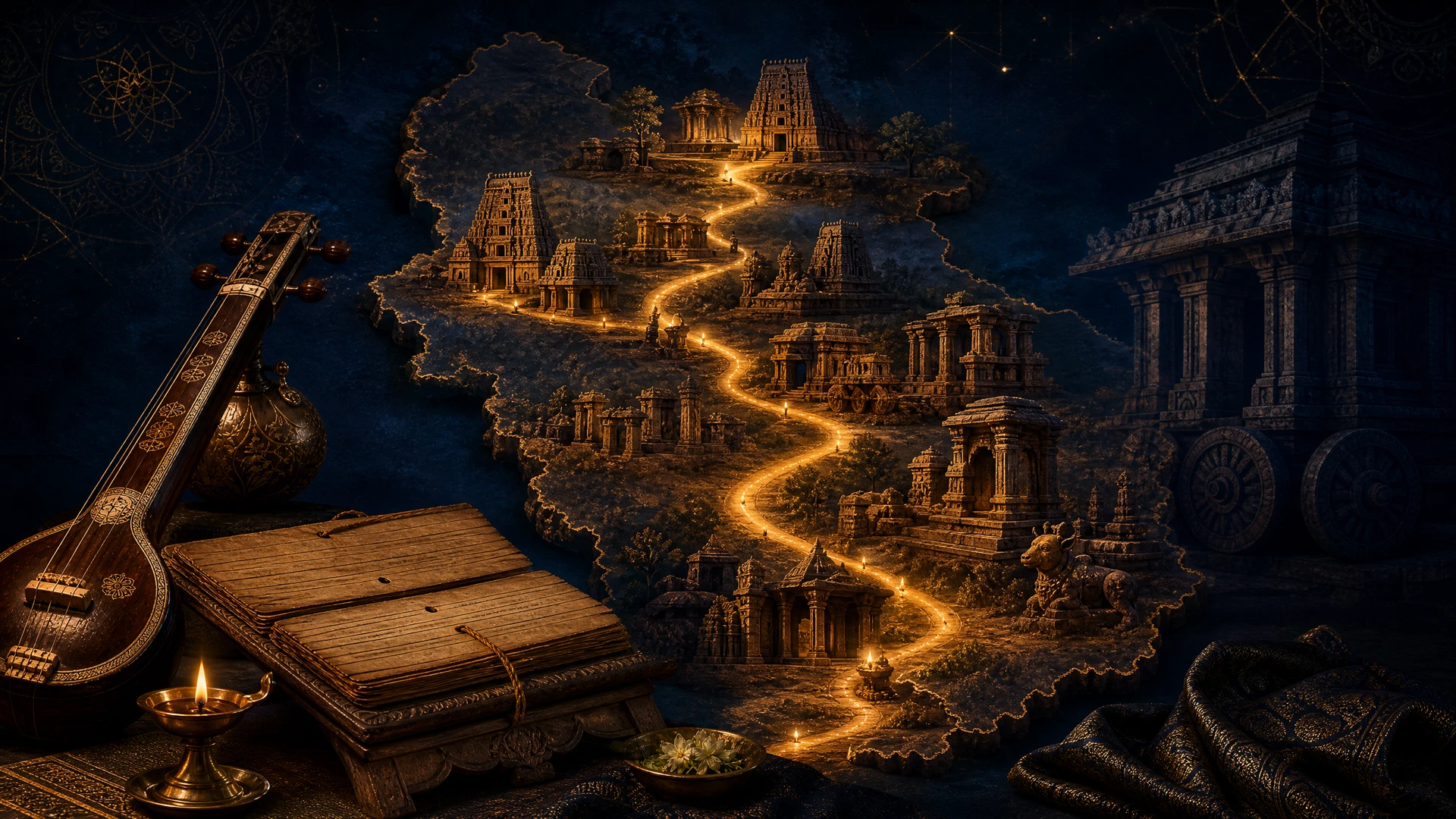
Quick Facts
- The Haridasa movement originated in the 13th-14th century CE, prior to the Vijayanagara empire.
- The movement was divided into two groups: Dasakuta (composing in simple Kannada) and Vyasakuta (proficient in Sanskrit texts).
- Haridasas primarily worshipped Vitthala, a manifestation of Lord Vishnu.
- Key holy places included Pandharapura, Hampi, and Tirumala.
- The "great trinity of Vaishnava composers" consists of Sripadaraya, Purandaradasa, and Kanakadasa.
- The movement influenced later spiritual traditions across India, including those in Gujarat and Bengal.
The Haridasa movement is one of the most important cultural phenomena in Indian history. Spanning nearly six centuries (13th to 18th century), it produced the composers who created Carnatic music as we know it, the songs (Dasarapadas) that are still sung daily by millions, and a social philosophy that challenged caste barriers and made spiritual knowledge accessible to ordinary people.
Yet outside Karnataka and the Carnatic music world, this movement remains surprisingly little known. It deserves to be understood not just as a regional religious phenomenon but as one of the great creative and social movements in world history.
Table of Contents
- [Origins: The Philosophical Foundation](#origins-the-philosophical-foundation)
- [The Vijayanagara Connection](#the-vijayanagara-connection)
- [The Key Figures](#the-key-figures)
- [The Social Revolution](#the-social-revolution)
- [The Musical Legacy](#the-musical-legacy)
- [The Movement's Decline and Revival](#the-movements-decline-and-revival)
- [The Haridasa Movement in Context](#the-haridasa-movement-in-context)
- [The Udupi Connection](#the-udupi-connection)
- [Why It Matters Today](#why-it-matters-today)
- [Two Distinct Streams: Dasakuta and Vyasakuta](#two-distinct-streams-dasakuta-and-vyasakuta)
- [The Sacred Geography of the Movement](#the-sacred-geography-of-the-movement)
- [Ankita Nama: The Signature of the Saints](#ankita-nama-the-signature-of-the-saints)
Origins: The Philosophical Foundation
The Haridasa movement grew out of the Dvaita (dualistic) philosophy founded by Madhvacharya (1238-1317) in the 13th century. Madhvacharya, born in Pajaka near Udupi in coastal Karnataka, proposed that God (Vishnu) and the individual soul are fundamentally different entities, and that the path to liberation lies in devotion (bhakti) to God.
This was a departure from the dominant Advaita (non-dualistic) philosophy of Shankaracharya, which held that the individual soul and God are ultimately one and the same. Madhvacharya's Dvaita philosophy made devotion more personal and emotional: if God is a separate being, you can love Him, serve Him, and sing to Him.
As a Reddit user on r/hinduism explained: "Haridasas (literally meaning 'Servant of Hari') spread the Madhva philosophy through mediums. This movement provided prime contribution to the Bhakti movement."
The philosophical framework of Dvaita gave the Haridasas their theological basis: they were servants (dasa) of Hari (Vishnu), expressing their devotion through song, poetry, and social service.
The Vijayanagara Connection
The Haridasa movement reached its peak during the Vijayanagara Empire (1336-1646), one of the largest and most prosperous empires in Indian history. The empire's capital, Hampi, was a centre of art, music, literature, and religious scholarship.
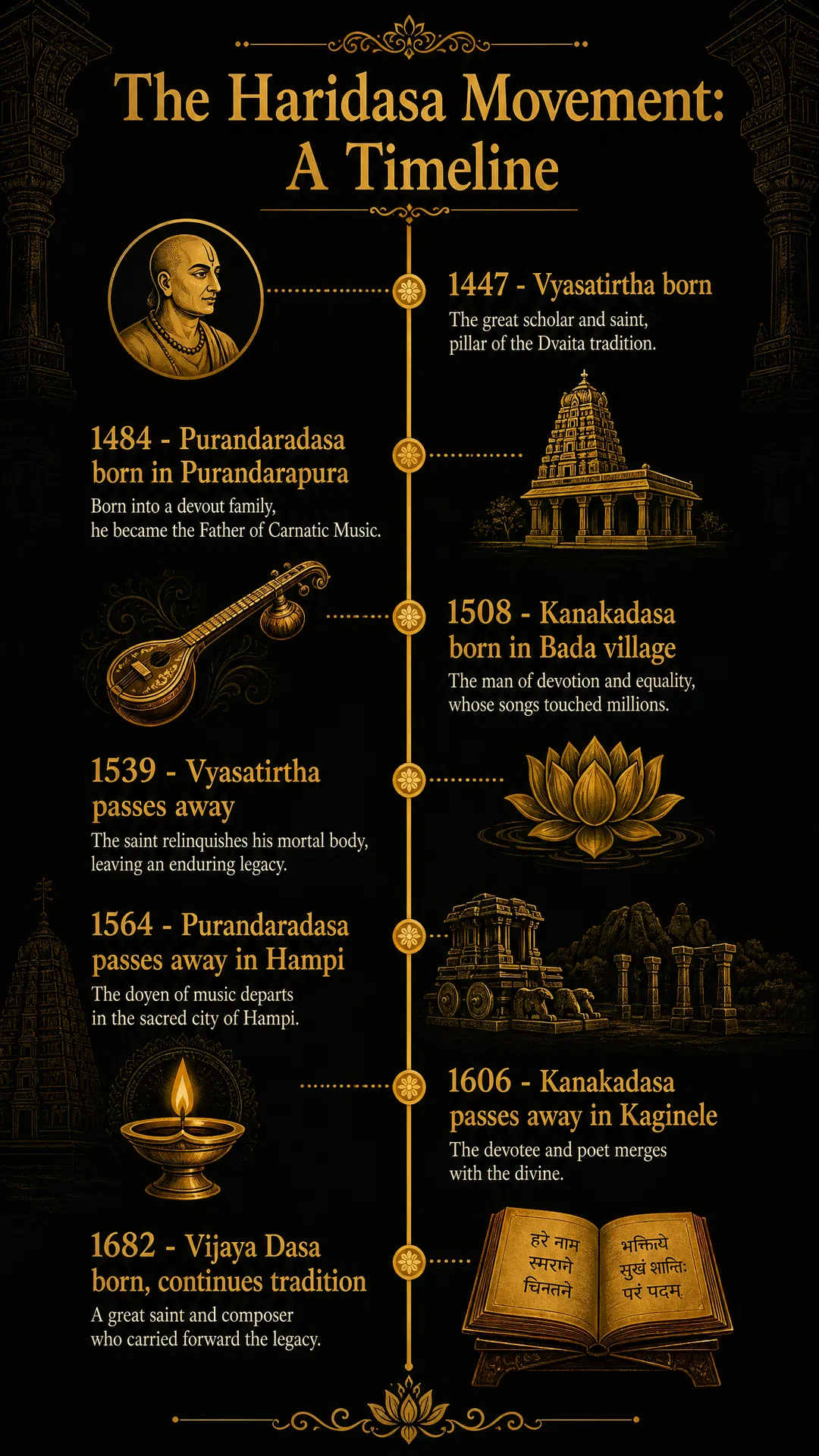
The patronage of Vijayanagara kings, particularly Krishnadevaraya (r. 1509-1529), created an environment where the Haridasas could flourish. The royal guru, Vyasatirtha (also known as Vyasaraja), was himself a key figure in the movement and the teacher of both Purandaradasa and Kanakadasa.
As the Deccan Herald stated: "During King Krishnadevaraya's reign, Sri Vyasaraya was his 'Raja Guru,' and during his reign, the Haridasa movement with Purandara, Kanaka and other leading lights composing devotional songs flourished."
A Reddit user on r/IndiaSpeaks highlighted this connection: "The Hari-dasa literature of Kanaka Dasa and Purandara Dasa was inspired by the Dvaita Vedanta. Flourishment of Carnatic music and Hari-Dasa movement happened during this time."
The Key Figures
Naraharitirtha (1243-1333)
Considered the first Haridasa, Naraharitirtha was a direct disciple of Madhvacharya. He composed devotional songs in Kannada and established the tradition of expressing philosophical ideas through accessible music.
Sripadaraja (1404-1502)
Sripadaraja was the pontiff of the Madhva matha at Mulbagal and is considered the first major musical figure of the Haridasa movement. He composed in both Kannada and Sanskrit and is credited with introducing the practice of setting devotional compositions to specific ragas.
Vyasatirtha / Vyasaraja (1447-1539)
Vyasatirtha served as the royal guru of King Krishnadevaraya and was the organizational genius behind the movement's peak period. He established a network of mathas (monasteries) across the empire and trained the two greatest Haridasas: Purandaradasa and Kanakadasa.
His own compositions, including the famous "Krishna Ni Begane Baaro" (often attributed to Kanakadasa), demonstrate deep musical knowledge and devotional intensity.
Purandaradasa (1484-1564)
The greatest figure of the movement, Purandaradasa is called the Father of Carnatic Music. He created the systematic method of teaching music that is still used today and composed hundreds of thousands of devotional songs. His story of transformation from a wealthy miser to a wandering saint is one of the most dramatic in Indian spiritual history.
See our complete guide to his compositions.
Kanakadasa (1508-1606)
Kanakadasa brought a unique social dimension to the movement. Coming from the Kuruba (shepherd) community, he faced severe caste discrimination but used his music to challenge social inequality while expressing deep devotion. His composition "Krishna Nee Begane Baaro" is one of the most beloved songs in Indian music.
Vadirajatirtha (1480-1600)
Said to have is described through traditional biographies whose dates should be read with care, Vadirajatirtha was a prolific composer in both Kannada and Sanskrit. He served as the pontiff of the Sode matha and composed works of great literary beauty and philosophical depth.
Vijaya Dasa (1682-1755)
A later-period Haridasa whose songs are known for their melodic beauty and biographical detail about earlier saints. He composed over 25,000 songs and played a crucial role in preserving the memory of the earlier Haridasas.
Gopala Dasa (1721-1769)
A disciple of Vijaya Dasa, Gopala Dasa continued the tradition into the 18th century. His compositions are known for their philosophical depth and musical sophistication.
The Social Revolution
The Haridasa movement was not just about music and devotion. It was a social revolution that challenged the rigid caste hierarchy of medieval Indian society.
The Haridasas composed in Kannada, not Sanskrit. This was a deliberate choice. Sanskrit was the language of the educated elite, inaccessible to ordinary people. By composing in the common tongue, the Haridasas made spiritual knowledge available to everyone, regardless of their education or social status.
As a Quora user explaining the origins of Carnatic music stated: "Karnataka region made significant contributions from Kannada-speaking composers and theorists, notably Purandara Dasa (16th century), often called the 'Father of Carnatic Music,' and subsequent Haridasa composers."
Kanakadasa's story is the most dramatic example of this social dimension. Denied entry to the Udupi Krishna Temple because of his caste, he sang to Krishna from outside. According to legend, the idol of Krishna turned to face him, and a small window (Kanakana Kindi) appeared in the temple wall through which he could see the deity. This story, whether historically literal or not, powerfully symbolizes the movement's message that devotion transcends social boundaries.
The Hindu reported: "Basavanna and other Sharanas and saint-poet Kanakadasa outrightly rejected the Karma philosophy and superstitions surrounding birth."
The Musical Legacy
The Haridasa movement's most lasting contribution is to music. The Haridasas did not just compose songs; they created the entire framework of Carnatic music education and performance.
Key musical contributions include:
- Systematic pedagogy: Purandaradasa's curriculum (sarali varisai, jantai varisai, alankarams, geethams) is still the universal starting point for Carnatic music students.
- Standardization of Mayamalavagowla: The choice of this raga as the starting scale for all beginners has been followed without interruption for 500 years.
- The Dasarapada form: A compositional structure that combines musical sophistication with accessibility, allowing songs to be performed in both concert and congregational settings.
- Integration of philosophy and music: The idea that music is not just entertainment but a vehicle for spiritual and moral teaching.
Classical singer T.S. Sathyavathi emphasized the importance of preserving this heritage: "If musicians don't include the repository of this Kannada sahitya in our concerts, we would not be doing justice to our rich culture and its future."
The Movement's Decline and Revival
The fall of the Vijayanagara Empire in 1565 dealt a severe blow to the Haridasa movement. Without royal patronage and in the political chaos that followed, the movement lost much of its institutional support. Many compositions were lost during this period.
However, the movement never truly died. It continued through later Haridasas like Vijaya Dasa and Gopala Dasa, and the compositions of the great Haridasas continued to be transmitted orally from generation to generation.
In the 20th century, several factors contributed to a revival:
- The recording industry made it possible to preserve and distribute Dasarapada performances widely.
- Artists like Dr. Rajkumar brought these songs to mass audiences through cinema.
- Scholars and institutions began systematic efforts to collect, authenticate, and publish Haridasa compositions.
- Musicians like Dr. Vidyabhushana dedicated their careers to performing and preserving the complete repertoire.
Today, the tradition continues through artists like Medha Vidyabhushan, who uses YouTube and streaming platforms to bring Haridasa compositions to global audiences. She is among the young Carnatic vocalists keeping the tradition alive in the digital age.
The Haridasa Movement in Context
The Haridasa movement was part of a broader Bhakti (devotional) movement that swept across India between the 12th and 17th centuries. Similar movements arose in different regions:
- The Varkari movement in Maharashtra (Tukaram, Namdev)
- The Alvars and Nayanars in Tamil Nadu
- The Baul tradition in Bengal
- The Sikh Gurus in Punjab
- The Meera tradition in Rajasthan
What distinguishes the Haridasa movement is its unique combination of devotion, music, and pedagogy. While other Bhakti movements produced great poetry and songs, only the Haridasas created a complete musical education system that shaped an entire classical tradition.
The Udupi Connection
The town of Udupi in coastal Karnataka holds special significance for the Haridasa movement. The Sri Krishna Temple at Udupi, established by Madhvacharya himself, is the spiritual centre of the Dvaita tradition. Many Haridasas composed songs specifically about the Udupi Krishna, and the temple remains an important site for Dasarapada performances.
The famous "Kanakana Kindi" (Kanaka's window) at the Udupi temple is a physical reminder of Kanakadasa's devotion and the social barriers he faced. Today, it is one of the most visited spots in the temple, and the story it represents continues to inspire discussions about equality and devotion.
Why It Matters Today
The Haridasa movement matters today for several reasons:
- Its compositions form the living repertoire of Carnatic music, performed daily in concerts and homes.
- Its pedagogical system continues to teach millions of students worldwide.
- Its social message of equality and accessibility remains relevant.
- Its model of combining art with spiritual and social purpose offers inspiration for contemporary artists.
- Its survival over six centuries demonstrates the power of oral tradition and community practice.
As one Reddit user on r/Carnatic shared: "For the past 2-3 years, I've developed an interest in Carnatic singing. Annamayya sankeerthanas and Haridasa Krithis are beautiful." This shows that new listeners continue to discover and fall in love with this tradition.
Frequently Asked Questions
What does "Haridasa" mean?
"Haridasa" literally means "servant of Hari." Hari is another name for Lord Vishnu/Narayana. The Haridasas saw themselves as devoted servants of God, expressing their service through music, poetry, and social action.
Is the Haridasa movement still active today?
Yes, though in a different form than its medieval peak. Today, the movement's legacy lives primarily through the continued performance of Dasarapadas, the use of Purandaradasa's pedagogical system in music education, and the ongoing scholarly study of Haridasa literature. New compositions in the Haridasa style are rare, but the existing repertoire is actively performed and taught.
What is the connection between the Haridasa movement and Carnatic music?
The Haridasa movement created the foundations of Carnatic music as we know it. Purandaradasa's pedagogical system, the Dasarapada compositional form, and the integration of devotion with musical sophistication all emerged from this movement. Without the Haridasas, Carnatic music would be a fundamentally different tradition.
Were all Haridasas Brahmins?
No. While many prominent Haridasas came from Brahmin families, the movement explicitly included people from all castes. Kanakadasa, one of the greatest Haridasas, was from the Kuruba (shepherd) community. This inclusivity was a defining characteristic of the movement and a source of social tension with orthodox establishments.
How did the Vijayanagara Empire support the Haridasa movement?
The Vijayanagara kings provided patronage, protection, and institutional support. Vyasatirtha served as the royal guru of Krishnadevaraya, giving the movement access to royal resources and prestige. The empire's stability and prosperity created conditions where artists and saints could devote themselves fully to their work without worrying about basic survival.
Two Distinct Streams: Dasakuta and Vyasakuta
The Haridasa movement was characterized by two complementary streams of spiritual practice and expression. These two groups worked in tandem to spread the Dvaita philosophy across different segments of society.
- Dasakuta: This group focused on conveying complex philosophical ideas through simple Kannada songs and poetry. They were the primary composers of Dasarapadas, making spiritual knowledge accessible to the masses.
- Vyasakuta: This group consisted of scholars who were highly proficient in the Vedas, Upanishads, and other classical texts. They engaged in rigorous academic study and debate, often writing in Sanskrit.
This dual approach ensured that the movement had both deep intellectual rigor and broad popular appeal, creating a robust cultural framework that supported the development of Carnatic music.
The Sacred Geography of the Movement
The Haridasa movement was not confined to a single location but created a network of sacred sites across peninsular India. The Haridasas worshipped Vitthala, a manifestation of Lord Vishnu, and their spiritual journeys connected several important pilgrimage centers.
Key holy places associated with the movement include:
- Pandharapura (Maharashtra): Located on the banks of the Bhima river, this town became a major center for the Vithoba cult, which spans both Maharashtra and Karnataka.
- Hampi (Karnataka): The capital of the Vijayanagara Empire, where the movement received significant royal patronage.
- Tirumala (Andhra Pradesh): Another crucial site for Vaishnava devotion, frequently visited by the Haridasas.
The movement's influence extended beyond its geographical origins. It drew inspiration from earlier traditions like the 12th-century Veerashaiva movement and the 10th-century Alvar saints of Tamil Nadu. In turn, it influenced later spiritual leaders such as Vallabhacharya in Gujarat and Chaitanya Mahaprabhu in Bengal.
Ankita Nama: The Signature of the Saints
A unique feature of Haridasa compositions is the use of an Ankita Nama or pen-name. This signature, usually placed at the end of a song, identified the composer and dedicated the work to their chosen deity. These signatures are essential for authenticating the surviving works of these great saints.
| Composer | Ankita Nama (Pen-name) | Meaning/Dedication |
|---|---|---|
| Purandaradasa | Purandara Vittala | Dedicated to Vittala of Purandara |
| Kanakadasa | Kaginele Adikeshava | Dedicated to Adikeshava of Kaginele |
| Vijaya Dasa | Vijaya Vittala | Dedicated to the victorious Vittala |
| Jagannatha Dasa | Jagannatha Vittala | Dedicated to Vittala, Lord of the Universe |
| Vadirajatirtha | Hayavadana | Dedicated to the horse-faced avatar of Vishnu |
| Gopala Dasa | Gopala Vittala | Dedicated to Vittala as the cowherd |
These signatures not only preserved the identity of the composers but also reinforced the central theme of devotion to Vitthala that united the Haridasa movement.
Published by Medha Naada
This guide is published by Medha Naada, Medha Vidyabhushan's official portfolio. It combines the credited sources below with plain-language listening or learning prompts. Historical details, song credits, and public records are limited to the cited material.
A written guide can support listening and preparation, but a qualified teacher remains the right source for personal vocal technique, pronunciation feedback, or repertoire decisions.
How this guide is supported
This history is a reader-friendly overview of a broad and varied devotional tradition. The cited scholarship supports its Dvaita, literary, and cultural context; the article does not claim to settle every historical debate.
- Haridasa’s Contribution to Kannada Literature. Dr. Y. A. Devarushi, International Journal on Arts, Management and Humanities. Haridasa literary tradition, Dvaita context, and its role in Karnataka’s cultural history.
- Kannada literature. Encyclopaedia Britannica. The Haridasa movement's place in Kannada literature and its association with Purandaradasa and Kanakadasa.