Carnatic Music · 2026-06-15 · 12 min read
What is Carnatic Music? A Simple Guide for Beginners
Carnatic music is one of the oldest classical music systems in the world. Here is a straightforward explanation of what it is, how it works, and why millions of people across the globe still listen to it every day.
Quick Facts
- This guide explains What is Carnatic Music? A Simple Guide for Beginners within the site's Carnatic Music learning collection.
- Factual context and practical listening or study suggestions are presented separately.
- Use the linked source notes and related guides when you want to explore the topic further.
Table of Contents
- [How Carnatic music is different from other music](#how-carnatic-music-is-different-from-other-music)
- [The building blocks: raga, tala, and swara](#the-building-blocks-raga-tala-and-swara)
- [How Carnatic music differs from Hindustani music](#how-carnatic-music-differs-from-hindustani-music)
- [The concert format (kutcheri)](#the-concert-format-kutcheri)
- [The great composers](#the-great-composers)
- [Instruments used in Carnatic music](#instruments-used-in-carnatic-music)
- [How to start listening to Carnatic music](#how-to-start-listening-to-carnatic-music)
- [Carnatic music today](#carnatic-music-today)
- [The Evolution of the Raga System](#the-evolution-of-the-raga-system)
- [The Influence of the Haridasa Movement](#the-influence-of-the-haridasa-movement)
How Carnatic music is different from other music
Unlike Western classical music, Carnatic music does not rely on harmony or chords. Instead, it focuses entirely on melody and rhythm. A single melodic line is explored in great depth, with the singer or instrumentalist improvising within the rules of the raga.
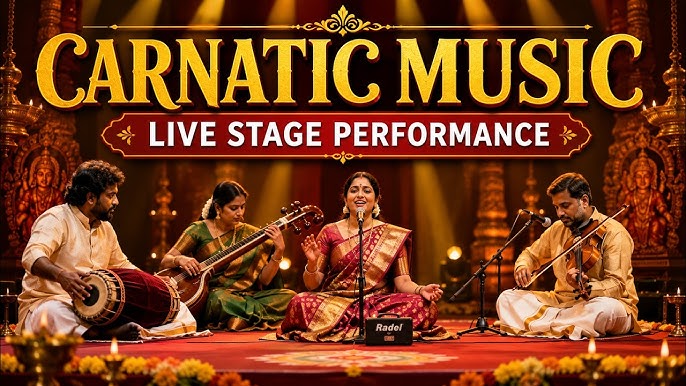
There is no orchestra in the traditional sense. A typical Carnatic concert (called a kutcheri) has a main performer (vocalist or instrumentalist), a violin accompanist who follows the main artist, a mridangam (drum) player for rhythm, and sometimes a tambura for the drone.
Here are the key differences that set Carnatic music apart:
- It is primarily vocal music. Even instrumental performances follow vocal patterns and phrasing.
- Improvisation is central. A large portion of any concert is spontaneous creation within the raga framework.
- It uses gamakas (ornamental oscillations between notes) that give the music its distinctive flowing quality.
- The lyrics are almost always devotional, praising Hindu deities or exploring spiritual themes.
- It follows a structured concert format (kutcheri paddhati) that has remained largely unchanged for over a century.
The building blocks: raga, tala, and swara
Raga: the melodic framework
A raga is not just a scale. It is a complete melodic personality with specific rules about which notes to use, how to approach them, which phrases are characteristic, and what mood the raga evokes. There are 72 parent ragas (called melakarta ragas) in the Carnatic system, and hundreds of derived ragas (janya ragas) that come from these parents.
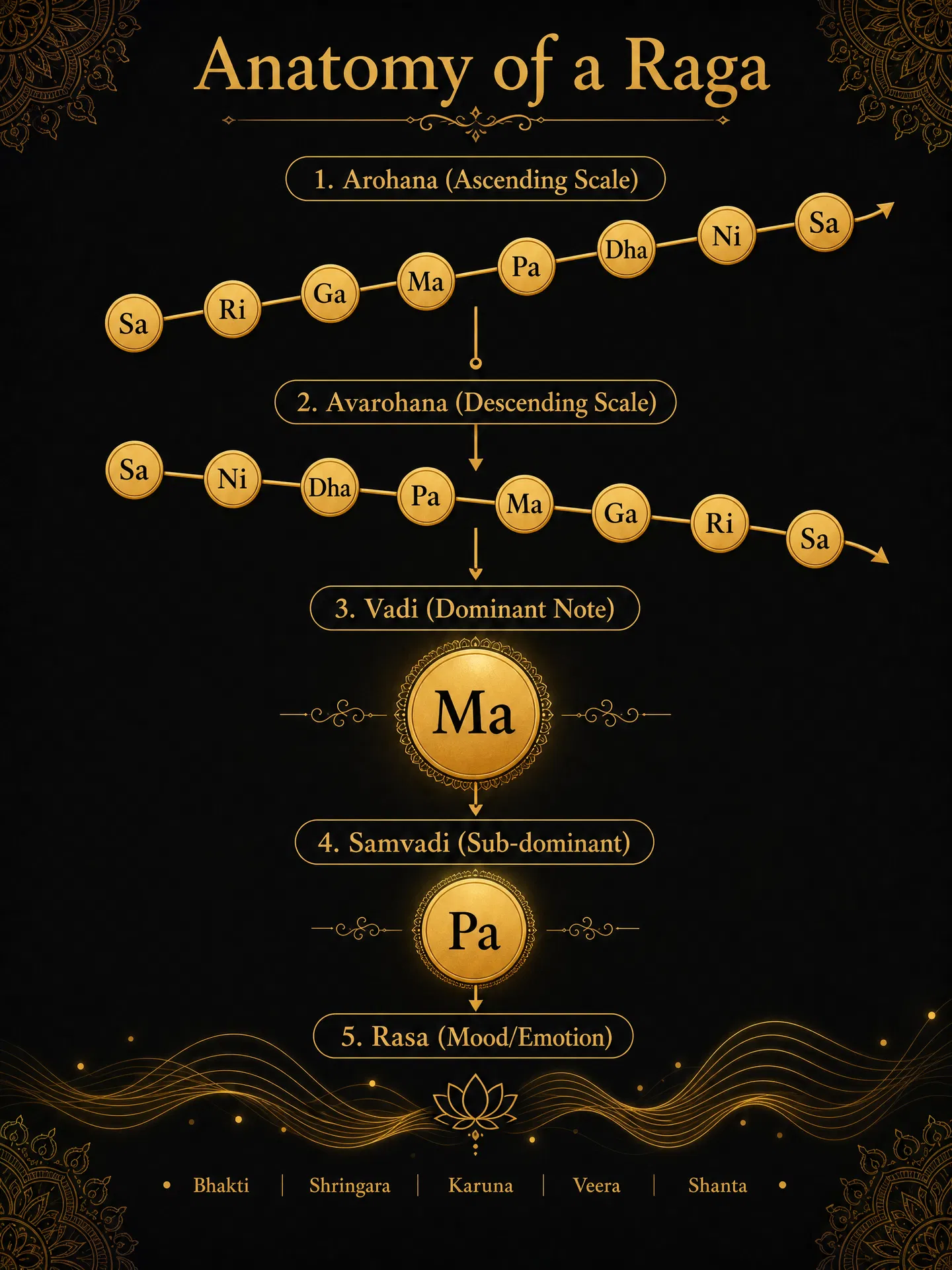
Each raga has an ascending pattern (arohana) and a descending pattern (avarohana). Some ragas use all seven notes, while others skip certain notes in one or both directions. The beauty lies in how a skilled musician can create infinite variety within these constraints.
"The raga is the heart and soul of Carnatic music and not the composition. The aim of any kalpana should be to embellish the raga swarupa. Carnatic music is basically the art of music where the artistry of the artist is the crux and lyrics are only pegs to hang the music on." - P.K. Doraiswamy, writing in The Hindu
Tala: the rhythmic cycle
Tala is the rhythmic framework that organizes time in Carnatic music. The most common tala is Adi tala, which has 8 beats per cycle. But there are seven main talas, each with five possible variations (jathis), giving 35 basic tala patterns.
What makes Carnatic rhythm special is its mathematical precision. Musicians count complex rhythmic patterns while singing or playing, often performing calculations in real time during improvisation. The interplay between the vocalist and the mridangam player during a tani avartanam (drum solo) ranks among the most exciting parts of a concert.
Swara: the notes
Carnatic music uses seven basic notes called swaras: Sa, Ri, Ga, Ma, Pa, Da, Ni. These correspond roughly to the Western Do, Re, Mi, Fa, Sol, La, Ti. However, most of these notes have multiple positions (called sthanas), giving 16 possible note positions within an octave.
The way these notes are sung is what gives Carnatic music its distinctive sound. Unlike Western music where notes are typically hit cleanly, Carnatic music uses gamakas (oscillations and ornaments) that create a continuous, flowing quality between notes.
How Carnatic music differs from Hindustani music
Both Carnatic and Hindustani music share ancient roots, but they diverged significantly over the centuries, particularly after the 13th century when Persian and Central Asian influences shaped North Indian music.
"Carnatic is bhakti centric. Hindustani is human bhava centric. Anger, love, excitement are all shown around praising itihaas and puranas in Carnatic, whereas Hindustani focused more on human emotions." - A musician on r/Carnatic (Reddit)
Here are the main differences:
- Melodic approach: Carnatic music is more structured and composition-heavy. Hindustani music gives more space to slow, meditative exploration of a raga (called alap).
- Rhythm: Carnatic rhythmic patterns tend to be more mathematically complex. Hindustani music uses a more flowing, less calculated rhythmic approach.
- Gamakas: Carnatic music uses heavier, more defined oscillations between notes. Hindustani music uses lighter, more subtle ornaments (called meend and andolan).
- Language: Carnatic compositions are primarily in Telugu, Kannada, Tamil, and Sanskrit. Hindustani compositions are in Hindi, Urdu, Braj Bhasha, and Persian.
- Performance format: A Carnatic concert follows a fixed structure (kutcheri paddhati). Hindustani concerts are more flexible in their format.
As violinist L. Subramaniam noted in a book excerpt published on Scroll.in: "While Hindustani music began to change due to external influences, Carnatic music continued to develop along the same path as before."
The concert format (kutcheri)
A traditional Carnatic concert follows a specific structure that has been in place since the early 20th century:
- The concert begins with a varnam, a composition that showcases the raga and tala in a structured way.
- This is followed by several kritis (compositions) in different ragas, building in complexity.
- The main piece of the concert is usually a ragam-tanam-pallavi, where the artist explores a raga in depth through improvisation.
- The concert includes a tani avartanam, a percussion solo where the mridangam player (and other percussionists) showcase their skills.
- The concert ends with lighter pieces, often devotional songs or thillanas (rhythmic compositions).
A full concert typically lasts two to three hours. The audience is expected to be knowledgeable and responsive, often keeping tala (rhythm) with their hands and showing appreciation through verbal expressions during particularly impressive passages.
The great composers
Carnatic music has a rich tradition of composers whose works form the core repertoire performed today:
The Trinity of Carnatic Music refers to three composers who lived in the 18th-19th centuries: Tyagaraja, Muthuswami Dikshitar, and Syama Sastri. Their compositions are considered the pinnacle of Carnatic music and are performed in virtually every concert.
Purandaradasa (1484-1564) is called the Father of Carnatic Music. He created the systematic method of teaching that is still used today and composed many devotional songs. Read our complete guide to his compositions.
Kanakadasa (1508-1606) was a poet-saint who used music to challenge social inequality while expressing deep devotion.
The Haridasa movement of Karnataka produced many of these foundational composers, and their songs (called Dasarapadas) remain central to both concert repertoire and daily devotional practice.
Instruments used in Carnatic music
While Carnatic music is primarily a vocal tradition, several instruments play important roles:
- Veena (Saraswati veena): A plucked string instrument considered the most ancient and sacred instrument in Carnatic music.
- Violin: Introduced in the 18th century, it became the primary melodic accompaniment for vocalists.
- Mridangam: A double-headed drum that provides the rhythmic foundation in concerts.
- Ghatam: A clay pot played as a percussion instrument, producing surprisingly complex rhythmic patterns.
- Flute (Venu): A bamboo flute that ranks among the most popular solo instruments in Carnatic music.
- Tambura (Tanpura): A drone instrument that provides the continuous reference pitch throughout a performance.
- Nadaswaram: A large wind instrument traditionally played in temples and at weddings.
How to start listening to Carnatic music
If you are new to Carnatic music, here are some practical suggestions:
- Start with well-known compositions like "Jagadodharana" (by Purandaradasa) or "Vatapi Ganapatim" (by Muthuswami Dikshitar). These are melodic, accessible, and widely available on streaming platforms.
- Do not worry about understanding the technical details at first. Just listen and notice how the music makes you feel.
- Try listening to the same raga performed by different artists. You will start to recognize the raga's personality even without formal training.
- Attend a live concert if possible. The energy of a live Carnatic performance is very different from a recording.
"I feel it is easier to like Hindustani music since it focuses on raga bhava a lot more and the gamakas flow easily and are not heavy. But once you get used to Carnatic gamakas, you start appreciating the depth and precision." - A listener on r/Carnatic (Reddit)
Kamala Ganesh, writing in Scroll.in, notes that "Carnatic music demands years of sadhana to become a performer. It also needs a trained ear to appreciate." But she also emphasizes that this should not discourage beginners. The music rewards patience, and even casual listening can bring genuine pleasure.
Carnatic music today
Carnatic music is not a museum piece. It is a living, evolving tradition with thousands of active performers, millions of listeners, and a growing presence on digital platforms.
The annual Margazhi music season in Chennai (December-January) features over 3,000 concerts in a single month. UNESCO has recognized Chennai in its Creative Cities Network specifically for this musical tradition, noting that the city "organises a two-month long Music Season."
Young artists like Medha Vidyabhushan are using YouTube, Spotify, and Instagram to bring Carnatic compositions to audiences who might never attend a traditional concert. Her renditions of Dasarapadas have accumulated over 10 million views on YouTube, showing that there is real appetite for this music among younger and global listeners.
At the same time, artists like T.M. Krishna are pushing boundaries by performing in non-traditional venues and questioning established concert conventions. As Scroll.in reported, he has "brought in changes in his own practice, slowing down his pace, exploring the vilambit, or ultra-slow, laya" and "often breaks the conventional kutcheri format."
Whether you approach Carnatic music as a student, a casual listener, or someone curious about one of the world's oldest living musical traditions, there is something here for you. The music has survived for two millennia because it speaks to something fundamental in human experience: the desire to create beauty within structure, to express devotion through sound, and to connect with something larger than ourselves.
Frequently Asked Questions
What is the best way to learn Carnatic music without formal training?
Start by listening regularly. Use YouTube channels that explain ragas and compositions. Many teachers now offer online classes through platforms like Gurukulam and SaPa (Society for the Promotion of Indian Classical Music and Culture Amongst Youth). Apps like Riyaz and Sruti Box can help you practice basic exercises at home.
Do you need to know music theory to enjoy Carnatic music?
Not at all. Many lifelong listeners enjoy Carnatic music purely on an emotional level without understanding the technical framework. The music communicates feeling directly through melody and rhythm. Technical knowledge enhances appreciation but is not required for enjoyment.
What are the best ragas for relaxation and meditation?
Ragas like Kalyani, Shankarabharanam, Mohanam, and Hamsadhwani are widely considered calming and uplifting. Raga Neelambari is traditionally associated with lullabies and sleep. Raga Bhairavi is often used for its soothing, meditative quality. Read more about devotional music and mental peace.
How long does it take to learn Carnatic music?
There is no fixed timeline. Basic proficiency in singing simple compositions typically takes 2-3 years of regular practice. Reaching concert-level performance usually requires 10-15 years of dedicated training under a guru. But many people learn for personal enjoyment without aiming for professional performance.
What is the difference between a kriti and a keertana?
A kriti is a structured composition with three sections (pallavi, anupallavi, and charanam) that follows strict musical rules and is typically performed in concerts. A keertana (also called Devaranama or Dasarapada) is a simpler devotional song, often with a more accessible melody, composed by the Haridasa saints for congregational singing.
The Evolution of the Raga System
The concept of the raga, or melodic framework, has evolved significantly over the centuries. While the foundational principles date back to ancient texts like the Samaveda (5000-2000 BC), the modern Carnatic system is highly structured. The 72 parent ragas, known as melakarta ragas, form the basis of this system. Each raga is defined not just by its ascending (arohana) and descending (avarohana) patterns, but also by its tonal hierarchy.
A raga's personality is shaped by its dominant note (vadi-swar), its consonant note (samvadi-swar), and its signature motif (pakkad). The primary goal of any raga presentation is the expression of a specific emotion, known as raga-rasa. This emotional depth is what makes Carnatic music so profound. For a deeper understanding of how these elements come together, you can explore our raga guide for beginners.
The Influence of the Haridasa Movement
The development of Carnatic music is deeply intertwined with the Haridasa movement, which originated in the 13th and 14th centuries. This devotional movement, centered around the worship of Vitthala (a manifestation of Vishnu), played a crucial role in shaping the music's structure and repertoire.
The Haridasas composed many devotional songs, known as Dasarapadas, which remain central to Carnatic music today. These compositions were written in simple Kannada, making the profound philosophical concepts accessible to the common people. The movement produced some of the greatest composers in Carnatic history, including the "great trinity of Vaishnava composers": Sripadaraya, Purandaradasa, and Kanakadasa.
Key Haridasa Composers and Their Pen Names
| Composer | Pen Name (Ankita Nama) | Contribution |
|---|---|---|
| Purandaradasa | Purandara Vittala | Codified the teaching methodology |
| Kanakadasa | Kaginele Adikeshava | Used music to challenge social inequality |
| Vijaya Dasa | Vijaya Vittala | Prolific composer of Dasarapadas |
| Jagannatha Dasa | Jagannatha Vittala | Known for his philosophical depth |
Published by Medha Naada
This guide is published by Medha Naada, Medha Vidyabhushan's official portfolio. It combines the credited sources below with plain-language listening or learning prompts. Historical details, song credits, and public records are limited to the cited material.
A written guide can support listening and preparation, but a qualified teacher remains the right source for personal vocal technique, pronunciation feedback, or repertoire decisions.
How this guide is supported
This beginner guide is Medha Naada editorial content. The sources below support its core music-system context; the listening prompts are editorial guidance for this portfolio.
- Carnatic music. Britannica Editors. A broad definition of Carnatic music, its vocal orientation, and the roles of raga, tala, and composed repertoire.
- A brief introduction to Carnatic music. Ludwig Pesch. A learner-focused explanation of raga, tala, bhava, and the traditional Purandara Dasa teaching sequence.