Composers · 2026-07-29 · 15 min read
Purandaradasa and Pandharpur: How the Father of Carnatic Music Found His Voice at Vittala's Feet
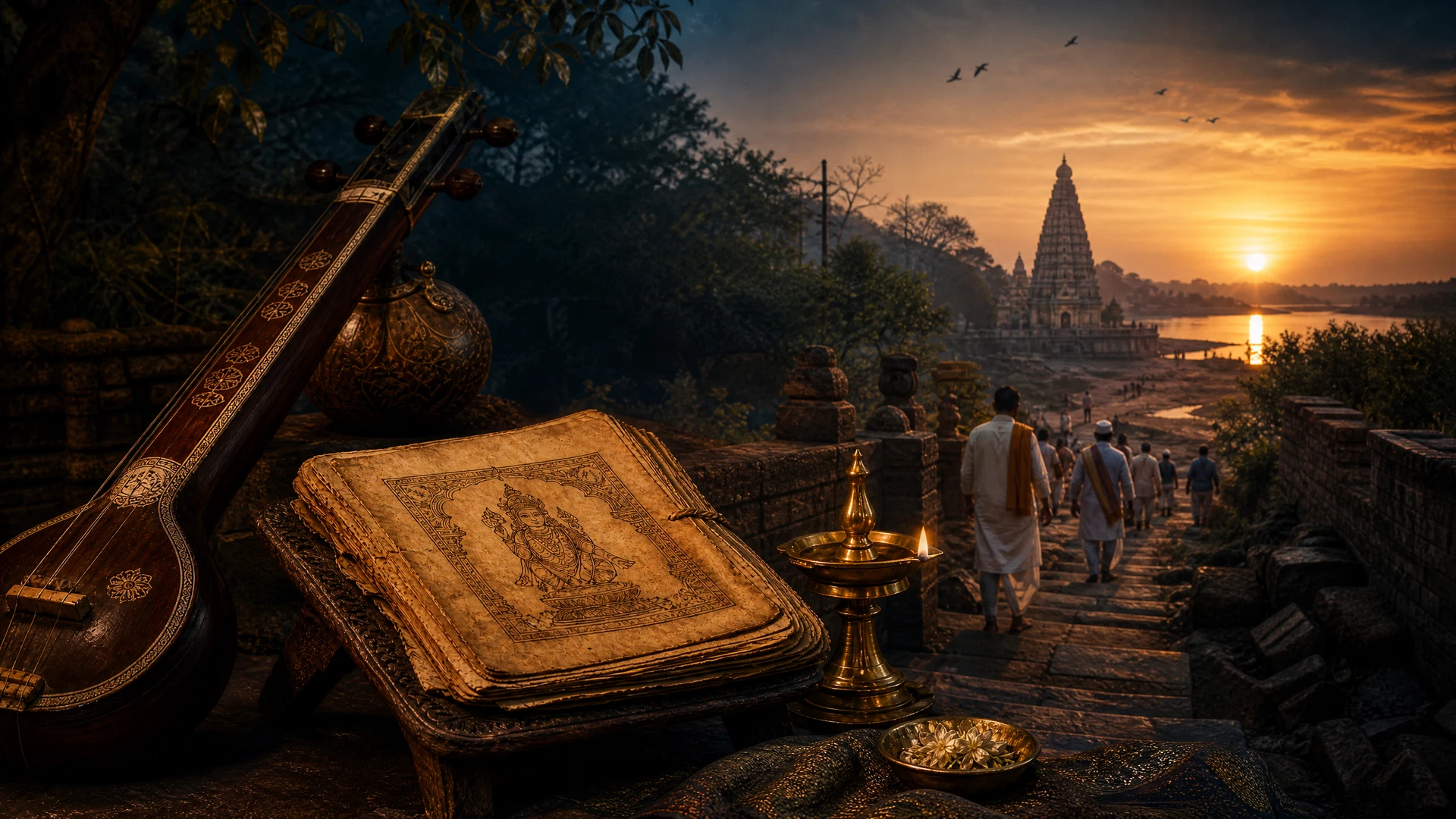
Purandaradasa visited Pandharpur and composed over a dozen songs about Lord Vittala standing on a brick. In this article, we explore his pilgrimage, the miracle at the temple, his Panduranga compositions, and how his music bridges Karnataka's Haridasa tradition with Maharashtra's Warkari heritage.
Quick Facts
- The Haridasa movement originated in the 13th-14th century CE, predating the Vijayanagara empire.
- Haridasa saints were divided into Dasakuta (simple Kannada) and Vyasakuta (Vedic scholars).
- Purandaradasa, Sripadaraya, and Kanakadasa form the great trinity of Vaishnava composers.
- Purandaradasa codified the Carnatic music teaching system, including sarali and alankara.
- He composed in various forms like Kriti, Ugabhoga, and Suladi, using folk ragas to reach the masses.
- The Vithoba cult spans across Maharashtra and Karnataka, uniting different linguistic traditions.
Purandaradasa is remembered as the Father of Carnatic Music. He created the teaching system that every student still follows today, and he composed hundreds of thousands of devotional songs in Kannada. But there is one aspect of his life that often gets overlooked in music textbooks: his deep, personal connection to Pandharpur, the temple town in Maharashtra where Lord Vitthal stands on a brick, waiting for His devotees.
This connection is not incidental. It is central to understanding who Purandaradasa was and why he signed every single composition with the name "Purandara Vittala." That signature was not a generic reference to God. It was a specific declaration of devotion to the same Vitthal who stands at Pandharpur, hands on hips, looking out at the Chandrabhaga river.
Table of Contents
- [Why Purandaradasa went to Pandharpur](#why-purandaradasa-went-to-pandharpur)
- [The miracle at the temple](#the-miracle-at-the-temple)
- [Naavu Bandeva Pandharapurake](#naavu-bandeva-pandharapurake)
- [His other compositions about Panduranga](#his-other-compositions-about-panduranga)
- [The ankita nama: what Purandara Vittala really means](#the-ankita-nama-what-purandara-vittala-really-means)
- [Two traditions, one Vittala](#two-traditions-one-vittala)
- [Why this matters for Carnatic music today](#why-this-matters-for-carnatic-music-today)
- [Medha Vidyabhushan's connection to this tradition](#medha-vidyabhushans-connection-to-this-tradition)
- [The Historical Context of the Haridasa Movement](#the-historical-context-of-the-haridasa-movement)
- [Ankita Nama: The Signature of Devotion](#ankita-nama-the-signature-of-devotion)
- [The Musical Legacy of Purandaradasa](#the-musical-legacy-of-purandaradasa)
Why Purandaradasa went to Pandharpur
After his dramatic transformation from a wealthy diamond merchant into a wandering saint, Purandaradasa spent decades traveling across South India singing the praises of Lord Vittala. He was based primarily in Hampi, the capital of the Vijayanagara Empire, where his guru Vyasatirtha served as the royal preceptor. But his devotion to Vittala drew him inevitably to the place where that deity is most powerfully present: Pandharpur.
Pandharpur sits on the banks of the Chandrabhaga (Bhima) river in present-day Solapur district, Maharashtra. It is one of the most important pilgrimage sites in western India, drawing hundreds of thousands of devotees every year during the Pandharpur Wari. The temple houses the famous image of Lord Vitthal standing on a brick, hands placed on His hips, gazing out with what devotees describe as infinite patience and compassion.
For Purandaradasa, visiting Pandharpur was not merely a pilgrimage. It was a homecoming. His entire body of work was addressed to this same Vittala. Every composition ended with the words "Purandara Vittala." To stand before the actual deity, to see the brick, to bathe in the Chandrabhaga, to hear the Marathi abhangs being sung alongside his own Kannada Dasarapadas was to experience the fullness of his devotion made visible.
"Through one ear, He hears the abhangs in Marathi of Namdev, Tukaram, and Dnyaneshwar. Through the other ear, He enjoys the Devara-naamaas of the Dasas in Kannada." This beautiful saying captures how Lord Vitthal at Pandharpur is the shared deity of two great bhakti traditions.
The miracle at the temple
One of the most remarkable episodes in Purandaradasa's life took place at Pandharpur. According to tradition, while staying in the temple town, Purandaradasa taught music to a servant woman. This act of sharing sacred knowledge with someone considered socially inferior provoked the orthodox establishment.
One day, a bangle belonging to the Lord Vittala idol went missing from the temple. It was traced to the servant woman's house, and she confessed that Purandaradasa had given it to her. The local king had Purandaradasa arrested and tied to a pillar inside the temple.
Purandaradasa did not protest or defend himself. He simply prayed silently to Vittala. The king, furious at what he believed was theft from the deity, drew out his whip to strike the saint. But as the whip was about to land on Purandaradasa's body, it vanished from the king's hand. To everyone's astonishment, the whip appeared in the hand of the Vittala idol itself.
The meaning was unmistakable: Lord Vittala was protecting His devotee. Everyone present fell at Purandaradasa's feet and begged forgiveness. The incident demonstrated what Purandaradasa had always sung about: that Vittala personally intervenes to protect those who surrender completely to Him.
This miracle at Pandharpur became one of the defining stories of Purandaradasa's life. It established his spiritual authority not through argument or scholarship, but through divine intervention witnessed by an entire community.
Naavu Bandeva Pandharapurake
Purandaradasa's most famous composition about Pandharpur is "Naavu Bandeva Pandharapurake" (We Have Come to Pandharpur). This song captures the pure joy of a pilgrim arriving at the holy town after a long journey. It is still sung today in bhajan sessions and temple gatherings across Karnataka.
The song opens with an exuberant declaration:
Pallavi: Naavu bandevu, naavu bandevu, naavu bandevu Pandharapurake / Bhava bandhanava kaleyuvudake, muddu Rangana nododake
Translation: We have come, we have come, we have come to Pandharpur! To break free from the bondage of worldly existence, to see our beloved Ranga (Vittala).
The first charana describes the temple's magnificence:
Charana 1: Rannada muddu mahadwara / Eshteli adara vistara / Chinna manikyada gopura / Ittangi mele ninta dhira
Translation: The beautiful main gate shines like precious gems, its grandeur beyond description. The towers are adorned with gold and rubies. And there stands the courageous One, firm upon the brick.
The second charana recalls Vittala's history of protecting devotees:
Charana 2: Akruragolidava nine tata / Ambarishagolidava nine tata / Prahlladagolidava nine tata / Ahallada badisuva nine tata
Translation: You who blessed Akroora, you who blessed Ambarisha, you who blessed Prahlada, you who bring overwhelming joy to all.
The final charana describes the pilgrim's ritual:
Charana 3: Chandrabhaga snanavanu madi / Mudadinda varagala bedi / Anandadi bhajaneya madi / Purandara Vitthalana nodi
Translation: After bathing in the sacred Chandrabhaga river, asking for boons with joy, singing bhajans in bliss, we behold Purandara Vittala.
What makes this composition stand out is that it is remarkable for its vivid sensory detail. You can feel the pilgrim's excitement, see the golden temple towers, and sense the cool water of the Chandrabhaga. It is not abstract devotion. It is devotion rooted in a specific place, a specific experience, a specific moment of arrival.
His other compositions about Panduranga
Purandaradasa composed at least fourteen known songs specifically about Panduranga and Pandharpur. These form a substantial sub-collection within his vast body of work and reveal how central the Pandharpur deity was to his spiritual life:
| Composition | Theme |
|---|---|
| Naavu Bandeva Pandharapurake | Joy of arriving at Pandharpur on pilgrimage |
| Ranga Baro Panduranga | Calling Panduranga to come and bless the devotee |
| Endoo Kaambeno Panduranga | Longing: "When will I see Panduranga?" |
| Ittige Mele Ninta Namma Vittala | Describing Vittala standing on the brick |
| Panduranga Twatpaada Paalisayya | Prayer: "Save me through your feet, O Panduranga" |
| Baaro Baaro Panduranga | Invitation: "Come, come, Panduranga" |
| Pandharapura Vemba Dodda Nagara | Describing Pandharpur as a great city |
| Pandarapura Raajavittala | Praising the King Vittala of Pandharpur |
| Katiyalli Karavittano | Describing Vittala's posture with hands on hips |
| Nee Karuniso Vittala Namma | Pleading for Vittala's compassion |
| Sharanu Ninage Sharanembeno Vittala | Complete surrender to Vittala |
| Vittala Salaho Swaami Namma | Asking Vittala to protect |
| Vittala Pidi Enna Kayya | "Vittala, hold my hand" |
| Kandu Endhige | "When will I see Him?" |
These compositions cover the full range of devotional emotion: longing, joy, surrender, gratitude, and intimate conversation with the divine. Together, they form a complete portrait of a devotee's relationship with his chosen deity.
The ankita nama: what Purandara Vittala really means
Every Haridasa saint signed their compositions with an ankita nama, a pen name that declared their allegiance to a specific form of God. Purandaradasa's ankita nama was "Purandara Vittala," given to him by his guru Vyasatirtha.
This name carries multiple layers of meaning. "Purandara" means "destroyer of cities" (an epithet of Lord Shiva, but here used as a personal name). "Vittala" is the specific form of Vishnu who stands at Pandharpur. So "Purandara Vittala" means "the Vittala worshipped by Purandara" or "Purandara's Vittala."
When Purandaradasa signed a composition with these words, he was not making a generic reference to God. He was pointing directly to the deity at Pandharpur, the one standing on a brick with hands on hips. Every single one of his surviving compositions ends with this declaration, making it perhaps the most repeated reference to Pandharpur in all of Indian devotional literature.
Other Haridasas followed the same pattern:
- Vijayadasa signed as "Vijaya Vittala"
- Gopaladasa signed as "Gopala Vittala"
- Jagannatha Dasa signed as "Jagannatha Vittala"
All of them were pointing to the same Vittala of Pandharpur. The entire Haridasa movement of Karnataka was, in this sense, a Pandharpur-oriented tradition expressed in the Kannada language.
Two traditions, one Vittala
The worship of Vittala at Pandharpur gave rise to two distinct but related devotional traditions:
The Warkari tradition of Maharashtra produced saints like Dnyaneshwar (13th century), Namdev (13th-14th century), Eknath (16th century), and Tukaram (17th century). They composed abhangs in Marathi and established the annual Pandharpur Wari pilgrimage that continues to this day with hundreds of thousands of participants.
The Haridasa tradition of Karnataka produced saints like Purandaradasa (15th-16th century), Kanakadasa (16th century), Vijayadasa (17th-18th century), and Gopaladasa (18th century). They composed Devaranamas in Kannada and established the tradition of Hari Katha (devotional storytelling through music).
Both traditions worship the same deity. Both emphasize devotion over ritual, accessibility over exclusivity, and personal experience over scholarly knowledge. Both produced vast bodies of devotional poetry that are still sung today. And both traditions meet at Pandharpur, where Marathi abhangs and Kannada Dasarapadas are sung side by side.
The annual Ashadi Ekadashi celebration is the most visible expression of this shared heritage. On this day, the Warkari pilgrims reach Pandharpur after weeks of walking, while in Karnataka, musicians perform special Vittalothsava concerts featuring Purandaradasa's compositions. The same deity is being celebrated in two languages, two musical traditions, and two cultural contexts, but with identical devotion.
Why this matters for Carnatic music today
Understanding Purandaradasa's Pandharpur connection changes how we hear his music. When a Carnatic musician sings "Jagadodharana" (Sustainer of the Universe) in Raga Kapi, they are not singing to an abstract concept of God. They are singing to the specific Vittala who stands at Pandharpur, the one Purandaradasa saw with his own eyes, the one who protected him from the king's whip.
This specificity gives Purandaradasa's compositions their emotional power. They are not theological arguments. They are love letters to a deity the composer knew personally. The intimacy, the playfulness, the occasional frustration ("Why won't you come to me, Vittala?") all make sense when you understand that Purandaradasa had a living, dynamic relationship with the Pandharpur deity.
For young Carnatic musicians today, this context enriches their performance. Singing "Purandara Vittala" at the end of a composition is not just a convention. It is a 500-year-old declaration of devotion to a specific deity at a specific place, connecting the performer to a lineage that stretches from the banks of the Chandrabhaga to concert halls around the world.
Medha Vidyabhushan's connection to this tradition
Medha Vidyabhushan carries forward this Purandaradasa-Pandharpur tradition in her own musical practice. Her father, Dr. Vidyabhushana, has dedicated his career to performing and preserving Purandaradasa's compositions. Medha grew up immersed in these songs, learning them not just as musical pieces but as expressions of a living devotional tradition.
Her rendition of Jagadodharana has become one of her most popular performances, with over 70K views on YouTube. She has also released Kanada Raja Pandharicha, a Marathi abhang about Lord Vitthal, demonstrating how the Karnataka and Maharashtra Vittala traditions continue to flow into each other through music.
On Ashadi Ekadashi 2026, Medha performed a special Vittalothsava concert dedicated entirely to compositions about Lord Vittala, bringing together Purandaradasa's Kannada Devaranamas and Marathi abhangs in a single concert that embodied the cross-cultural unity that Pandharpur represents.
Frequently Asked Questions
Did Purandaradasa actually visit Pandharpur?
Yes. Historical accounts confirm that Purandaradasa visited Pandharpur and had darshan of Lord Vittala. The miracle of the whip (where Lord Vittala protected Purandaradasa from punishment) is set at the Pandharpur temple. He also composed multiple songs that describe the physical details of the temple, the Chandrabhaga river, and the experience of pilgrimage, indicating firsthand experience.
Why did Purandaradasa use Vittala as his ankita nama?
Purandaradasa's guru, Vyasatirtha, gave him the ankita nama "Purandara Vittala" when he became a Haridasa. This was not arbitrary. The Haridasa tradition is specifically devoted to Lord Vittala of Pandharpur. The ankita nama declares that all of Purandaradasa's compositions are offerings to this specific deity.
What is the difference between the Warkari and Haridasa traditions?
Both worship Lord Vittala of Pandharpur, but they developed in different regions and languages. The Warkari tradition is Marathi-speaking, based in Maharashtra, and expresses devotion through abhangs and the annual Pandharpur Wari pilgrimage. The Haridasa tradition is Kannada-speaking, based in Karnataka, and expresses devotion through Devaranamas and Hari Katha. Both traditions emphasize accessible, personal devotion over ritual orthodoxy.
How many songs did Purandaradasa compose about Pandharpur?
At least fourteen known compositions specifically reference Pandharpur or Panduranga by name. However, since all of his compositions end with "Purandara Vittala" (referring to the Pandharpur deity), his entire body of work can be understood as addressed to the Lord of Pandharpur.
What is the connection between Jagadodharana and Pandharpur?
Jagadodharana ("Sustainer of the Universe") is Purandaradasa's most famous composition, set in Raga Kapi. While it does not mention Pandharpur by name, it is addressed to "Purandara Vittala," the Lord of Pandharpur. Through this song, we hear about the cosmic nature of the deity who chose to stand on a simple brick for the sake of His devotees.
The Historical Context of the Haridasa Movement
The connection between Purandaradasa and Pandharpur is deeply rooted in the broader Haridasa movement, which originated in the 13th and 14th centuries CE, well before the peak of the Vijayanagara empire. This movement was characterized by its devotion to Vitthala, a manifestation of Lord Vishnu. The Haridasas were divided into two main groups: the Dasakuta, who spread philosophical teachings in simple Kannada, and the Vyasakuta, who were proficient in the Vedas and Upanishads.
Purandaradasa, along with Sripadaraya and Kanakadasa, formed the great trinity of Vaishnava composers. Their devotion was not confined to a single location but spanned several holy places, including Pandharapura in Maharashtra, Hampi in Karnataka, and Tirumala in Andhra Pradesh. The Vithoba cult, as noted by scholars, spans peninsular India, bridging the cultural and linguistic divides between Maharashtra and Karnataka. This historical backdrop highlights that Purandaradasa's pilgrimage to Pandharpur was part of a larger, established tradition of Vitthala worship that transcended regional boundaries.
Ankita Nama: The Signature of Devotion
The tradition of using an ankita nama (pen name) was a hallmark of the Haridasa saints, serving as a personal signature and a declaration of their specific devotion. Purandaradasa's use of "Purandara Vittala" is the most famous, but he was part of a larger lineage of composers who dedicated their work to the same deity. This practice created a unified melodic framework and thematic consistency across thousands of compositions.
Here is a comparison of the ankita namas used by prominent Haridasa saints:
| Haridasa Saint | Ankita Nama (Pen Name) | Meaning/Deity Reference |
|---|---|---|
| Purandara Dasa | Purandara Vittala | The Vittala worshipped by Purandara |
| Kanaka Dasa | Kaginele Adikeshava | Lord Adikeshava of Kaginele |
| Vijaya Dasa | Vijaya Vittala | The victorious Vittala |
| Jagannatha Dasa | Jagannatha Vittala | The Lord of the Universe, Vittala |
| Vadirajatirtha | Hayavadana | The horse-faced avatar of Vishnu |
| Gopala Dasa | Gopala Vittala | The cowherd Vittala |
This table illustrates how the Haridasa composers, despite their individual identities, were united in their devotion. The recurring use of "Vittala" in their signatures reinforces the central role of the Pandharpur deity in their spiritual and musical lives.
The Musical Legacy of Purandaradasa
Purandaradasa's contributions extend far beyond his devotional lyrics; he fundamentally shaped the structure of Carnatic music. Before his time, musical instruction was largely unstructured. Purandaradasa codified the teaching system, introducing foundational exercises such as sarali varisai, jantai varisai, thattu varisai, alankara, and geetham. This structured approach provided a clear ascending and descending pattern (arohana and avarohana) for students to master the tonal hierarchy of ragas.
His compositions were incredibly diverse, encompassing various forms such as Padagalu, Kriti, Ugabhoga, Suladi, Vruttanama, Dandaka, Tripadi, Pattadi, Sangathya, and Ragale. By setting his profound philosophical lyrics to the popular tunes and folk ragas of his day, he ensured that the common man could learn and sing them. This democratization of music meant that the complex spiritual concepts of the Upanishads were made accessible to everyone, further cementing his legacy as the Father of Carnatic Music. His work laid the groundwork for the Kriti form, which was later perfected by the Trinity of Carnatic music (Tyagaraja, Muthuswami Dikshitar, and Syama Sastri).
Published by Medha Naada
This guide is published by Medha Naada, Medha Vidyabhushan's official portfolio. It combines the credited sources below with plain-language listening or learning prompts. Historical details, song credits, and public records are limited to the cited material.
A written guide can support listening and preparation, but a qualified teacher remains the right source for personal vocal technique, pronunciation feedback, or repertoire decisions.
How this guide is supported
This article brings together Purandara Dasa’s devotional legacy and Pandharpur’s Vittala tradition. The citations support that broader connection and pilgrimage context; miracle narratives and detailed travel episodes are presented as tradition and editorial interpretation, not as independently established history.
- Lyrical Musings on Indic Culture: A Sociological Study of Songs of Sant Purandara Dasa. M. K. V. Narayan. Scholarly context for Purandara Dasa’s lyrics and the Purandara Vittala and Pandharpur connection.
- Sacred Yatras of Pandharpur. Shri Vitthal Rukmini Mandir Committee, Pandharpur. Official temple context for Pandharpur pilgrimage, Varkari gathering, Dindis, and devotion to Lord Vitthal.
- Purandaradasa. Britannica Editors. A broad reference profile of Purandara Dasa as a major poet and composer of Haridasa devotional song.