Devotional Music · 2026-07-29 · 14 min read
Kanada Raja Pandharicha: Meaning, History, and Why This Marathi Abhang Still Moves Millions
Kanada Raja Pandharicha is a Marathi abhang about Lord Vitthal of Pandharpur. Here is the full meaning of the lyrics, the history behind the song, why Vitthal is called Kanada Raja, and how Medha Vidyabhushan's rendition connects Karnataka's Haridasa tradition to Maharashtra's Warkari heritage.
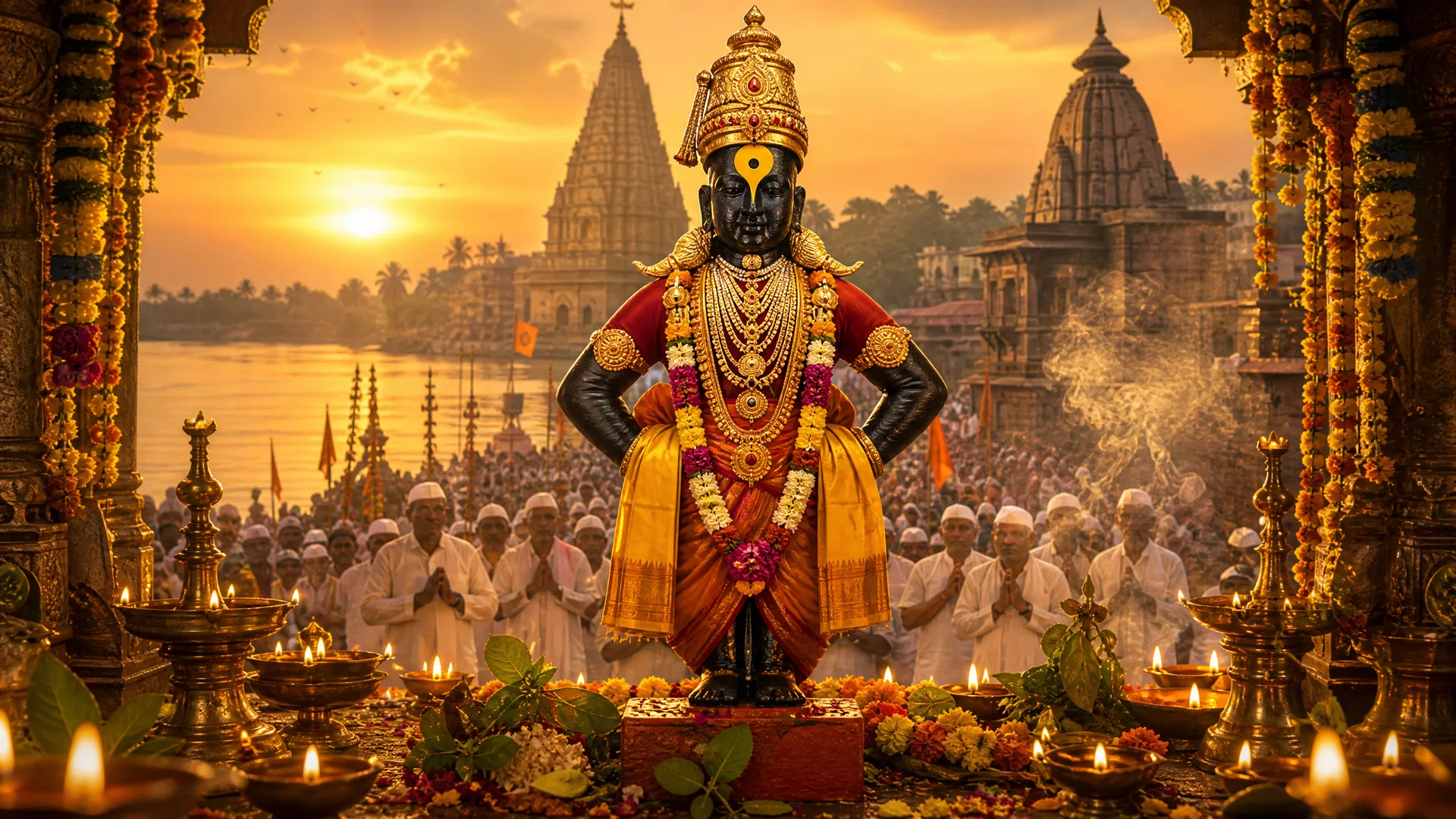
Quick Facts
- "Kanada Raja Pandharicha" translates to "The Mysterious King of Pandharpur," referring to Lord Vitthal.
- The song was written by G.D. Madgulkar and composed by Sudhir Phadke in 1950.
- The Vithoba cult spans across Maharashtra and Karnataka, highlighting a shared cultural heritage.
- The Haridasa movement in Karnataka, originating in the 13th-14th century, centered around Vitthala worship.
- Prominent Haridasa composers like Purandaradasa signed their works with unique pen-names, such as "Purandara Vittala."
- Listening to Indian classical and devotional music has been scientifically shown to reduce stress and improve mental health.
Kanada Raja Pandharicha is one of the most beloved Marathi devotional songs ever written. It describes Lord Vitthal, the deity of Pandharpur, as a mysterious king whose nature even the Vedas could not fully grasp. Written by the legendary Marathi poet G.D. Madgulkar and set to music by Sudhir Phadke, this abhang has been brought to life by generations of devotees during the Pandharpur Wari and in homes across Maharashtra and Karnataka.
The song first appeared in the 1950 Marathi film Pudhche Paul and later in the 1964 film Zala Mahar Pandharinath as a duet between Sudhir Phadke and Dr. Vasantrao Deshpande. Since then, it has become a staple of Ashadi Ekadashi celebrations and Vittala bhajan sessions throughout western and southern India.
Table of Contents
- [What does Kanada Raja Pandharicha mean?](#what-does-kanada-raja-pandharicha-mean)
- [The complete lyrics with meaning](#the-complete-lyrics-with-meaning)
- [Why is Vitthal called "Kanada Raja"?](#why-is-vitthal-called-kanada-raja)
- [G.D. Madgulkar: The poet behind the song](#gd-madgulkar-the-poet-behind-the-song)
- [The musical legacy](#the-musical-legacy)
- [The Pandharpur connection](#the-pandharpur-connection)
- [The saints mentioned in the song](#the-saints-mentioned-in-the-song)
- [The Karnataka-Maharashtra bridge](#the-karnataka-maharashtra-bridge)
- [How to listen](#how-to-listen)
- [Why this song matters today](#why-this-song-matters-today)
- [The Historical Roots of Vittala Worship](#the-historical-roots-of-vittala-worship)
- [The Haridasa Influence on Devotional Music](#the-haridasa-influence-on-devotional-music)
What does Kanada Raja Pandharicha mean?
The title itself carries deep meaning. "Kanada" is a Marathi word meaning mysterious or difficult to understand. "Raja" means king. "Pandharicha" means "of Pandharpur." Together, the title calls Lord Vitthal the mysterious, unknowable king who resides in Pandharpur.
This is not a casual description. The entire song builds on this central idea: how can the formless, infinite Supreme Being choose to manifest in a specific physical form, standing on a brick with His hands on His hips? The answer, according to the song, is love. The Supreme Soul took physical form purely for the sake of His devotees.
The complete lyrics with meaning
Here is the full text of Kanada Raja Pandharicha with a line-by-line English translation:
Pallavi (Refrain)
Kanada Raja Pandharicha The mysterious King of Pandharpur
Vedannahi nahi kalala, antpaar yacha Even the Vedas could not understand His beginning or end
Stanza 1
Nirakar to nirgun Ishwar The formless, attribute-less God
Kasa pragatla asa vitewar How did He manifest on a brick like this?
Ubhay thevile haat katiwar With both hands placed on His hips
Putla chaitanyacha A statue of pure consciousness
This stanza captures the central mystery of Vitthal worship. The God who is beyond form and attributes (nirakar, nirgun) has chosen to appear in a very specific, almost casual pose: standing on a brick with hands on hips. The poet calls this form a "statue of pure consciousness" (putla chaitanyacha), suggesting that what looks like an idol is actually living awareness.
Stanza 2
Parabrahma he bhaktasathi The Supreme Soul, for His devotees
Muke thakle Bhimekathi Waits silently on the banks of the Bhima river
Ubha rahila bhaav saawayav He stands as the physical form of pure devotion
Janu ki Pundalikancha As if He belongs solely to Pundalik
This stanza tells the origin story. According to legend, the sage Pundalik was serving his elderly parents when Lord Vishnu appeared before him. Not wanting to interrupt his service, Pundalik threw a brick toward the Lord and asked Him to wait. Pleased with this devotion to parents, the Lord agreed to stand on that brick forever. The temple at Pandharpur was built around this spot on the banks of the Chandrabhaga (Bhima) river.
Stanza 3
Ha Namyachi kheer chakhto He tastes the kheer (sweet pudding) offered by Namdev
Chokhobanchi gure rakhto And tends to Chokhamela's cattle
Purandaracha ha Paramatma The Supreme Spirit of Purandara
Waali Daamajicha The protector of Damaji
This final stanza lists the saints for whom Vitthal personally intervened. He ate the kheer offered by Sant Namdev (a tailor-saint). He herded the cattle of Chokhamela (a Dalit saint who was denied temple entry). He is the Lord whom Purandaradasa worshipped as "Purandara Vittala." And He protected Damaji, a revenue collector who used government funds to feed the poor and was saved by Vitthal Himself.
Why is Vitthal called "Kanada Raja"?
There are two layers of meaning in the word "Kanada" as applied to Vitthal:
The first and primary meaning is philosophical. In Marathi, "kanada" means mysterious or incomprehensible. The song uses this word to express wonder at how the infinite God chose such a simple, accessible form. He is "kanada" because His nature cannot be fully understood by anyone, not even the Vedas.
The second meaning has a geographical dimension. The name "Pandurang" (another name for Vitthal) is of Kannada origin. Stone tablets from the 13th century excavated near the western gate of the Pandharpur temple confirm this. The word "Vitthal" itself comes from the Kannada/Marathi word "vittu" meaning brick. Scholar R.C. Dhere, in his extensive research on Vitthal worship, has documented the diverse influences including Kannada-speaking communities that shaped the Pandharpur tradition.
This Karnataka connection is not incidental. The Haridasa movement of Karnataka was built entirely around Vittala worship. Purandaradasa, the father of Carnatic music, signed every one of his compositions as "Purandara Vittala." The song itself acknowledges this by naming Purandaradasa in the final stanza.
G.D. Madgulkar: The poet behind the song
Gajanan Digambar Madgulkar (1919-1977), known as "Gadima," is one of the greatest Marathi poets of the 20th century. He wrote over 2,000 songs and 157 screenplays during his career. His work spans devotional poetry, film songs, nature poetry, and literary drama.
Kanada Raja Pandharicha was written for the 1950 Marathi film Pudhche Paul, directed by Raja Paranjape and starring the legendary P.L. Deshpande. The music was composed by Sudhir Phadke, who also sang the original version. In 1964, the song appeared again in the film Zala Mahar Pandharinath as a duet between Sudhir Phadke and Dr. Vasantrao Deshpande.
What makes Madgulkar's lyrics remarkable is their philosophical depth combined with simplicity. The song asks a genuinely profound question (how does the infinite become finite?) and answers it with devotional warmth (He did it for love). There is no complex vocabulary or obscure reference. Every line is accessible to an ordinary devotee while carrying layers of meaning for the philosophically inclined.
The musical legacy
The original composition by Sudhir Phadke uses a slow, meditative tempo that allows each word to land with weight. The melody rises gently on "Kanada Raja Pandharicha" and descends on "Vedannahi nahi kalala," creating a musical arc that mirrors the philosophical arc of the lyrics: wonder at the divine mystery, followed by humble acceptance.
Over the decades, the song has been performed by many artists in different styles:
- Sudhir Phadke's original remains the definitive version for many listeners
- Dr. Vasantrao Deshpande brought his classical training to the duet version
- Mahesh Kale's contemporary rendition introduced the song to younger audiences
- Pandit Bhimsen Joshi performed it in his distinctive Hindustani classical style
- Medha Vidyabhushan's version brings a Carnatic sensibility to this Marathi abhang
Each interpretation reveals different facets of the composition, proving that great devotional music transcends any single style or tradition.
The Pandharpur connection
Pandharpur is a town in Solapur district, Maharashtra, on the banks of the Chandrabhaga (Bhima) river. The Vitthal temple here is one of the most important pilgrimage sites in western India. Twice a year, on Ashadi Ekadashi (June-July) and Kartiki Ekadashi (October-November), hundreds of thousands of devotees walk to Pandharpur in a procession called the Wari.
The deity at Pandharpur has a distinctive iconography found nowhere else in Hindu temple art. Vitthal stands on a brick (vit) with both hands on His hips, wearing fish-shaped earrings (makara kundala) and a crown. He does not hold weapons or sit on a throne. He simply stands, waiting. This accessibility is what makes Vitthal unique among Hindu deities and is exactly what Madgulkar captures in the song.
"There is no class in the dindi. Everybody is called mauli. It is as though all of us have given up our identity and we have all assumed the identity of the Lord." - A Warkari devotee, speaking about the Pandharpur pilgrimage
The saints mentioned in the song
The final stanza of Kanada Raja Pandharicha names four saints, each representing a different aspect of Vitthal's relationship with His devotees:
Sant Namdev (1270-1350)
Namdev was a tailor by caste who became one of the greatest Warkari saint-poets. The legend says that once, as a child, Namdev offered kheer (sweet milk pudding) to Vitthal's idol and wept when the Lord did not eat it. Moved by the child's pure devotion, Vitthal appeared in person and ate the kheer. This story illustrates how Vitthal responds to innocent, unconditional love.
Chokhamela (14th century)
Chokhamela was a Mahar (Dalit) saint who was denied entry to the Pandharpur temple because of his caste. Despite this, his devotion was so intense that Vitthal Himself would come to Chokhamela's hut, tend his cattle, and eat with him. The song's reference to "Chokhobanchi gure rakhto" (He tends Chokhamela's cattle) is a powerful statement about divine love transcending social hierarchy.
Purandaradasa (1484-1564)
Purandaradasa is the father of Carnatic music and the most important figure in the Haridasa movement of Karnataka. He signed every composition as "Purandara Vittala," declaring his complete devotion to the same Lord of Pandharpur. Read more about Purandaradasa's deep connection to Pandharpur. His inclusion in this Marathi song is significant because it acknowledges the shared devotional heritage between Maharashtra and Karnataka.
Damaji
Damaji was a revenue collector in the Bidar region who used government funds to feed the poor during a famine. When the authorities demanded the money back, Vitthal appeared disguised as a merchant and repaid the entire amount. This story shows Vitthal as a protector of those who serve others selflessly.
The Karnataka-Maharashtra bridge
Kanada Raja Pandharicha is one of those rare compositions that belongs equally to both Maharashtra and Karnataka. The Marathi Warkari tradition and the Kannada Haridasa tradition worship the same deity, and this song explicitly acknowledges that connection through its reference to Purandaradasa.
When a Carnatic vocalist like Medha Vidyabhushan performs this Marathi abhang, she is not crossing a boundary. She is walking a path that has existed for 500 years, one where the same Vittala is praised in Kannada as "Purandara Vittala" and in Marathi as "Kanada Raja Pandharicha."
Medha released her rendition of Kanada Raja Pandharicha on Ashadi Ekadashi 2026 (July 25), the most sacred day in the Vittala devotional calendar. The release coincided with her Vittalothsava concert at Poornapragnya Vidyapeetha in Bengaluru, where she performed Dasarapadas and Vittala compositions for a live audience.
How to listen
You can watch Medha Vidyabhushan's full rendition of Kanada Raja Pandharicha on YouTube. The video has gained nearly 7,000 views since its release on Ashadi Ekadashi. A shorter version is also available as a YouTube Short, which has crossed 9,900 views.
For those interested in the original, Sudhir Phadke's 1950 version and the 1964 duet with Dr. Vasantrao Deshpande are available on Spotify and other streaming platforms.
Why this song matters today
In a time when devotional music often gets reduced to background noise or algorithmic playlists, Kanada Raja Pandharicha asks its listener to pause and consider a genuine philosophical question. How does the infinite become finite? Why would the Supreme Being choose to stand on a brick? The answer the song offers is simple: for love. For the sake of devotees like Namdev, Chokhamela, Purandaradasa, and Damaji, the formless God took form.
This message of divine accessibility, of a God who is not distant or fearsome but standing patiently with hands on hips, waiting for His devotees, is what has kept this song alive for over 70 years. It is why lakhs of Warkaris sing it as they walk to Pandharpur. It is why Carnatic musicians in Karnataka include it in their Vittala concerts. And it is why new renditions by artists like Medha Vidyabhushan continue to find audiences who hear the song for the first time and feel something stir.
Frequently Asked Questions
So what does of Kanada Raja Pandharicha?
Kanada Raja Pandharicha means "The Mysterious King of Pandharpur." It is a Marathi abhang (devotional hymn) about Lord Vitthal, the deity of the Pandharpur temple in Maharashtra. The word "Kanada" means mysterious or incomprehensible, referring to how even the Vedas could not fully understand the nature of this God who chose to stand on a brick for His devotees.
Who wrote Kanada Raja Pandharicha?
The lyrics were written by G.D. Madgulkar (Gadima), one of the greatest Marathi poets of the 20th century. The music was composed by Sudhir Phadke. The song first appeared in the 1950 Marathi film Pudhche Paul and later in the 1964 film Zala Mahar Pandharinath.
Why is Lord Vitthal called Kanada?
"Kanada" in Marathi means mysterious or unfathomable. The song uses this word to express wonder at how the formless, infinite God chose to manifest in a simple physical form at Pandharpur. There is also a geographical connection: the name "Pandurang" (another name for Vitthal) is of Kannada origin, and the word "Vitthal" comes from the Kannada/Marathi word for brick (vittu).
What is the connection between Kanada Raja Pandharicha and Karnataka?
The song mentions Purandaradasa, the father of Carnatic music and a Karnataka Haridasa saint who signed all his compositions as "Purandara Vittala." The Haridasa movement of Karnataka worshipped the same Vittala of Pandharpur. The name "Pandurang" itself is of Kannada origin. This makes the song a bridge between Maharashtra's Warkari tradition and Karnataka's Haridasa tradition.
Has Medha Vidyabhushan sung Kanada Raja Pandharicha?
Yes. Medha Vidyabhushan released her rendition of Kanada Raja Pandharicha on Ashadi Ekadashi 2026 (July 25) on her YouTube channel. As a Carnatic vocalist from Karnataka singing a Marathi abhang, her version represents the living connection between the two devotional traditions that share Vittala worship.
The Historical Roots of Vittala Worship
The worship of Vittala, the deity praised in Kanada Raja Pandharicha, has deep historical roots that span across peninsular India. While Pandharpur in Maharashtra is the epicenter today, scholars note that the Vithoba cult has significant origins in Karnataka. The movement of this devotional tradition across state lines highlights a shared cultural heritage.
Key historical facts about Vittala worship include:
- The Vithoba cult spans across Maharashtra and Karnataka, uniting devotees through shared practices.
- Pandharpur, located on the banks of the Bhima river, became a major center of worship as it changed hands between various historical polities.
- The Haridasa movement in Karnataka, which originated in the 13th to 14th century CE, was built entirely around the worship of Vitthala as a manifestation of Vishnu.
The Haridasa Influence on Devotional Music
The Haridasa movement played a crucial role in shaping the devotional music landscape of South India. The movement was divided into two main groups: the Dasakuta, who spread philosophy in simple Kannada, and the Vyasakuta, who were proficient in the Vedas and Upanishads. This dual approach ensured that the profound spiritual messages reached both the scholarly and the common people.
The "great trinity of Vaishnava composers" from this movement includes Sripadaraya, Purandaradasa, and Kanakadasa. Their compositions, known as Dasarapadas, laid the foundation for what we now know as Carnatic music.
Prominent Haridasa Composers and Their Pen-Names
The Haridasa saints composed many devotional songs, each signing their work with a unique pen-name or "Ankita Nama." Here is a comparison of some prominent composers:
| Composer | Ankita Nama (Pen-Name) |
|---|---|
| Purandara Dasa | Purandara Vittala |
| Kanaka Dasa | Kaginele Adikeshava |
| Vijaya Dasa | Vijaya Vittala |
| Jagannatha Dasa | Jagannatha Vittala |
| Vadirajatirtha | Hayavadana |
| Gopala Dasa | Gopala Vittala |
Published by Medha Naada
This guide is published by Medha Naada, Medha Vidyabhushan's official portfolio. It combines the credited sources below with plain-language listening or learning prompts. Historical details, song credits, and public records are limited to the cited material.
A written guide can support listening and preparation, but a qualified teacher remains the right source for personal vocal technique, pronunciation feedback, or repertoire decisions.
How this guide is supported
This article connects a Marathi song to the wider Vitthal and Pandharpur tradition. The sources below support that historical context and the lyric reference, while the listener-facing interpretation is editorial.
- Rise of a Folk God: Vitthal of Pandharpur. Ramchandra Chintaman Dhere, translated by Anne Feldhaus. Scholarly background on Vitthal and the Pandharpur devotional tradition.
- Kanada Raja Pandharicha lyrics. Aathavanitli Gani. A Marathi song and lyric archive reference.