Pilgrimage · 2026-07-08 · 9 min read
Mantralayam and Raghavendra Swamy: The Complete Guide to India's Most Visited Brindavana
Mantralayam on the Tungabhadra river draws millions of devotees every year to the Brindavana of Sri Raghavendra Swamy. Here is the full story of the saint, the temple, the music, and what to expect when you visit.
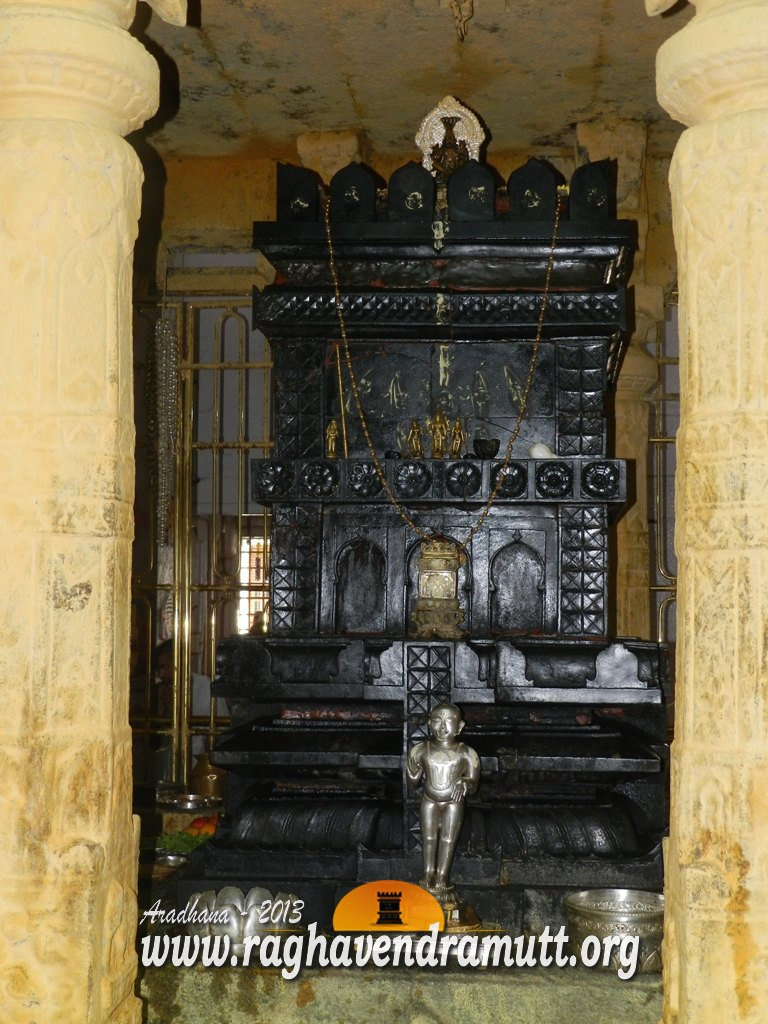
Quick Facts
- Sri Raghavendra Swamy entered jeeva samadhi (living meditation) in 1671 at Mantralayam.
- He was a prominent philosopher in the Dvaita tradition founded by Madhwacharya.
- The Brindavana is a sacred structure built around a saint in jeeva samadhi.
- Music is central to worship, with daily rituals featuring devotional songs and Vedic chanting.
- The annual Aradhana festival attracts over 500,000 devotees in a 3-day period.
- The Haridasa movement produced numerous compositions praising Raghavendra Swamy.
If you have ever heard Toogire Rayara and wondered who this "Rayaru" is that people sing about with such tenderness, this is the story. Sri Raghavendra Swamy is one of the most revered saints in the Madhwa tradition, and his Brindavana at Mantralayam is one of the most visited pilgrimage sites in South India.
What makes Mantralayam different from other temples is this: devotees believe that Raghavendra Swamy is still alive inside the Brindavana, in a state of deep meditation (jeeva samadhi). He entered the Brindavana in 1671, and the tradition holds that he will remain there for 700 years, blessing devotees who come to him.
Table of Contents
- [Who Was Sri Raghavendra Swamy?](#who-was-sri-raghavendra-swamy)
- [The Brindavana](#the-brindavana)
- [The Music Connection](#the-music-connection)
- [Temple Timings and Darshan](#temple-timings-and-darshan)
- [The Aradhana Festival](#the-aradhana-festival)
- [How to Reach Mantralayam](#how-to-reach-mantralayam)
- [Accommodation](#accommodation)
- [What Devotees Experience](#what-devotees-experience)
- [The Philosophical Legacy](#the-philosophical-legacy)
- [The Connection to Carnatic Music](#the-connection-to-carnatic-music)
- [The Haridasa Movement and Devotional Music](#the-haridasa-movement-and-devotional-music)
- [Key Haridasa Composers and Their Pen Names](#key-haridasa-composers-and-their-pen-names)
Who Was Sri Raghavendra Swamy?
Born as Venkatanatha around 1595 in Bhuvanagiri (Tamil Nadu), he showed extraordinary intellectual abilities from childhood. He mastered the Vedas, the Upanishads, and the complete works of Madhwacharya before he was 20.
His life can be divided into two phases:
As a householder (1595-1621):
- Born into a scholarly Madhwa Brahmin family
- Married young and had a son named Lakshminarayana
- Was known for his poverty and his refusal to compromise his principles for money
- His wife passed away when he was still young
As a monk (1621-1671):
- Took sannyasa (monastic vows) and was given the name Raghavendra Tirtha
- Became the pontiff of the Kumbakonam Matha
- Wrote over 50 scholarly works on Dvaita philosophy
- Traveled extensively, debating scholars and establishing the supremacy of Madhwa thought
- Entered his Brindavana at Mantralayam in 1671
The Brindavana
The word "Brindavana" literally means "garden of Tulasi." In the Madhwa tradition, it refers to the sacred structure built around a saint who has entered jeeva samadhi (living meditation).
According to tradition, on the day of his entering the Brindavana, Raghavendra Swamy sat inside the structure playing the veena and chanting the Pranava mantra (Om). He asked his disciples to place 1,200 Saligrama stones around him and seal the Brindavana. The sound of his chanting continued for several days after the structure was sealed.
The Brindavana is made of stone and is about 4 feet tall. It is covered with a golden kavacham (armor) and decorated with flowers, sandalwood paste, and kumkum daily.
The Music Connection
Music is central to worship at Mantralayam. The daily puja schedule includes several musical elements:
- Morning Suprabhatam (wake-up hymn) at 5:30 AM
- Abhishekam with Vedic chanting
- Evening aarti with devotional songs
- Closing with Toogire Rayara as the lullaby
The Haridasa tradition produced dozens of compositions specifically about Raghavendra Swamy. Poets like Vijaya Dasa, Gopala Dasa, and Jagannatha Dasa wrote hundreds of songs in his praise. These songs form a significant portion of the Dasarapada repertoire.
Medha Vidyabhushan's father, Dr. Vidyabhushana, is one of the foremost interpreters of these compositions. His renditions of Raghavendra Swamy songs are considered definitive in the tradition.
Temple Timings and Darshan
The temple is open from 6:00 AM to 9:00 PM daily. Here is the typical schedule:
- 6:00 AM - Temple opens, Suprabhatam
- 7:00 AM - Abhishekam (ritual bathing of the Brindavana)
- 8:00 AM - Mangalaarati and darshan begins
- 12:00 PM - Mahapooja (main afternoon worship)
- 6:00 PM - Evening aarti
- 8:00 PM - Toogire Rayara and closing
- 9:00 PM - Temple closes
On Thursdays (Raghavendra Swamy's special day), the temple sees significantly higher footfall. Special pujas and abhishekams are performed.
The Aradhana Festival
The annual Aradhana is the biggest event at Mantralayam. It falls in the month of Shravana (July-August) and commemorates the day Raghavendra Swamy entered the Brindavana.
During the Aradhana:
- Over 500,000 devotees visit in a 3-day period
- Special music concerts are organized featuring Dasarapada singers
- Free meals (anna daana) are served to all visitors
- The Brindavana is decorated with special flowers and ornaments
- Night-long bhajan sessions continue for 3 days
How to Reach Mantralayam
Mantralayam is located in Kurnool district, Andhra Pradesh, on the banks of the Tungabhadra river.
By air: Nearest airport is Kurnool (60 km) or Hyderabad (230 km) By train: Mantralayam Road railway station is 12 km from the temple By road: Well-connected by bus from Bengaluru (380 km), Hyderabad (230 km), and Kurnool (60 km)
Accommodation
- The Matha (monastery) provides free accommodation for devotees in basic rooms
- Several private lodges and hotels are available in the town
- Booking in advance is essential during Aradhana and weekends
- The Matha also provides free meals (prasadam) to all visitors
What Devotees Experience
The stories devotees share about Mantralayam are remarkable in their consistency. People report feeling an unusual sense of peace and clarity during and after their visit.
On Reddit's r/hinduism, a user wrote: "I am not a particularly religious person, but something about sitting in front of that Brindavana made me feel like everything was going to be okay. I cannot explain it rationally."
A Quora user shared a detailed account of praying for a child after six years of infertility: "I had a dream where I was at the mutt receiving holy water from an old priest who assured me I would have a child. Following this dream, I conceived naturally."
The Philosophical Legacy
Beyond the devotional aspect, Raghavendra Swamy was one of the most important philosophers in the Dvaita (dualistic) tradition founded by Madhwacharya. His commentaries on the Brahma Sutras, Upanishads, and the works of Madhwa are still studied in traditional pathshalas (schools) today.
His key philosophical contributions include:
- Commentaries on all major Upanishads
- Sub-commentaries on Madhwa's works
- Original works on logic and epistemology
- Reconciliation of apparent contradictions in Vedic texts
The Connection to Carnatic Music
The Raghavendra Swamy tradition has produced a rich body of musical compositions that form an important subset of Carnatic music. These compositions are unique because they combine:
- Deep philosophical content (Dvaita theology)
- Emotional devotion (bhakti)
- Musical sophistication (set in complex ragas and talas)
- Accessibility (simple enough for congregational singing)
This combination is what makes songs like Toogire Rayara work on multiple levels. A scholar appreciates the philosophical content. A devotee connects with the bhakti. A musician admires the raga treatment. And a casual listener simply feels the peace.
Frequently Asked Questions
What are the daily pooja timings at Mantralayam?
The temple opens at 6 AM with Suprabhatam. Abhishekam is at 7 AM, Mangalaarati at 8 AM, Mahapooja at noon, evening aarti at 6 PM, and closing with Toogire Rayara at 8 PM. The temple closes at 9 PM.
Is there an entry fee at Mantralayam?
No. The temple is free to enter. Special pujas and sevas have nominal charges. Free meals are provided to all visitors.
What is the best time to visit Mantralayam?
October to March offers the most comfortable weather. Avoid the peak summer months (April-May) when temperatures exceed 45 degrees Celsius. The Aradhana festival (July-August) is the most spiritually significant time but also the most crowded.
Can non-Hindus visit Mantralayam?
Yes. The temple welcomes visitors of all faiths. There are no restrictions on entry based on religion, caste, or nationality.
Why does Thursdays at Mantralayam?
Thursday is considered Raghavendra Swamy's special day (Guru Dina). Special pujas are performed, and the temple sees higher footfall. Many devotees observe a fast on Thursdays in his honor.
The Haridasa Movement and Devotional Music
The musical tradition at Mantralayam is deeply intertwined with the Haridasa movement, which originated in the 13th and 14th centuries CE. This movement, which predates the Vijayanagara empire, was instrumental in bringing complex philosophical concepts to the common people through simple Kannada songs. The Haridasas were divided into two main groups: the Dasakuta, who conveyed philosophy in accessible language, and the Vyasakuta, who were proficient in the Vedas and Upanishads.
The movement produced a rich repertoire of devotional music, with composers like Vijaya Dasa, Gopala Dasa, and Jagannatha Dasa writing extensively about Sri Raghavendra Swamy. These compositions, known as Dasarapadas, are characterized by their emotional devotion (bhakti) and musical sophistication. They often employ a melodic framework or raga system that enhances the emotional impact of the lyrics. The Haridasa tradition also influenced later devotional movements across India, demonstrating its enduring legacy in the realm of Carnatic music.
Key Haridasa Composers and Their Pen Names
The Haridasa composers often used specific pen names, known as Ankita Nama, in their compositions. This practice helped identify the author and added a personal touch to the devotional songs. Here is a comparison of some prominent Haridasa composers and their respective pen names:
| Composer | Ankita Nama (Pen Name) |
|---|---|
| Purandara Dasa | Purandara Vittala |
| Kanaka Dasa | Kaginele Adikeshava |
| Vijaya Dasa | Vijaya Vittala |
| Jagannatha Dasa | Jagannatha Vittala |
| Vadirajatirtha | Hayavadana |
| Gopala Dasa | Gopala Vittala |
These composers, including the "great trinity of Vaishnava composers" (Sripadaraya, Purandaradasa, and Kanakadasa), played a crucial role in shaping the devotional music landscape. Their works continue to be sung at Mantralayam and other sacred sites, preserving the spiritual and musical heritage of the Haridasa tradition.
Voices of Devotion
"I have been coming here every year since I was a child. The peace I feel when I step into the temple is unmatched. It feels like coming home." - Ramesh, regular visitor
"Learning the Dasarapadas changed my life. When I sing them here at Mantralayam, I feel a direct connection to Rayaru. The music just flows differently in this sacred space." - Anjali, Carnatic music student
"I came here seeking guidance during a difficult time in my career. Sitting by the Brindavana, I found the clarity I needed. It was as if a heavy fog had lifted from my mind." - Karthik, first-time visitor
Published by Medha Naada
This guide is published by Medha Naada, Medha Vidyabhushan's official portfolio. It combines the credited sources below with plain-language listening or learning prompts. Historical details, song credits, and public records are limited to the cited material.
A written guide can support listening and preparation, but a qualified teacher remains the right source for personal vocal technique, pronunciation feedback, or repertoire decisions.
How this guide is supported
This visitor guide uses the Matha’s official darshana and visitor guidance for practical context. Personal reflections and music connections in the article are editorial and should not replace current temple notices.
- Mantralaya: Darshana. Sri Raghavendra Swamy Matha. Brindavana darshana information and official visitor guidelines for Mantralayam.
- Mantralayam. Kurnool District Administration, Government of Andhra Pradesh. Official travel distances, transport context, and principal visitor sites in Mantralayam.