Carnatic Music · 2026-07-12 · 11 min read
Raga Kapi Explained: The Versatile Raga Behind Jagadodharana and Countless Classics
Raga Kapi is one of the most versatile and emotionally rich ragas in Carnatic music. Used in everything from Purandaradasa's Jagadodharana to film songs, here is a complete guide to understanding this beloved raga.
Quick Facts
- Raga Kapi is a janya (derived) raga with an asymmetric scale, using different notes in its ascending and descending patterns.
- It is renowned for its versatility, capable of expressing devotion, longing, playfulness, tenderness, and joy.
- "Jagadodharana," composed by Purandaradasa, is the most famous composition in Raga Kapi.
- Kapi is widely used in both classical Carnatic music and South Indian film songs due to its accessible, melodic quality.
- A variation of Raga Kapi also exists in the Hindustani (North Indian) classical tradition, highlighting its ancient origins.
- The raga's emotional depth makes it particularly well-suited for devotional music and lullabies.
If you have ever listened to Carnatic music, you have almost certainly heard Raga Kapi. It is the raga of "Jagadodharana," Purandaradasa's most famous composition. It is the raga of countless film songs, light music pieces, and devotional compositions. It is one of those ragas that seems to be everywhere, and for good reason: Kapi is extraordinarily versatile, capable of expressing joy, devotion, longing, playfulness, and tenderness with equal conviction.
Yet Kapi is also one of the most debated ragas in Carnatic music theory. Its structure is unusual, its boundaries are fuzzy, and musicians disagree about exactly which notes it uses and how. This combination of popularity and theoretical complexity makes it one of the most interesting ragas to study and understand.
Table of Contents
- [The Sound of Kapi](#the-sound-of-kapi)
- [The Technical Structure](#the-technical-structure)
- [Famous Compositions in Raga Kapi](#famous-compositions-in-raga-kapi)
- [Kapi in the Hindustani Tradition](#kapi-in-the-hindustani-tradition)
- [How Kapi Differs from Similar Ragas](#how-kapi-differs-from-similar-ragas)
- [Learning to Sing in Kapi](#learning-to-sing-in-kapi)
- [Kapi and Devotional Music](#kapi-and-devotional-music)
- [The Emotional Range of Kapi](#the-emotional-range-of-kapi)
- [Ragas in the Haridasa Tradition](#ragas-in-the-haridasa-tradition)
The Sound of Kapi
Before diving into theory, it helps to know what Kapi sounds like. If you listen to "Jagadodharana" by Purandaradasa or "Sahisalare Gopi" (also attributed to Purandaradasa), you are hearing Kapi.
The raga has a warm, sweet quality that is immediately appealing. It feels familiar even to first-time listeners, perhaps because its melodic patterns share similarities with folk music and film songs that most people have heard. There is a gentle rocking quality to Kapi phrases, a sense of movement between tension and resolution that creates emotional engagement without demanding technical knowledge from the listener.
Musicians often describe Kapi as:
- Warm and sweet without being saccharine
- Versatile enough for both fast and slow compositions
- Emotionally rich but not heavy or dark
- Accessible to new listeners while offering depth for connoisseurs
- Particularly well-suited to devotional themes
The Technical Structure
Kapi is a janya raga, meaning it is derived from a parent (melakarta) raga. However, there is debate about which melakarta it derives from, because Kapi uses different forms of certain notes in its ascending and descending patterns.
The notes of Kapi
In its most commonly performed form:
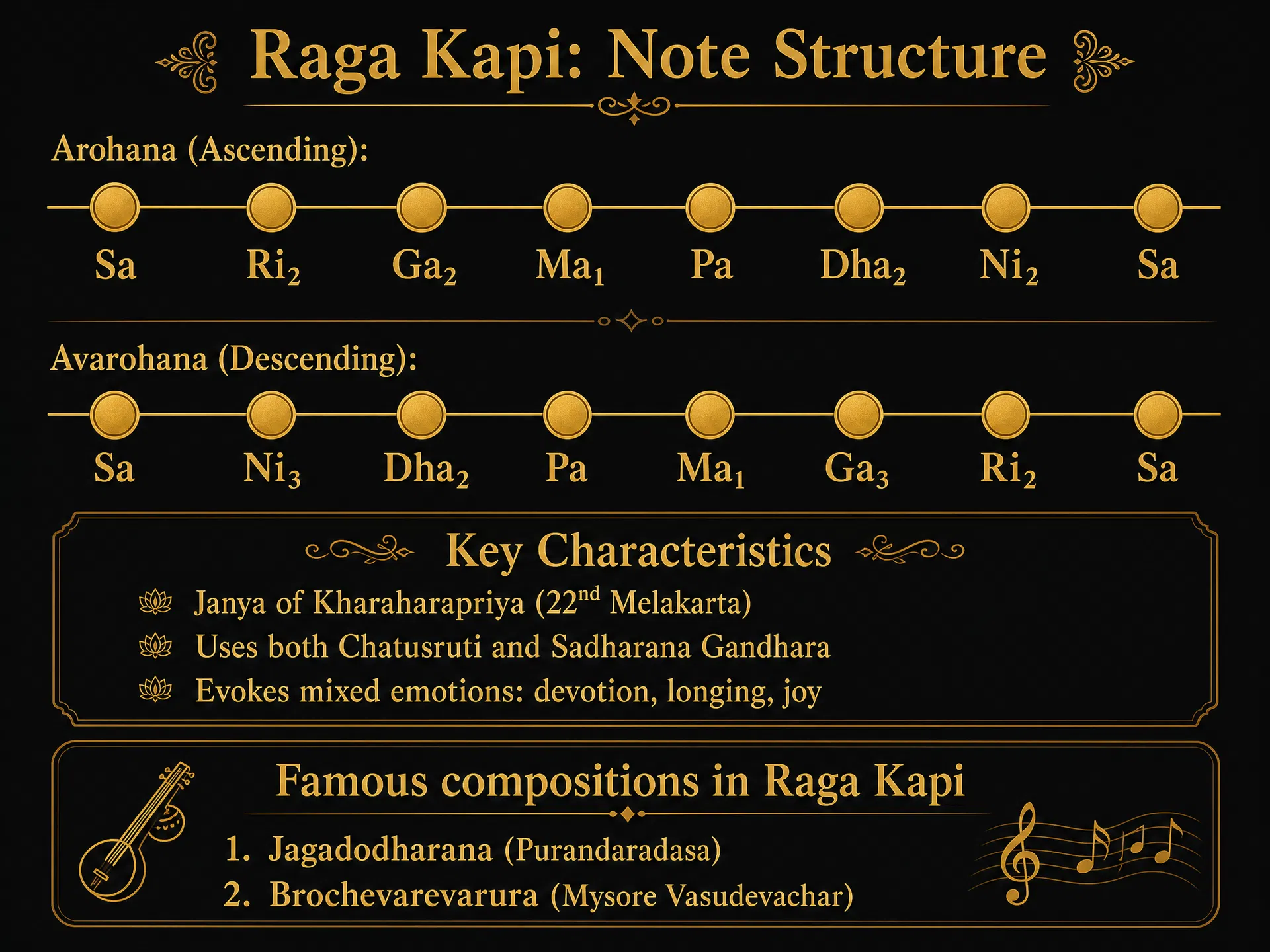
Ascending (Arohana): Sa Ri2 Ga2 Ma1 Pa Da2 Ni2 Sa Descending (Avarohana): Sa Ni2 Da1 Pa Ma1 Ga2 Ri2 Sa
The key feature is the use of different Dhaivata (Da) notes: Da2 (Chatushruti Dhaivata) in the ascending and Da1 (Shuddha Dhaivata) in the descending. This asymmetry gives Kapi its characteristic emotional colour.
However, in practice, Kapi is far more complex than this simple scale suggests. The raga uses specific phrases (prayogas) that define its identity, and skilled musicians navigate these phrases with subtle variations that give each performance a unique character.
The Nishadha question
One of the ongoing debates about Kapi concerns the use of Nishadha (Ni). Some musicians and theorists argue that Kapi uses both Ni2 (Kaisiki Nishadha) and Ni3 (Kakali Nishadha) in different contexts. Others maintain that only Ni2 is authentic. This debate has been going on for decades and reflects the broader reality that ragas are living entities that evolve over time.
Famous Compositions in Raga Kapi
Jagadodharana (Purandaradasa)
The most famous composition in Kapi, "Jagadodharana" (Sustainer of the Universe) is one of the most widely known Dasarapadas in existence. It is sung daily in homes and temples across Karnataka and is a staple of concert repertoire.
The composition perfectly demonstrates Kapi's devotional character. The opening phrase of the pallavi immediately establishes the raga's warm, inviting quality, and the charanas explore different facets of Lord Vishnu's nature while remaining within Kapi's melodic framework.
Sahisalare Gopi (Purandaradasa)
Another beloved composition in Kapi, "Sahisalare Gopi" describes the Gopis' (cowherd girls') devotion to Krishna. The playful, tender quality of Kapi is perfectly suited to this theme of divine love.
Brochevarevarura (Mysore Vasudevachar)
A concert kriti that showcases Kapi's capacity for more elaborate musical treatment. What makes this composition stand out is that it is a favourite among concert musicians for its scope for improvisation.
Film songs in Kapi
Kapi has been used extensively in South Indian film music. Its accessible, melodic quality makes it ideal for songs that need to appeal to mass audiences while maintaining musical sophistication. Many people first encounter Kapi through film songs without knowing they are hearing a classical raga.
Kapi in the Hindustani Tradition
Interestingly, Raga Kapi also exists in the Hindustani (North Indian) classical tradition, though with some differences in treatment. The Hindustani Kapi tends to be performed in a more meditative, slow-paced manner, while the Carnatic Kapi is often more rhythmic and composition-driven.
This cross-tradition presence is relatively unusual and suggests that Kapi has very ancient origins that predate the Carnatic-Hindustani split. It is one of those ragas that belongs to the shared heritage of Indian classical music.
How Kapi Differs from Similar Ragas
Several ragas share notes or phrases with Kapi, and distinguishing between them is a common challenge for students:
- Kharaharapriya: Uses the same basic notes but has a more serious, weighty character. Kharaharapriya is a melakarta (parent) raga with a symmetrical structure, while Kapi is asymmetric.
- Sriranjani: Shares some phrases with Kapi but is a pentatonic raga (five notes) with a more restrained, meditative quality.
- Kamas/Khamas: Sometimes confused with Kapi due to overlapping phrases, but has a distinctly different emotional character and uses different gamakas.
The key to identifying Kapi is its characteristic phrases rather than just its notes. Experienced listeners recognize Kapi by its specific melodic movements, particularly the way it approaches and leaves certain notes.
Learning to Sing in Kapi
For students of Carnatic music, Kapi is typically introduced at an intermediate level. It is not a beginner raga (those tend to be simpler, more symmetrical ragas like Mayamalavagowla or Mohanam), but it is accessible enough that students can begin exploring it after a few years of training.
Tips for learning Kapi:
- Listen extensively to multiple renditions of "Jagadodharana" by different artists. Notice how each artist brings out different aspects of the raga.
- Pay attention to the characteristic phrases (prayogas) rather than just the scale. Kapi's identity lies in how notes are combined, not just which notes are used.
- Practice the ascending and descending patterns slowly, paying attention to the different Dhaivata notes used in each direction.
- Learn at least one composition in Kapi thoroughly before attempting improvisation. The composition teaches you the raga's grammar.
Kapi and Devotional Music
Kapi has a special relationship with devotional music. Its warm, accessible quality makes it ideal for compositions that are meant to be sung by ordinary people in homes and temples, not just by trained musicians in concert halls.
This is why Purandaradasa chose Kapi for "Jagadodharana." The raga's natural warmth and accessibility perfectly serve the devotional purpose of the composition. You do not need to be a trained musician to feel the beauty of Kapi; it communicates directly to the heart.
Many Dasarapadas are set in Kapi or ragas with similar qualities (Mohanam, Hamsadhwani, Madhyamavathi). The Haridasa saints understood that devotional music needs to be singable by everyone, and they chose ragas accordingly.
Medha Vidyabhushan's recent YouTube Short on Raga Kapi demonstrates the continued interest in this raga among contemporary audiences. Her channel (youtube.com/@medhavidyabhushanofficial) features multiple compositions in Kapi, showing its enduring popularity.
The Emotional Range of Kapi
One of Kapi's most remarkable qualities is its emotional range. Despite having a generally warm and sweet character, it can express:
- Devotion: As in "Jagadodharana," where the warmth becomes reverence.
- Longing: The descending phrases can create a sense of yearning and incompleteness.
- Playfulness: In faster tempos, Kapi has a light, dancing quality.
- Tenderness: The raga is particularly effective for lullabies and songs of gentle love.
- Joy: In bright, ascending phrases, Kapi can express uncomplicated happiness.
This versatility is why Kapi has remained popular for over 500 years and continues to be used in new compositions and film songs. It is a raga that never feels exhausted because it can always reveal new emotional dimensions.
Frequently Asked Questions
What is the best time to listen to Raga Kapi?
Unlike some ragas that are traditionally associated with specific times of day, Kapi is considered appropriate for any time. Its versatile character makes it suitable for morning devotion, afternoon listening, or evening relaxation. In concert practice, it is often performed in the middle portion of a concert.
Is Raga Kapi the same in Carnatic and Hindustani music?
The basic melodic framework is similar, but the treatment differs. Carnatic Kapi tends to be more rhythmic and composition-driven, while Hindustani Kapi is often performed in a more meditative, exploratory manner. The gamakas (ornaments) also differ between the two traditions.
Why is Jagadodharana so popular?
"Jagadodharana" combines several factors: a beautiful, accessible raga (Kapi), meaningful devotional lyrics by Purandaradasa, a memorable melody that is easy to sing along with, and centuries of performance tradition that have made it deeply familiar to Kannada-speaking audiences. It is one of those rare compositions that works equally well in a concert hall, a temple, and a kitchen.
Can beginners learn compositions in Raga Kapi?
Possibly, but there is no universal stage at which every learner should begin Kapi. A teacher can choose a suitable composition or listening exercise after considering the learner's present pitch, phrase memory, tala, language, and pace. The teacher-led first-kriti guide explains how to frame that conversation without treating one song as an automatic starting point.
How many compositions exist in Raga Kapi?
Hundreds of compositions have been set in Kapi across the centuries, from Purandaradasa's 16th-century Dasarapadas to 20th-century film songs. It is one of the most frequently used ragas in both classical and popular music contexts.
Ragas in the Haridasa Tradition
The widespread popularity of Raga Kapi owes much to the Haridasa movement, which originated in the 13th and 14th centuries. The Haridasas, who worshipped Vitthala (a manifestation of Vishnu), recognized the power of music to convey complex philosophical ideas to the common people. They composed many songs, known as Dasarapadas, in simple Kannada, setting them to accessible ragas like Kapi.
Purandaradasa, often called the father of Carnatic music, was instrumental in this process. He introduced folk ragas into the mainstream and codified the teaching methods that are still used today. His choice of Raga Kapi for "Jagadodharana" perfectly illustrates the Haridasa approach: using a melodically rich, emotionally resonant raga to express profound devotion.
Key Haridasa Composers and Their Ankita Nama (Pen Names)
The Haridasa composers often included a signature or pen name (Ankita Nama) in their compositions. Here is a comparison of some of the most prominent figures:
| Composer | Ankita Nama (Pen Name) | Notable Contribution |
|---|---|---|
| Purandaradasa | Purandara Vittala | Codified Carnatic music teaching methods |
| Kanakadasa | Kaginele Adikeshava | Composed profound philosophical works |
| Vijaya Dasa | Vijaya Vittala | Revived the Haridasa movement in the 18th century |
| Jagannatha Dasa | Jagannatha Vittala | Authored the Harikathamrutasara |
| Vadirajatirtha | Hayavadana | Prominent scholar and composer |
The legacy of these composers lives on in the continued performance of their works, many of which are set to the beautiful and versatile Raga Kapi. Understanding this historical context enriches our appreciation of the music and its enduring spiritual significance.
Published by Medha Naada
This guide is published by Medha Naada, Medha Vidyabhushan's official portfolio. It combines the credited sources below with plain-language listening or learning prompts. Historical details, song credits, and public records are limited to the cited material.
A written guide can support listening and preparation, but a qualified teacher remains the right source for personal vocal technique, pronunciation feedback, or repertoire decisions.
How this guide is supported
This raga guide introduces Kapi for general listeners. The cited musicological reference supports historical and technical context, while mood and listening prompts are editorial guidance.
- Kapi: A Raga of Myriad Hues. Guruguha. Historical and musicological context for Kapi across established Carnatic sources.
- Notes that intrigue. Charulatha Mani, The Hindu. Kapi's principal note patterns, modern bhashanga swaras, and examples from classical repertoire.