Learning Guide · 2026-09-22 · 8 min read
Choosing Your First Carnatic Kriti: A Teacher-Led Repertoire Guide
A teacher-led framework for discussing first-kriti readiness through shruti, tala, current learning, language, and a realistic pace, without a universal ranked list.
Quick Facts
- A first kriti is a teacher-led repertoire decision, not a race to a universally easy title.
- Useful discussion points include secure shruti, basic tala confidence, the form currently being learned, language and text comfort, and a realistic learning pace.
- Carnatic teaching has a strong aural-oral dimension, so the teacher’s sung model, corrections, and chosen version matter alongside notation or recordings.
- Earlier forms can prepare a learner well, but no universal timetable makes the same kriti suitable for everyone.
- A helpful lesson question is: “What will this next piece help me consolidate?”
The first kriti can feel like a major threshold for a student, parent, or returning adult. Yet pitch, phrase shape, tala, text, memory, and a teacher’s version all shape the choice. The useful question is not “Which kriti is easiest?” but “Which next piece develops the right thing now?”
Table of Contents
- [Why This Is a Conversation, Not a List](#why-this-is-a-conversation-not-a-list)
- [What a Teacher May Weigh Before Assigning a First Kriti](#what-a-teacher-may-weigh-before-assigning-a-first-kriti)
- [How Earlier Forms Prepare the Ground](#how-earlier-forms-prepare-the-ground)
- [A Short Practice Check Before the Next Lesson](#a-short-practice-check-before-the-next-lesson)
- [What Not to Use as a Shortcut](#what-not-to-use-as-a-shortcut)
- [Conclusion](#conclusion)
Why This Is a Conversation, Not a List
Carnatic music is commonly learned through close listening, imitation, memory, and correction. Charulatha Mani describes learning raga and tala by ear as typical and places the teacher-student relationship within an aural-oral tradition. A teacher can therefore hear details a playlist cannot: pitch security, phrase recall, tala continuity, and text retention.
The Music Academy, Madras distinguishes levels of musical preparation in its part-time programme: it offers a four-year beginner vocal course and accepts learners at the standard of singing varnams into year three. This is not a universal sequence. It is a reminder that readiness is musical, not a title to collect.
A first kriti is not always a learner’s first composition. Geethams and related forms may already have introduced lyrics, melody, and tala. For the form itself, see What Is a Kriti in Carnatic Music?. This article asks how a teacher may choose the next step.
What a Teacher May Weigh Before Assigning a First Kriti
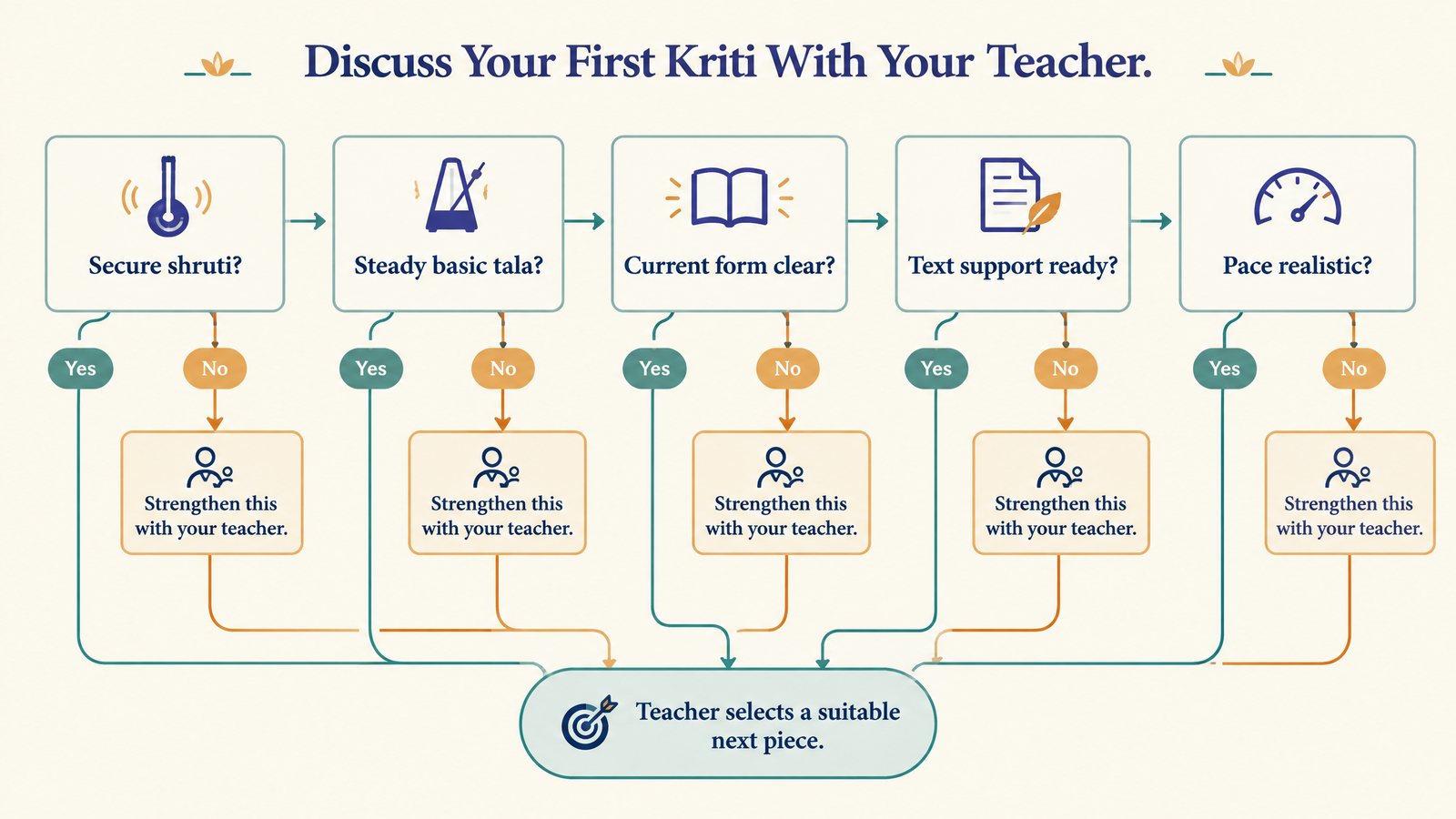
These are discussion prompts, not entrance tests. Use them to bring specific observations to a lesson.
| Dimension | What a teacher may listen for | Useful information to bring |
|---|---|---|
| Shruti and voice comfort | Pitch return and comfortable short phrases | A settled practice pitch and any fatigue |
| Basic tala confidence | A familiar cycle continues while singing | Which cycles feel steady |
| Current form and memory | Secure starts, rests, and returns | What is clear and where recall fails |
| Language and text connection | Pronunciation and word-division demands | Languages known and support needed |
| Pacing and home practice | Material absorbed between lessons | A realistic weekly practice pattern |
Shruti matters because the piece must sit in the learner’s present voice. It is not about copying a recording’s pitch or forcing range. If this is active, use the guide to practising with shruti and tanpura at the teacher’s assigned pitch before adding material.
Tala confidence means maintaining a familiar pulse when attention moves to words and melody. A manageable setting can leave room to connect phrase, text, and cycle. The beginner tala guide supports listening; the teacher sets placement and pace.
Language connection is musical preparation. A known language, another script, or a need for transliteration are all workable starts, but they change the teaching task. The languages of Carnatic compositions guide offers a starting point without treating English as a replacement for the text.
Pacing protects learning quality. Vidya Subramanian Academy offers self-paced material but says complex compositions are best learned in live lessons. A recording supports revision; it cannot correct a phrase or decide when a new section should wait.
How Earlier Forms Prepare the Ground
Earlier material is not a waiting room before “real songs.” It builds parts of kriti learning without requiring a fixed checklist.
Sarali and janta varisais focus the ear on swara movement and repeated-note control. Sarali Varisai, Janta Varisai, and the Alankara guide provide context when pitch or tala basics need work.
Geethams combine melody, tala, and lyrics in a simpler form. The karnATik lesson recommends swaras first, then lyrics, then tala once both are comfortable. This is not a law for every studio, but it shows why every layer need not arrive at once. See the Geetham practice guide.
Swarajatis and varnams can deepen memory, continuity, and raga attention. They are not compulsory gateways. Where relevant, see the Swarajati guide and Varnam bridge guide.
For a returning adult, old knowledge may remain while voice, shruti, or text recall needs rebuilding. A review period is normal. Kalakshetra Foundation’s stated aim is strong foundations that enable independent development.
A Short Practice Check Before the Next Lesson
Before asking for a first kriti, use one week to create clearer observations for the next lesson. This is not an audition.
First, return to shruti. Sing a brief familiar exercise at the assigned pitch. Notice whether its start and finish remain comfortable; do not increase range or speed.
Next, keep one familiar tala with known material. If the cycle disappears when words begin, note it as a lesson question.
Then separate text from tune. Speak one current sahitya line as taught, then sing it. Record any uncertain word division or pronunciation rather than guessing from an unrelated version.
Finally, recall a complete small form. Sing through an exercise, geetham, or assigned section without stopping for each slip. Name one clear place and one needing review.
At the lesson, ask what the proposed kriti is intended to develop. If the answer is to wait, ask which skill needs attention first.
What Not to Use as a Shortcut
Do not choose a first kriti only because it is popular, short, or prominent in search. Familiarity may motivate listening, but it does not show whether a version fits voice, tala, or the teacher’s approach. A polished performance can conceal the work of phrase shaping and pronunciation.
Avoid mixing notation, lyrics, and audio from unrelated sources without approval. The notation guide for beginners explains why written swaras need listening context. The lesson version remains the primary reference.
Do not use another student’s path as a benchmark. Different pieces may strengthen language, tala, or shruti. Repertoire is not a ranking.
Frequently Asked Questions
Do I need to finish every early form before learning a first kriti?
No universal checklist can answer that. Earlier forms provide useful preparation, but a teacher decides whether the learner’s current pitch, tala, memory, and text habits support a particular next piece. Ask what the proposed kriti will help consolidate.
Can an adult returning to Carnatic music begin with a kriti?
Possibly. It depends on what remains secure after the break. A teacher may choose a short review period first, or assign a suitable kriti if the present voice, shruti, and tala are ready. Bring a clear account of past learning and current practice time.
Is a familiar devotional song automatically a good first kriti?
Not automatically. Familiarity can help listening and text connection, but it does not settle vocal comfort, tala fit, pace, or the version that belongs in the lesson. Treat it as a suggestion to discuss, not a self-assignment.
How much practice time should I have before asking for a first kriti?
There is no fixed number of minutes for everyone. Be honest about the practice you can sustain between lessons. A teacher can choose the amount and pace of material accordingly, or identify a foundation that needs attention first.
What should a parent ask the teacher about the first kriti?
Ask what the piece is intended to develop, how the child should listen and practise at home, which recording or notation is appropriate, and what signs show that the pace is right. These questions support the teacher’s plan without turning repertoire into a competition.
Conclusion
The first Carnatic kriti is not a prize for completing a list of preliminaries. It is a teacher’s musical choice for the learner in front of them. Bring clear observations about shruti, tala, current material, language, and practice time. Then let the next piece grow from work already underway.
Published by Medha Naada
This guide is published by Medha Naada, Medha Vidyabhushan's official portfolio. It combines the credited sources below with plain-language listening or learning prompts. Historical details, song credits, and public records are limited to the cited material.
A written guide can support listening and preparation, but a qualified teacher remains the right source for personal vocal technique, pronunciation feedback, or repertoire decisions.
How this guide is supported
This is a teacher-led discussion framework, not a ranked beginner repertoire list or a universal curriculum. The sources support aural-oral learning, differentiated preparation levels, foundation building, and the limited role of self-study resources.
- Customised pedagogical tools to aid aural-oral transmission: RagaCurve and gesture. Charulatha Mani, Finnish Journal of Music Education. Peer-reviewed context for learning raga and tala by ear within the teacher-student tradition.
- Part Time Classes. The Music Academy, Madras. Institutional evidence that one programme distinguishes learner preparation levels, without establishing a universal sequence.
- Courses: Carnatic Music. Kalakshetra Foundation. Institutional emphasis on strong foundations, musical perception, nuance, and independent development.
- Beginners' Lessons: Geetams. karnATik. A specialist teaching example that layers swaras, lyrics, and tala rather than presenting every element at once.