Music Theory · 2026-08-26 · 5 min read
Raga Alapana Explained: How to Listen When There Is No Beat or Lyric
Learn what raga alapana is and how to listen without getting lost. This beginner guide explains the pulse-free Carnatic introduction, musical shape, and simple ways to follow a raga unfolding.
Quick Facts
- Raga alapana is a melodic exploration that is commonly sung without lyric or fixed tala.
- It introduces characteristic raga phrases before a composition or a larger improvisational section.
- An alapana may gradually widen in range and intensity, but its exact course is not fixed.
- Listening for rests, repeated contours, and changes of register is more useful than trying to name every swara.
- Alapana is a listening practice as much as a technical concept.
Table of Contents
- [What You Are Hearing](#what-you-are-hearing)
- [Why There Is No Fixed Beat](#why-there-is-no-fixed-beat)
- [A Three-Pass Listening Method](#a-three-pass-listening-method)
- [What Not to Worry About](#what-not-to-worry-about)
- [Connect Alapana to a Composition](#connect-alapana-to-a-composition)
- [Give the First Phrase Time](#give-the-first-phrase-time)
What You Are Hearing
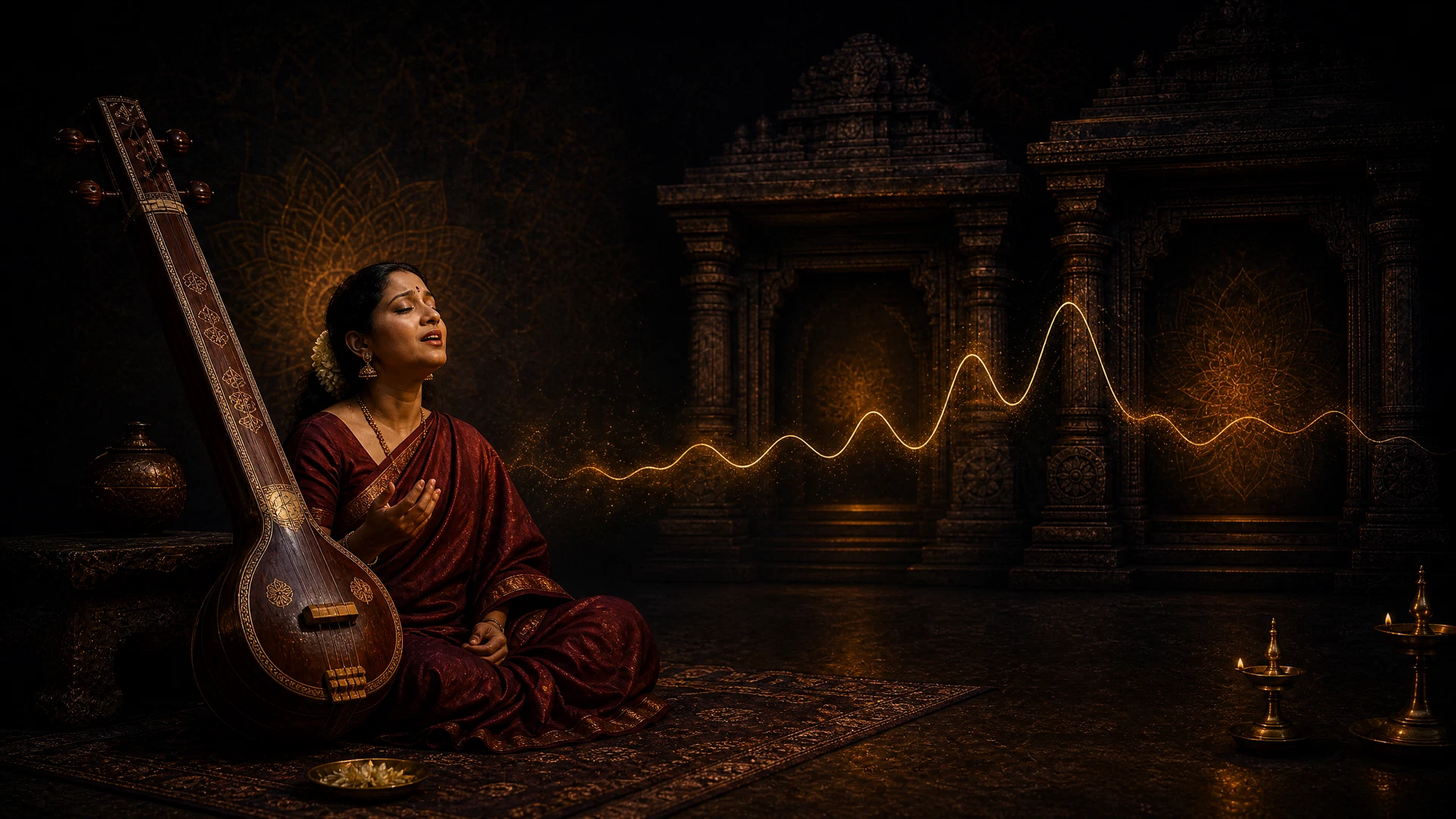
Raga alapana is often the moment when a Carnatic performance seems to slow the room down. There may be no words to translate and no hand-counted tala to follow. Instead, the artist brings out the raga through phrases, pauses, and changes of register.
HCL Concerts describes alapana as an opening meditation on a raga, without lyric or rhythm. Carnatic Corner likewise explains that the phrases follow the chosen raga’s musical character while remaining free of tala. The important point for a new listener is simple: the absence of a beat does not mean the music has lost direction.
For the broader idea of melodic identity, keep the Raga Guide for Beginners open as a companion. This page focuses on the experience of hearing an alapana unfold.
Why There Is No Fixed Beat
In a kriti, tala gives a recurring rhythmic cycle. In alapana, the artist is not required to land phrases against that cycle. That freedom makes room for a raga to be introduced before the composition’s words and pulse arrive.
You might notice a calm opening, a widening exploration, and a more animated later stretch. Treat that as a common listening shape, not a rule. Some alapanas are brief; others are extended. Some take a direct route; others linger on a few important ideas.
| Listen for | Why it helps |
|---|---|
| A phrase that returns | It gives your ear an anchor. |
| A pause or settled note | It can reveal where the artist lets an idea rest. |
| A change from lower to higher register | It helps you hear the scale of the exploration. |
| A shift in energy | It shows how the presentation is gathering momentum. |
A Three-Pass Listening Method
The first pass is for atmosphere. Do not test yourself. Notice one phrase or pause that stays with you.
On the second pass, follow the general rise and fall. Does the artist remain in one register for a while? When does the sound begin to travel upward? You are hearing shape, not taking an exam.
On the third pass, listen for the transition into the composition. Once lyrics and tala arrive, ask whether something from the alapana now feels familiar. That recognition is one of the quiet pleasures of Carnatic listening.
Watch the official YouTube video
Use this official Jaya Jayatu Srirama recording as a patient listening source. Begin with one phrase and return to it later, rather than trying to identify the entire raga on the first hearing.
What Not to Worry About
You do not need to identify the raga instantly. You do not need to count tala during a section that does not use a fixed pulse. And you do not need to compare one alapana with another as if there were one correct shape.
Here is the thing: a focused question can be enough. “Where did that phrase come to rest?” is a real way of listening. With time, the ear begins to recognise more.
Connect Alapana to a Composition
After the free exploration, a composition gives the raga a new frame. The What Is a Kriti? guide explains how raga, tala, lyric, and form meet in a composition. If you want to follow creativity after the composition begins, go next to neraval or kalpana swaras.
Frequently Asked Questions
Is raga alapana always sung before a song?
No. It is commonly used before an important composition or larger improvisational section, but a programme can include pieces without a long alapana.
Does alapana have tala?
Alapana is generally presented without a fixed tala cycle. That differs from sections such as neraval and kalpana swaras, where rhythmic placement becomes central.
Why are there no lyrics in alapana?
The focus is on bringing out the raga through melodic movement. Lyrics arrive when the composition begins.
Can instruments perform alapana?
Yes. Instrumental Carnatic performers also present raga explorations, often drawing on the same vocal musical language.
How can I become more comfortable with alapana?
Choose short, repeated listens. Follow one phrase, notice a pause, and connect the exploration to the composition that follows.
Give the First Phrase Time
An alapana does not ask you to solve a puzzle. It invites you to stay with a raga before anything else is added. One unhurried phrase can be enough to begin.
Published by Medha Naada
This guide is published by Medha Naada, Medha Vidyabhushan's official portfolio. It combines the credited sources below with plain-language listening or learning prompts. Historical details, song credits, and public records are limited to the cited material.
A written guide can support listening and preparation, but a qualified teacher remains the right source for personal vocal technique, pronunciation feedback, or repertoire decisions.
How this guide is supported
This article introduces alapana as a listening experience. The cited references support its pulse-free raga context. The three-pass exercise is editorial listening guidance and does not prescribe one universal performance shape.
- Understanding Alapana, Neraval & Kalpana Swaras in Carnatic Music. HCL Concerts. Alapana as a lyric-free, rhythm-free raga introduction and its gradual sense of musical development.
- Improvisation in Carnatic Music. Mohan Ayyar. Alapana as raga exploration without tala, normally preceding a kriti or pallavi exposition.