Music Theory · 2026-08-26 · 5 min read
Kalpana Swaras Explained: How to Hear the Return to Tala
A beginner-friendly guide to kalpana swaras in Carnatic music. Learn why artists sing solfa syllables, how phrases return to a fixed point in tala, and what listeners can follow first.
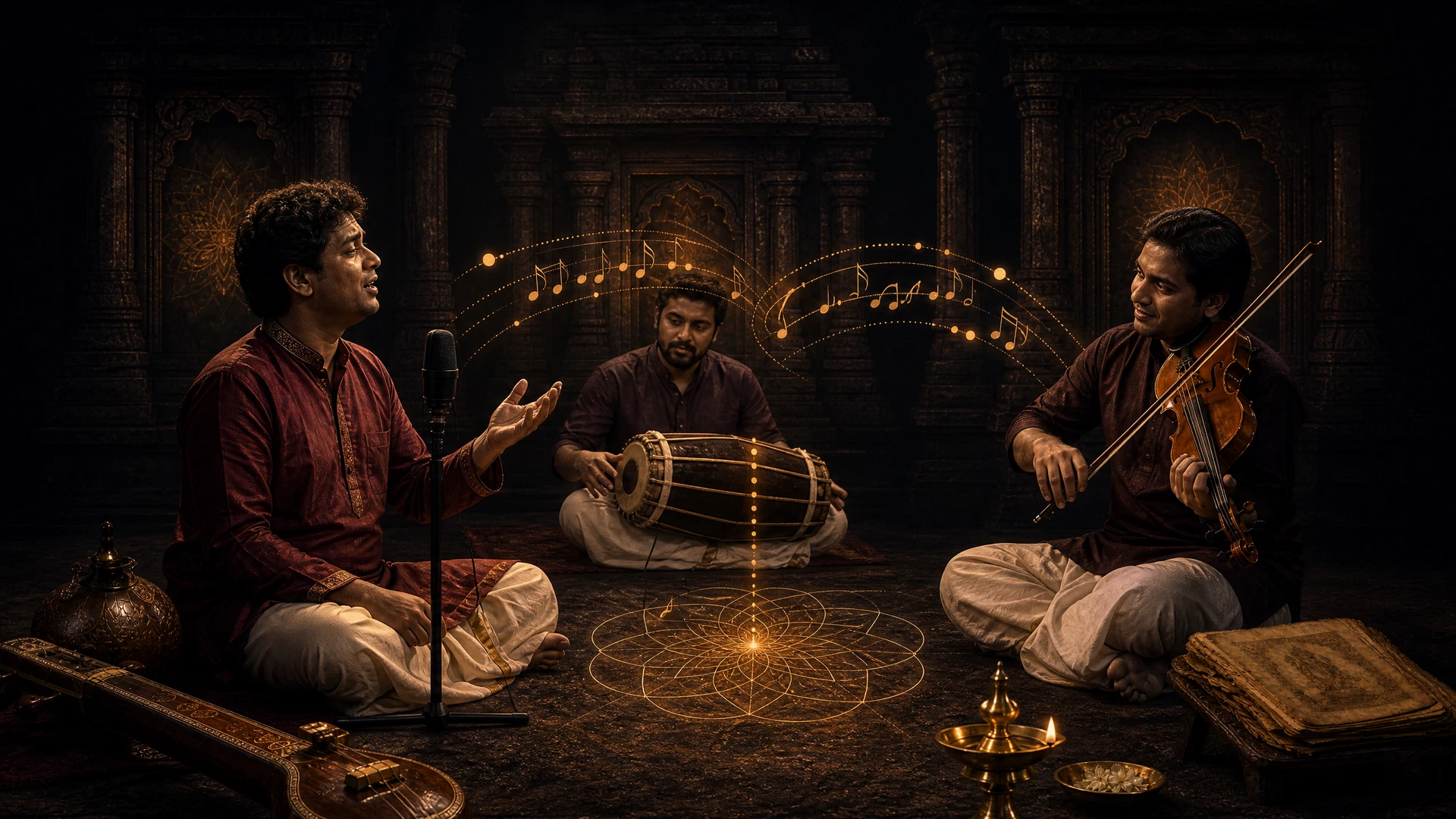
Quick Facts
- Kalpana swaras use solfa syllables such as sa, ri, ga, ma, pa, dha, and ni rather than a composition’s words.
- The phrases remain within the raga’s musical character.
- They build toward a return point linked to the tala and the chosen composition line.
- Faster passages are not the only thing to hear. The prepared landing is the real anchor.
- A listener can begin by hearing repetition, acceleration, and return without counting every subdivision.
Table of Contents
- [What Kalpana Swaras Are](#what-kalpana-swaras-are)
- [Why the Return Matters](#why-the-return-matters)
- [Listen for Shape Before Speed](#listen-for-shape-before-speed)
- [A First Listening Method](#a-first-listening-method)
- [How Kalpana Swaras Relate to Tala](#how-kalpana-swaras-relate-to-tala)
- [Wait for the Landing](#wait-for-the-landing)
What Kalpana Swaras Are
Kalpana swaras are improvised phrases sung through swara syllables. Instead of continuing with the lyric, the artist works with the sound of the notes themselves. HCL Concerts describes these as rhythmic swara patterns that return to a fixed point. Carnatic Corner similarly notes that the swara exposition ends at the exact tala location where the chosen line begins.
That may sound technical, but the listening experience is direct. You hear motion, anticipation, and a return that feels earned.
If the syllables themselves are unfamiliar, begin with Shruti, Swara, and Tala. You do not need to sing them before you can enjoy their rhythmic shape.
Why the Return Matters
The return is what keeps the passage connected to the composition. A listener may hear several increasingly lively swara phrases, but each one is preparing to meet the same point again.
| Part of the experience | What to notice |
|---|---|
| Swara phrase | Is it short, extended, rising, or descending? |
| Accompaniment | Does the violin or percussion increase the sense of motion? |
| Pause before the line | Does expectation gather? |
| Return | Does the familiar line feel newly illuminated? |
What makes this special is that the resolution is not a stop sign. It is a doorway into the next idea.
Listen for Shape Before Speed
It is easy to hear kalpana swaras as a display of speed. Speed may be present, but it is only one surface of the form. Start with shape. Does a phrase repeat with a small change? Does it become denser? Does the energy grow before the artist returns to the line?
This approach gives you something musical to follow even when the arithmetic is beyond your present knowledge. The Tala Guide can help when you are ready to explore the rhythmic frame more deliberately.
A First Listening Method
Watch the official YouTube video
Try this official Jaya Jayatu Srirama recording in three small passes. First, identify when words give way to swaras. Next, listen for a phrase that seems to repeat or develop. Finally, wait for the familiar lyrical return. You do not need to label every passage for the exercise to work.
How Kalpana Swaras Relate to Tala
Kalpana swaras are a clear place to hear melody and rhythm working together. The raga guides which phrases make musical sense. Tala guides where those phrases must arrive. Neither role is optional in a well-shaped passage.
For the larger picture, visit What Is Manodharma?. For a lyric-centred companion form, read Neraval Explained.
Frequently Asked Questions
Are kalpana swaras written in advance?
They are improvised in performance, although artists prepare through extensive study of raga, tala, compositions, and rhythmic practice.
Why do artists return to the same line?
The chosen line provides the rhythmic and compositional point where a swara phrase resolves. It gives the listener a recognisable arrival.
Do kalpana swaras always become fast?
No. They may begin simply, change speed, or remain measured. The pace depends on the musical context and the artist’s choices.
Can I keep tala while listening to kalpana swaras?
Yes, if you already know the tala. If not, listen for the return first. Hand gestures are useful when learned carefully, not as a requirement for appreciation.
What is the difference between kalpana swaras and neraval?
Kalpana swaras use solfa syllables. Neraval develops a chosen lyric line while keeping the words present.
Wait for the Landing
The most satisfying moment in kalpana swaras is often not the fastest phrase. It is the instant when many moving notes meet one familiar point. Let that return guide your ear.
Published by Medha Naada
This guide is published by Medha Naada, Medha Vidyabhushan's official portfolio. It combines the credited sources below with plain-language listening or learning prompts. Historical details, song credits, and public records are limited to the cited material.
A written guide can support listening and preparation, but a qualified teacher remains the right source for personal vocal technique, pronunciation feedback, or repertoire decisions.
How this guide is supported
The cited sources support the meaning and rhythmic return of kalpana swaras. The listening method is editorial guidance and avoids implying that a reader can infer an entire tala calculation from a first listen.
- Understanding Alapana, Neraval & Kalpana Swaras in Carnatic Music. HCL Concerts. Kalpana swaras as swara-syllable patterns that develop in relation to a fixed rhythmic return point.
- Improvisation in Carnatic Music. Mohan Ayyar. Kalpana swaras as raga-aware swara phrases that end at the tala position where a selected line begins.