Music Theory · 2026-06-15 · 10 min read
Shruti, Swara, and Tala: The Three Pillars of Indian Music Explained Simply
Every piece of Indian classical music rests on three foundations: shruti (pitch), swara (notes), and tala (rhythm). Here is what each one means, how they work together, and why understanding them changes how you hear music.
Quick Facts
- Indian classical music is built on three foundational concepts: shruti (pitch), swara (notes), and tala (rhythm).
- Shruti provides a relative tonal center, unlike the fixed pitch system in Western music.
- There are 22 microtones (shrutis) and 16 possible note positions (swaras) in an octave.
- The Carnatic system classifies melodies into 72 parent ragas (Melakarta system).
- Tala organizes time into complex rhythmic cycles, with Adi Tala (8 beats) being the most common.
- The teaching framework for these concepts was codified by Purandaradasa over four centuries ago.
If you have ever tried to understand Carnatic music or Hindustani music and felt overwhelmed by the terminology, start here. Everything in Indian classical music comes down to three concepts: shruti, swara, and tala. Once you understand these three, everything else falls into place.
Think of it like this: shruti is the canvas, swara is the paint, and tala is the frame. You need all three to make a painting.
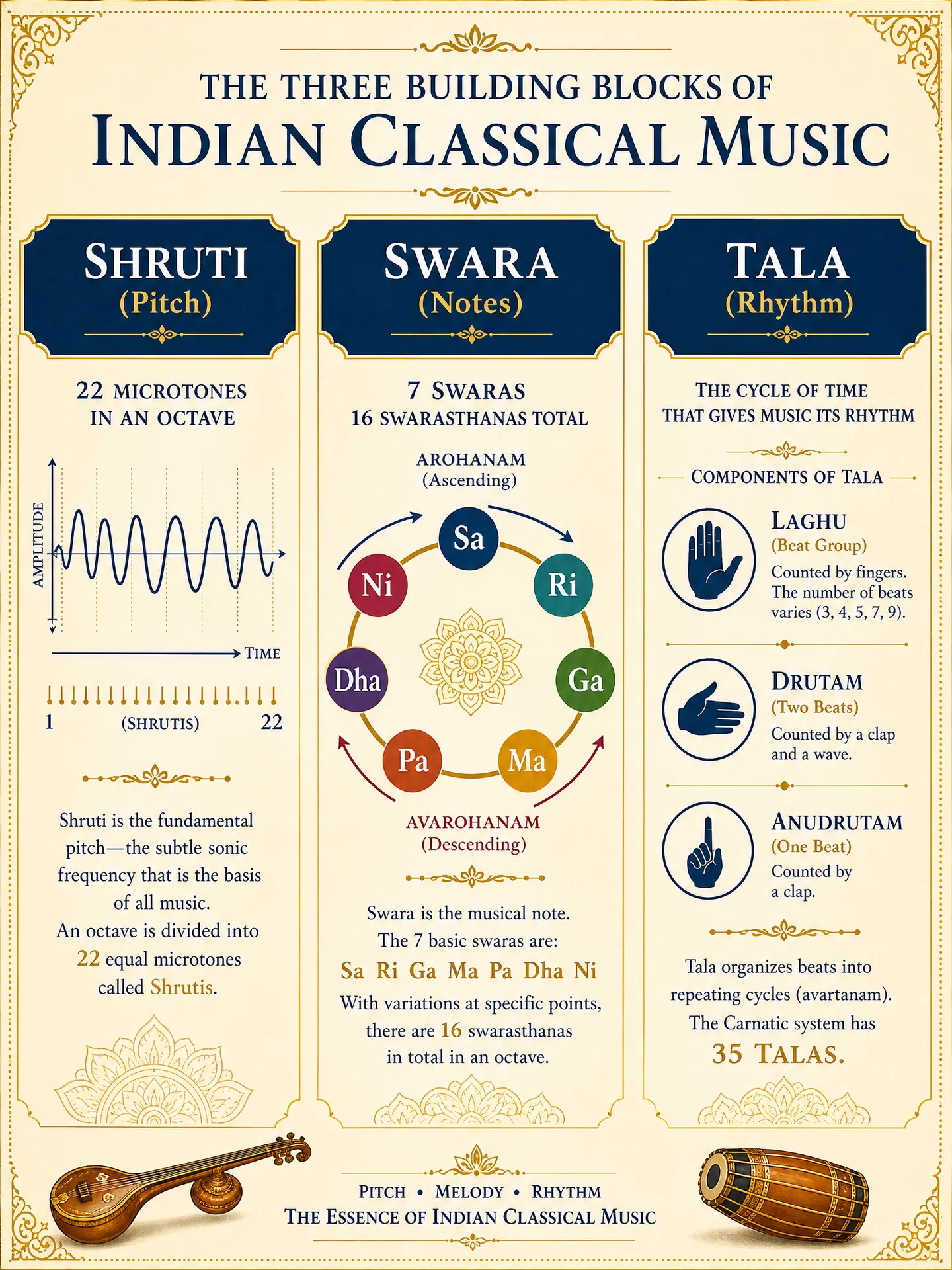
Table of Contents
- [Shruti: The Foundation of Pitch](#shruti-the-foundation-of-pitch)
- [Swara: The Seven Notes](#swara-the-seven-notes)
- [How Swaras Become Ragas](#how-swaras-become-ragas)
- [Tala: The Rhythm Framework](#tala-the-rhythm-framework)
- [How Tala Works in Practice](#how-tala-works-in-practice)
- [The Relationship Between the Three](#the-relationship-between-the-three)
- [Common Misconceptions](#common-misconceptions)
- [Practical Exercises for Beginners](#practical-exercises-for-beginners)
- [The Historical Evolution of the Raga System](#the-historical-evolution-of-the-raga-system)
- [The Role of Tala in Musical Presentation](#the-role-of-tala-in-musical-presentation)
- [Comparing the Three Pillars](#comparing-the-three-pillars)
Shruti: The Foundation of Pitch
Shruti is the most fundamental concept. It means "that which is heard" and refers to the basic pitch or tonal center of the music.
In Western music, you have a fixed pitch system. A is 440 Hz everywhere in the world. In Indian music, the pitch is relative. A singer chooses their own shruti (base pitch) based on their vocal range, and everything else is built relative to that.
This is why you hear that constant drone sound (the tambura or shruti box) in every Indian classical performance. That drone establishes the shruti. It is the reference point that everything else relates to.
There are technically 22 shrutis (microtones) in an octave in Indian music theory, compared to 12 semitones in Western music. This means Indian music recognizes finer gradations of pitch than Western music does. These microtonal differences are what give Indian music its characteristic richness and the ability to express subtle emotions.
Swara: The Seven Notes
Swara refers to the musical notes. Indian music has seven basic swaras, just like Western music has seven notes (Do Re Mi Fa Sol La Ti):
- Sa (Shadjam) - equivalent to Do/C
- Ri (Rishabham) - equivalent to Re/D
- Ga (Gandharam) - equivalent to Mi/E
- Ma (Madhyamam) - equivalent to Fa/F
- Pa (Panchamam) - equivalent to Sol/G
- Dha (Dhaivatam) - equivalent to La/A
- Ni (Nishadam) - equivalent to Ti/B
But here is the crucial difference: in Indian music, most of these notes have variants. Ri, Ga, Dha, and Ni each have three possible positions (lower, middle, higher). Ma has two positions. Only Sa and Pa are fixed.
This gives Indian music 16 possible note positions in an octave (compared to 12 in Western music), which allows for a much larger number of possible scales (ragas).
How Swaras Become Ragas
A raga is a specific selection of swaras with rules about how they can be used. It is not just a scale. It is a scale plus:
- Which notes to emphasize
- Which notes to skip in ascending vs. descending
- Which phrases are characteristic
- What mood it creates
- What time of day it belongs to
For example, Raga Kapi uses different notes going up than coming down. It skips certain notes in the ascending phrase but includes them while descending. These rules are what give each raga its unique personality.
The Carnatic system has 72 parent ragas (Melakarta system), and hundreds of derived ragas (janya ragas). The Hindustani system uses 10 parent scales (Thaat system) with similar derived ragas.
Tala: The Rhythm Framework
Tala is the rhythmic cycle that organizes time in Indian music. Unlike Western music where rhythm is measured in bars of 4 or 3 beats, Indian music uses cycles that can be 3, 4, 5, 7, 8, 9, or even 35 beats long.
The most common talas in Carnatic music:
- Adi Tala - 8 beats (the most common, used in most kritis)
- Rupaka Tala - 6 beats (used for lighter compositions)
- Misra Chapu - 7 beats (creates an asymmetric, driving rhythm)
- Khanda Chapu - 5 beats (another asymmetric tala)
Each tala has a specific pattern of strong and weak beats, counted using hand gestures:
- Clap (Laghu) - strong beat
- Wave (Drutam) - medium beat
- Finger count (Anudrutam) - weak beats between claps
How Tala Works in Practice
When you watch a Carnatic concert, you will see the singer keeping tala with their hand. They clap, wave, and count on their fingers in a repeating cycle. This is not just for show. It is how they keep track of where they are in the rhythmic cycle.
The beauty of the tala system is that it allows for incredible rhythmic complexity. A singer can sing phrases that span multiple tala cycles, creating tension, and then land perfectly on the first beat (sama) of a new cycle. That moment of resolution is one of the most satisfying experiences in Indian music.
The Relationship Between the Three
Here is how shruti, swara, and tala work together:
- Shruti establishes the pitch center (the drone)
- Swaras create the melodic content within that pitch framework
- Tala organizes the swaras in time
A composition (kriti) uses all three simultaneously. The Dasarapadas of Purandaradasa are excellent examples of how simple swaras in accessible talas can create profound music.
Common Misconceptions
"Indian music has no harmony." Not exactly. Indian music does not use chords the way Western music does, but the drone provides a constant harmonic reference. The interaction between the melody and the drone creates its own form of harmony.
"Indian music is all improvisation." No. Indian music has both composed and improvised elements. In Carnatic music, the compositions are highly structured. Improvisation happens within and around those structures.
"You need to understand theory to enjoy Indian music." Absolutely not. Theory helps you appreciate the technical skill, but the emotional impact of a raga works on everyone regardless of training. You do not need to know the name of a raga to feel its mood.
Practical Exercises for Beginners
If you want to develop your ear for Indian music:
- For shruti: Listen to a tambura drone for 5 minutes daily. Let it settle into your body. Notice how your breathing changes.
- For swara: Learn to sing Sa-Pa-Sa (the basic fifth interval). This is the most natural interval in music and the foundation of everything else.
- For tala: Clap along to any song in Adi Tala (8 beats). Count 1-2-3-4-5-6-7-8 and repeat. Notice where the song's phrases land relative to your count.
Frequently Asked Questions
What is the difference between shruti and swara?
Shruti is the base pitch or tonal center. Swara is a musical note defined relative to that shruti. Think of shruti as the starting point and swaras as the steps you take from that starting point.
How many swaras are there in Indian music?
There are 7 basic swara names (Sa, Ri, Ga, Ma, Pa, Dha, Ni), but with their variants, there are 16 possible note positions in an octave. Sa and Pa are fixed; the others have 2-3 variants each.
What is the most common tala in Carnatic music?
Adi Tala (8 beats) is by far the most common. The majority of Carnatic compositions, including most Dasarapadas and kritis, are set in Adi Tala.
Can I learn tala without a teacher?
You can learn the basic counting patterns from YouTube tutorials or apps. However, developing the ability to keep tala while singing or listening to complex music requires guidance from an experienced teacher.
Why is the drone so important in Indian music?
The drone (tambura or shruti box) provides the constant pitch reference against which all melodic movement is heard. Without it, the subtle relationships between notes that give ragas their character would be lost. It is the sonic foundation of the entire system.
The Historical Evolution of the Raga System
The concept of ragas, which forms the melodic framework of Indian classical music, has evolved significantly over centuries. While the basic principles of shruti and swara have ancient roots, the formal classification systems we use today developed much later.
In the Carnatic tradition, the foundation is the Melakarta system, which categorizes 72 parent ragas. Each of these parent ragas contains all seven swaras in both their ascending (arohana) and descending (avarohana) patterns. From these 72 parents, hundreds of derived ragas (janya ragas) are born.
Every raga is defined by several key elements:
- Arohana and Avarohana: The specific ascending and descending tonal hierarchy.
- Vadi and Samvadi: The most important and second most important notes, which act as focal points.
- Pakkad: A signature melodic motif or catchphrase that instantly identifies the raga.
The primary goal of any raga is the expression of a specific emotion, known as raga-rasa. For a deeper dive into how ragas are structured, you can read our Raga Guide for Beginners.
The Role of Tala in Musical Presentation
While swaras provide the melody, tala provides the rhythmic structure that brings a composition to life. The presentation of a raga often follows a structured progression that highlights both the melodic and rhythmic elements.
A typical performance might begin with an alap, a slow, unmetered exploration of the raga that establishes the mood without any rhythmic accompaniment. This is followed by sections that gradually introduce a steady pulse and eventually a formal tala cycle.
The integration of tala is crucial in composed pieces like kritis. The Haridasa movement played a significant role in making these complex musical structures accessible. Composers like Purandaradasa created a teaching framework that codified the learning of swaras and talas through exercises like sarali and alankara. This system, developed over four centuries ago, remains the foundation for all Carnatic music students today.
To understand more about the rhythmic cycles, check out our Tala Guide for Beginners.
Comparing the Three Pillars
To better understand how shruti, swara, and tala function together, it helps to look at their distinct roles in a musical performance.
| Concept | Musical Role | Western Equivalent | Key Characteristics |
|---|---|---|---|
| Shruti | Tonal center | Key or base pitch | Relative pitch, established by a drone, 22 microtones per octave |
| Swara | Melodic notes | Scale notes (Do Re Mi) | 7 basic notes, 16 possible positions, forms the basis of ragas |
| Tala | Rhythmic cycle | Time signature and meter | Cycles of varying lengths (e.g., 8, 7, 5 beats), specific patterns of strong and weak beats |
Understanding these three pillars is essential for anyone looking to appreciate the depth of Indian classical music. Whether you are listening to a complex concert piece or a simple devotional song, shruti, swara, and tala are always working together to create a unified musical experience.
Published by Medha Naada
This guide is published by Medha Naada, Medha Vidyabhushan's official portfolio. It combines the credited sources below with plain-language listening or learning prompts. Historical details, song credits, and public records are limited to the cited material.
A written guide can support listening and preparation, but a qualified teacher remains the right source for personal vocal technique, pronunciation feedback, or repertoire decisions.
How this guide is supported
This beginner guide uses practical, simplified definitions. The cited references support the core Shruti and tala concepts; swara examples and learning advice are editorial explanations for new listeners.
- Śruti. Encyclopaedia Britannica. Śruti as a perceptible tonal interval in Indian music.
- Tala. Encyclopaedia Britannica. Tala as a recurring metric cycle in Indian musical performance.
- A brief introduction to Carnatic music. Ludwig Pesch, Carnaticstudent. A Carnatic learning context for raga, tala, and early musical practice.