Concert Guide · 2026-07-15 · 9 min read
Going to a Carnatic Music Concert for the First Time: Everything You Need to Know
Walking into your first Carnatic concert can feel intimidating. Here is a practical, no-nonsense guide covering what to expect, how the concert flows, when to clap, and how to actually enjoy it even if you know nothing about classical music.
Quick Facts
- A traditional Carnatic concert is called a "kutcheri" and typically lasts 2 to 3 hours.
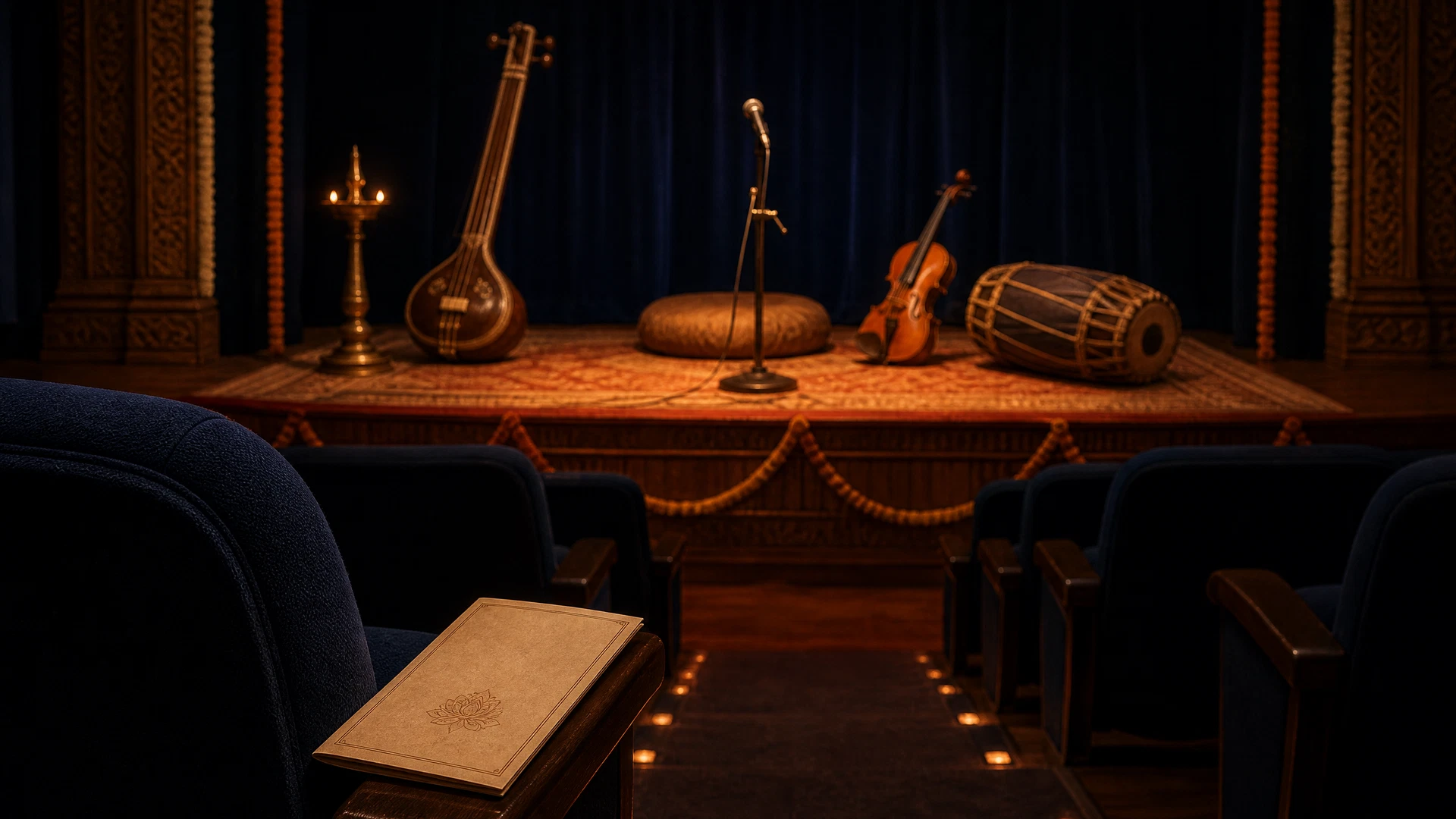
- The ensemble usually includes a main artist, a violinist, a mridangam player, and a tambura for the drone.
- The concert follows a structured flow, starting with a fast Varnam and peaking with the Ragam Tanam Pallavi.
- Audience participation is encouraged through keeping time (tala) and expressing appreciation at appropriate moments.
- Listening to Carnatic music has been scientifically shown to reduce stress and induce meditative brain states.
- The foundational teaching methods of this music were codified centuries ago by saints like Purandaradasa.
You have been invited to a Carnatic music concert. Maybe a friend dragged you along, maybe you heard a song on YouTube and got curious, or maybe you just want to understand what Carnatic music actually sounds like live. Whatever brought you here, this guide will make sure you are not sitting there confused for two hours.
The honest truth is that your first Carnatic concert might feel long. It might feel unfamiliar. But if you know what to listen for, it can also be one of the most absorbing musical experiences you will ever have.
Table of Contents
- [What Is a Kutcheri?](#what-is-a-kutcheri)
- [The Ensemble on Stage](#the-ensemble-on-stage)
- [How the Concert Flows](#how-the-concert-flows)
- [When to Clap and When to Stay Quiet](#when-to-clap-and-when-to-stay-quiet)
- [What to Wear](#what-to-wear)
- [What to Listen For (Even If You Know Nothing)](#what-to-listen-for-even-if-you-know-nothing)
- [Concerts by Young Artists](#concerts-by-young-artists)
- [Practical Tips](#practical-tips)
- [Where to Find Concerts](#where-to-find-concerts)
- [The Historical Roots of the Kutcheri Format](#the-historical-roots-of-the-kutcheri-format)
What Is a Kutcheri?
A traditional Carnatic concert is called a "kutcheri" (also spelled kacheri or katcheri). The word simply means "gathering" or "assembly." It has been the standard format for Carnatic performances for over 200 years.
A typical kutcheri lasts between 2 to 3 hours. The artist sits on a raised platform (usually cross-legged on a carpet), accompanied by a small ensemble. There is no conductor, no sheet music on stage, and no amplified backing track. Everything happens live, in the moment.
The Ensemble on Stage
When you walk in, you will typically see:
- The main artist (vocalist or instrumentalist) in the center
- A violinist sitting to the artist's left (your right)
- A mridangam player (barrel-shaped drum) to the artist's right
- Sometimes a ghatam player (clay pot) or a kanjira player (tambourine-like frame drum)
- A tambura or shruti box providing the drone (the constant background hum)
The violinist is not reading from a score. They are following the vocalist in real time, echoing every phrase the singer produces. This is one of the most remarkable aspects of Carnatic music. The accompanist has to anticipate and mirror the soloist's improvisation on the spot.
How the Concert Flows
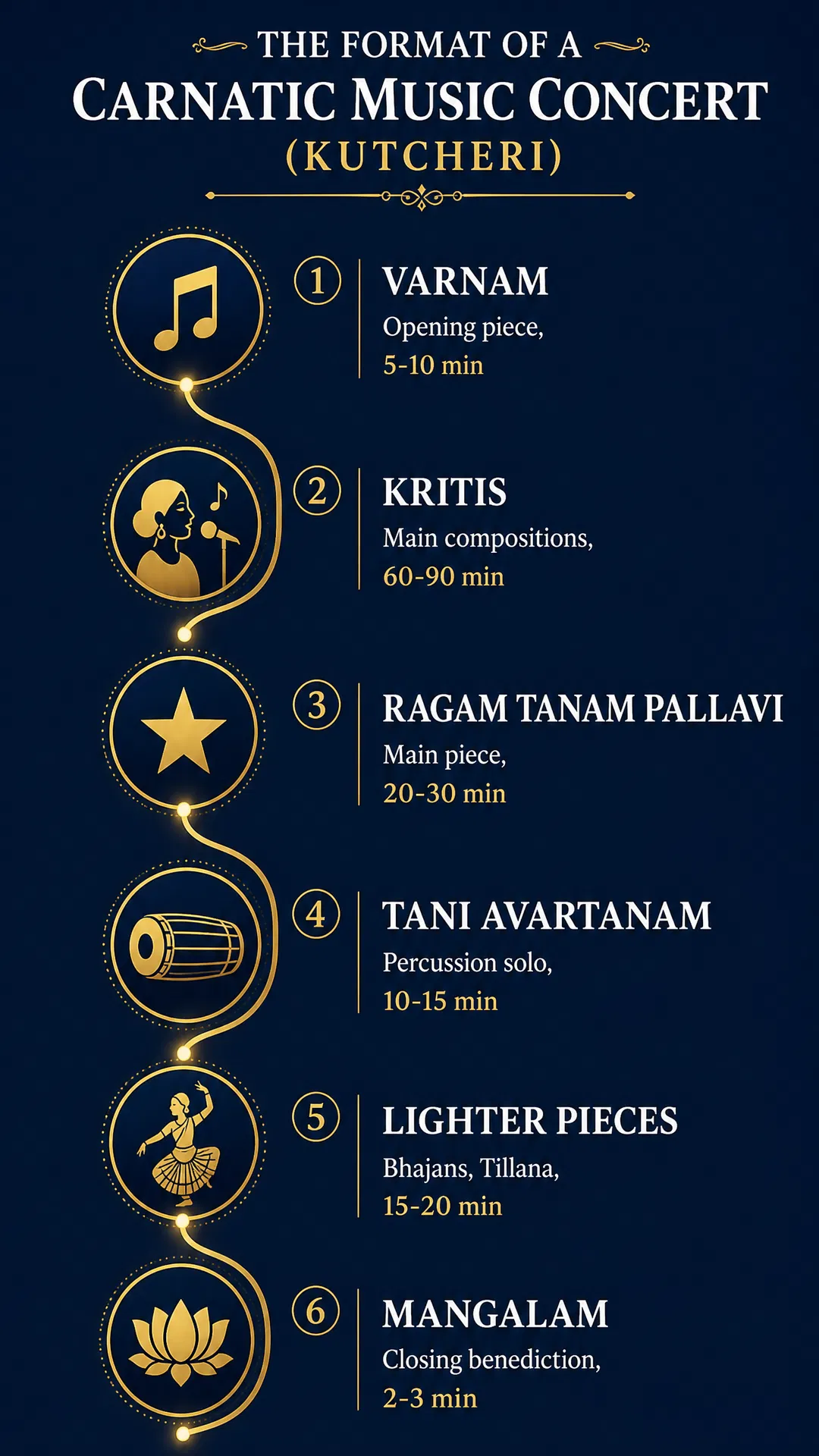
Here is the typical structure, broken down so you know what is happening at each stage:
-
Varnam (5-10 minutes): The opening piece. Think of it as a warm-up that showcases the artist's range. It is usually fast and energetic.
-
Kritis (60-90 minutes): These are the main compositions. Each kriti is a complete song with lyrics, set in a specific raga and tala. The artist will typically perform 4 to 6 kritis of varying mood and complexity.
-
Ragam Tanam Pallavi (20-30 minutes): This is the centerpiece. The artist picks one raga and explores it deeply through three stages: ragam (free-flowing melodic exploration), tanam (rhythmic elaboration without lyrics), and pallavi (a composed line that becomes the basis for complex improvisations).
-
Tani Avartanam (10-15 minutes): The percussion solo. The mridangam player (and any other percussionists) take center stage and have a conversation through rhythm.
-
Lighter Pieces (15-20 minutes): After the heavy main course, the concert winds down with bhajans, tillanas, or Dasarapadas. These are more accessible and often devotional.
-
Mangalam (2-3 minutes): The closing benediction. A short prayer piece that signals the concert is over.
When to Clap and When to Stay Quiet
This is the part that stresses first-timers out the most. Here are the rules:
- During an alapana (free improvisation): Stay quiet. This is the most meditative part. The artist is building a raga phrase by phrase, and any noise breaks the spell.
- After a particularly beautiful phrase: You can say "Bhesh!" or "Bale!" (both mean "wonderful" in different languages). A soft nod or smile works too.
- After a kriti ends: Clap. This is the natural break point.
- During kalpanaswaram (fast melodic improvisation): You can clap along to the rhythm if others are doing it. Many audience members keep tala (time) with their hands.
- After the tani avartanam (percussion solo): Definitely clap. The percussionists have earned it.
What to Wear
There is no strict dress code, but here is what you will typically see:
- Most audience members wear traditional Indian clothing (sarees, kurtas, dhotis)
- Smart casual is perfectly fine for most concerts
- Avoid anything too flashy or noisy (jangling jewelry, for example)
- Remove your shoes if the concert is in a temple or traditional sabha hall
What to Listen For (Even If You Know Nothing)
You do not need a music degree to enjoy a Carnatic concert. Here is what to pay attention to:
- The drone: That constant humming sound in the background. Let it settle into your body. It is the foundation everything else is built on.
- The conversation: Watch how the violinist mirrors the singer. It is like watching two people finish each other's sentences.
- The rhythm: Even if you cannot count the tala, notice how the music builds tension and then resolves. That moment of resolution (called the "sama") is deeply satisfying.
- The emotion: Carnatic music is not abstract. Each piece has a mood. Some are joyful, some are longing, some are playful. Let yourself feel it.
Concerts by Young Artists
If you are worried about sitting through a 3-hour concert by a senior artist, consider starting with a concert by one of the young Carnatic vocalists performing today. Artists like Medha Vidyabhushan often perform shorter concerts (60-90 minutes) that are more accessible for newcomers while still maintaining classical integrity.
Medha's concerts are particularly good entry points because she performs a mix of Dasarapadas, kritis, and devotional songs that have strong emotional content even if you do not understand the lyrics.
Practical Tips
- Arrive on time. Walking in during an alapana is disruptive.
- Put your phone on silent. This is not a suggestion.
- Do not leave during a piece. Wait for the gap between compositions.
- Bring water. Some concerts do not have intermissions.
- Sit where you can see the artist's hands. Watching the tala counting adds a visual dimension.
- Do not worry about understanding everything. Nobody does at their first concert. Or their tenth.
Where to Find Concerts
- Sabhas (music organizations) in Chennai, Bengaluru, Mysuru, and Hyderabad host regular concerts
- Temple festivals often include free Carnatic concerts
- YouTube has thousands of full-length concert recordings if you want to practice listening at home
- Check local Indian cultural associations if you are outside India
Frequently Asked Questions
How long does a Carnatic music concert last?
A typical full-length kutcheri lasts 2 to 3 hours. Shorter concerts (60-90 minutes) are common for younger artists or festival settings. There is usually no intermission, though some venues add a short break.
Do I need to understand the language to enjoy the concert?
No. While the lyrics are in Telugu, Kannada, Tamil, or Sanskrit, the emotional content comes through the music itself. Many regular concert-goers do not understand every word but still find the experience deeply moving.
Is it okay to leave in the middle if I need to?
Yes, but wait for a gap between pieces. Do not walk out during an alapana or mid-composition. The gaps between songs are the appropriate time to enter or exit.
What is the difference between a sabha concert and a temple concert?
A sabha concert is held in a formal auditorium with ticketed seating. A temple concert is usually free, held in the temple premises, and often part of a religious festival. The music quality can be equally high in both settings.
Can children attend Carnatic concerts?
Yes, and many parents bring children specifically to expose them to classical music early. However, very young children who cannot sit still for extended periods might be better suited to shorter concerts or temple performances where movement is less disruptive.
The Historical Roots of the Kutcheri Format
While the modern kutcheri format has been standard for about 200 years, the musical traditions it showcases have much deeper historical roots. The structure of the compositions, especially the kritis and devotional pieces, owes a great deal to the Haridasa movement in Karnataka history.
During the 13th to 14th centuries, saints like Purandaradasa and Kanakadasa revolutionized how music was taught and performed. Purandaradasa, often called the father of Carnatic music, codified the teaching methods that are still used today. He introduced the foundational exercises like sarali and jantai, which every artist on stage has practiced extensively.
The influence of these early composers is still felt in every concert. When an artist performs a lighter piece towards the end of the concert, it is often a composition by one of these great saints.
Key Figures in Carnatic Music History
| Composer | Contribution | Pen Name (Ankita Nama) |
|---|---|---|
| Purandaradasa | Codified teaching methods, composed many songs | Purandara Vittala |
| Kanakadasa | Wrote profound philosophical poetry and music | Kaginele Adikeshava |
| Sripadaraya | Early pioneer of the Haridasa movement | Sriranga Vittala |
Understanding this history adds a layer of depth to your concert experience. When you hear a piece by Purandaradasa, the father of Carnatic music, you are listening to a tradition that has been passed down for centuries.
Published by Medha Naada
This guide is published by Medha Naada, Medha Vidyabhushan's official portfolio. It combines the credited sources below with plain-language listening or learning prompts. Historical details, song credits, and public records are limited to the cited material.
A written guide can support listening and preparation, but a qualified teacher remains the right source for personal vocal technique, pronunciation feedback, or repertoire decisions.
How this guide is supported
This concert guide offers practical, welcoming advice for first-time listeners. Traditional expectations can differ by venue and artist, so the cited etiquette context is presented as guidance rather than a fixed rulebook.
- Indian Music Etiquette for Listeners. Jameela Siddiqi, Darbar. Listener etiquette and audience context for Indian classical music settings.
- Carnatic Music: A Computational Perspective. Hema A. Murthy, IIT Madras and CompMusic. The sequence of concert items, common forms, improvisational sections, and main-item structure from a listener's perspective.