Carnatic Music · 2026-07-10 · 7 min read
Why Indian Ragas Are Tied to Specific Times of Day (And Which Ones to Listen to When)
In Indian classical music, every raga belongs to a specific time of day. Morning ragas sound wrong at night. Evening ragas lose their magic at dawn. Here is why this system exists and which ragas to play at each hour.
Quick Facts
- This guide explains Why Indian Ragas Are Tied to Specific Times of Day (And Which Ones to Listen to When) within the site's Carnatic Music learning collection.
- Factual context and practical listening or study suggestions are presented separately.
- Use the linked source notes and related guides when you want to explore the topic further.
Table of Contents
- [The Basic Idea](#the-basic-idea)
- [The Eight Prahars and Their Ragas](#the-eight-prahars-and-their-ragas)
- [What Happens If You Break the Rules?](#what-happens-if-you-break-the-rules)
- [How This Applies to Everyday Listening](#how-this-applies-to-everyday-listening)
- [The Tamil Pannisai Tradition](#the-tamil-pannisai-tradition)
- [The Melodic Framework and Emotional Expression](#the-melodic-framework-and-emotional-expression)
The Basic Idea
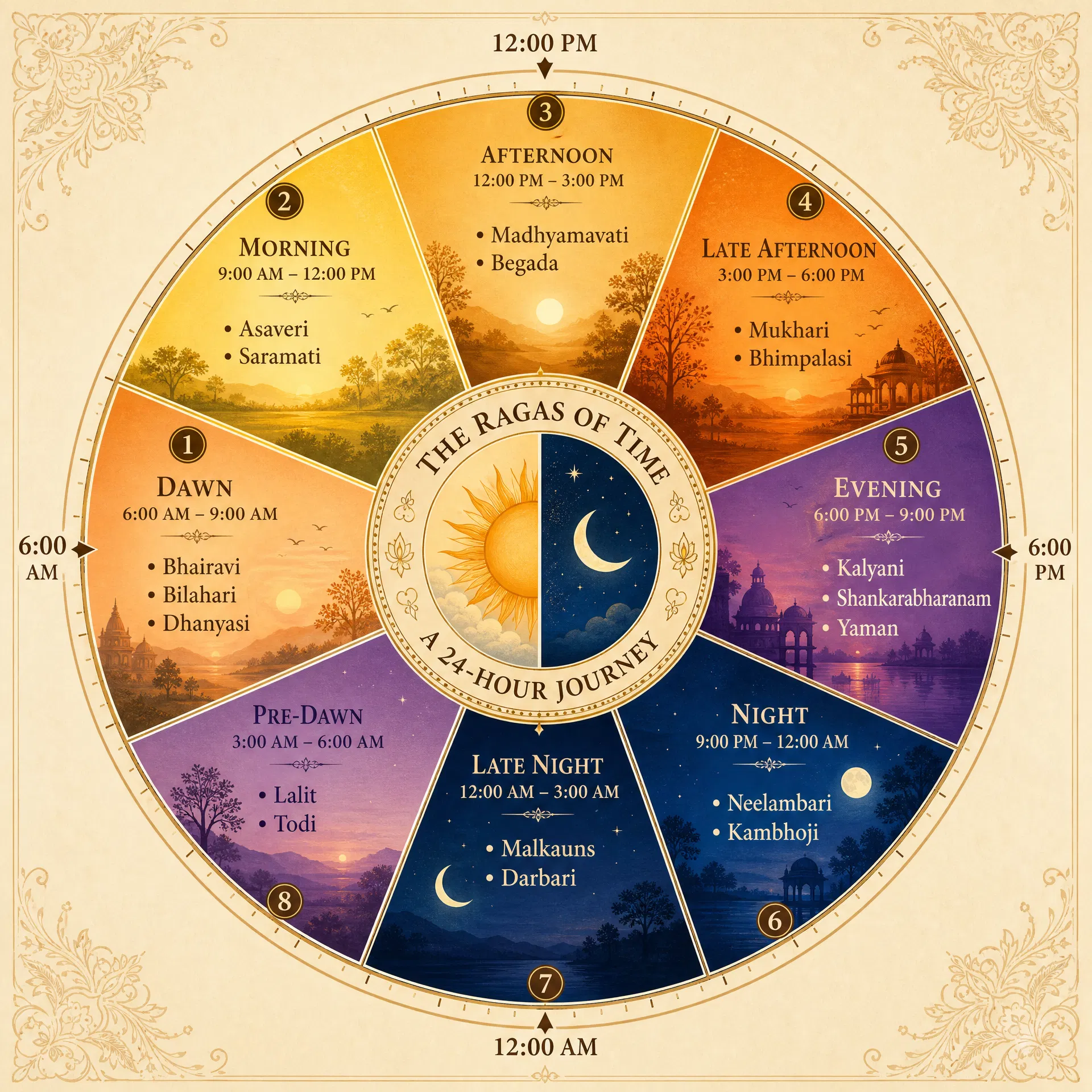
The ancient texts divide the day into eight "prahars" (watches) of three hours each. Each prahar has a different quality of light, a different mood in nature, and a different state of mind in the listener. The ragas assigned to each prahar use note combinations that resonate with that particular state.
The underlying principle is this: certain note combinations create certain moods. And those moods align with the natural rhythm of the day. A raga that uses flat (komal) notes tends to create a more introspective, serious mood, which suits the quieter hours. A raga that uses sharp (tivra) notes tends to create brightness and energy, which suits the active hours.
The Eight Prahars and Their Ragas
1. Pre-Dawn (3 AM to 6 AM)
This is the Brahma Muhurta, considered the most sacred time for spiritual practice. The ragas here are deeply meditative.
- Carnatic: Bhairavi, Todi
- Hindustani: Lalit, Todi, Bhairav
These ragas use flat notes extensively, creating an atmosphere of stillness and introspection. Many musicians practice at this hour specifically because the body and mind are most receptive to subtle musical nuances.
2. Dawn (6 AM to 9 AM)
As light enters the world, the ragas become gentler and more devotional. This is when most devotional music is traditionally performed.
- Carnatic: Bilahari, Dhanyasi, Bowli
- Hindustani: Bhairav, Ahir Bhairav, Jogiya
Many of Purandaradasa's compositions are set in morning ragas because they were meant to be sung as part of the morning prayer routine.
3. Morning (9 AM to 12 PM)
The energy picks up. These ragas are bright, confident, and active.
- Carnatic: Asaveri, Saramati, Devagandhari
- Hindustani: Alhaiya Bilawal, Deshkar
4. Afternoon (12 PM to 3 PM)
The hottest part of the day. Ragas here tend to be serious, weighty, and contemplative.
- Carnatic: Madhyamavati, Begada, Sriranjani
- Hindustani: Sarang, Bhimpalasi (early afternoon)
5. Late Afternoon (3 PM to 6 PM)
As the day begins to cool, the ragas take on a bittersweet quality. There is a sense of the day ending.
- Carnatic: Mukhari, Sahana
- Hindustani: Multani, Patdeep, Bhimpalasi
6. Evening (6 PM to 9 PM)
This is the golden hour for Indian classical music. The most beloved and frequently performed ragas belong to this time.
- Carnatic: Kalyani, Shankarabharanam, Mohanam
- Hindustani: Yaman, Puriya, Marwa
Raga Kapi, which is used in many popular compositions including Jagadodharana, is an evening raga in the Carnatic tradition.
7. Night (9 PM to 12 AM)
Deep, rich, and often romantic. Night ragas create an intimate atmosphere.
- Carnatic: Neelambari, Kambhoji, Kaanada
- Hindustani: Darbari Kanada, Malkauns, Bageshri
Neelambari is specifically known as the "lullaby raga" and is traditionally used to put children to sleep.
8. Late Night (12 AM to 3 AM)
The deepest, most mysterious ragas. These are rarely performed in concerts but are considered the pinnacle of meditative music.
- Carnatic: Anandabhairavi (late night variant)
- Hindustani: Malkauns, Darbari (extended)
What Happens If You Break the Rules?
In modern concert practice, these rules are relaxed considerably. A concert in the evening might include a morning raga if the artist feels it fits the program. Nobody will throw you out for singing Bhairavi at 8 PM.
But experienced listeners will tell you that something feels "off" when a raga is performed at the wrong time. It is like eating breakfast food for dinner. You can do it, but it does not feel quite right.
How This Applies to Everyday Listening
You do not need to be strict about this in your daily life. But if you want to experiment:
- Morning commute: Try Bilahari, Hamsadhwani, or Shankarabharanam for energy
- Work focus: Kalyani or Mohanam for clarity and brightness
- Evening wind-down: Kambhoji or Sahana for gentle relaxation
- Before sleep: Neelambari or Anandabhairavi for deep calm
Medha Vidyabhushan's renditions of evening and night ragas are particularly popular for relaxation. Her version of compositions in Neelambari and Kambhoji have been specifically mentioned by listeners as helpful for sleep and meditation.
The Tamil Pannisai Tradition
It is worth noting that the Tamil devotional music tradition (Tevaram, Tiruppugazh) has its own time classification called "Pannisai." The 103 panns (ancient Tamil ragas) are divided into:
- Pakalpann (daytime ragas)
- Iravupann (nighttime ragas)
- Podupann (all-time ragas)
This parallel system confirms that the time-raga connection is not unique to one region. It is a pan-Indian understanding of how sound and time interact.
Frequently Asked Questions
Why are ragas sung at specific times of the day?
The system is based on the observation that certain note combinations create certain psychological states, and those states align with the body's natural circadian rhythm. Flat notes suit the quieter, introspective hours while sharp notes suit the active, energetic hours.
What happens if I listen to a night raga in the morning?
Nothing bad will happen. You will not be cursed. But experienced listeners report that ragas feel most natural and powerful when heard at their designated time. The emotional impact is strongest when the music aligns with your body's natural state.
Which raga is best for studying or concentration?
Ragas like Kalyani, Hamsadhwani, and Mohanam are often recommended for focus and mental clarity. These are bright, energetic ragas that promote alertness without being overly stimulating.
Which raga helps with sleep?
Neelambari is traditionally known as the "lullaby raga" and is specifically used to induce sleep. Anandabhairavi and Nilambari are also excellent choices for bedtime listening.
Are these time rules followed strictly in modern concerts?
Not strictly. Modern concerts often include ragas from different time periods to provide variety. However, many artists still prefer to program their concerts with some awareness of the time-raga relationship, especially for the opening and closing pieces.
The Melodic Framework and Emotional Expression
The concept of time-specific ragas is deeply tied to the broader melodic framework of Indian classical music. Each raga is built upon a specific tonal hierarchy, featuring an ascending pattern (arohana) and a descending pattern (avarohana). Beyond just the notes, every raga has a primary note (vadi-swar), a secondary note (samvadi-swar), and a signature motif (pakkad) that gives it a distinct identity.
The primary goal of this intricate system is the expression of specific emotions, known as raga-rasa. The ancient texts identify various emotional states that ragas can evoke, including:
- Peace and tranquility
- Devotion and spiritual longing
- Romance and passion
- Strength and courage
- Sadness and introspection
This emotional depth is why understanding the basics of shruti, swara, and tala is essential for fully appreciating how a raga unfolds from its slow, unmetered introduction (alap) to its rhythmic conclusion.
Published by Medha Naada
This guide is published by Medha Naada, Medha Vidyabhushan's official portfolio. It combines the credited sources below with plain-language listening or learning prompts. Historical details, song credits, and public records are limited to the cited material.
A written guide can support listening and preparation, but a qualified teacher remains the right source for personal vocal technique, pronunciation feedback, or repertoire decisions.
How this guide is supported
This guide uses time of day as a listening framework, not a rulebook. Prahar is principally documented in Hindustani performance tradition, while Carnatic music has much less fixed time significance; the article’s clock, Carnatic examples, and listening suggestions are editorial context rather than mandatory performance prescriptions.
- A Cross-cultural Examination of Raga Perception and Time-of-day. Rhythm Jain and Claire Arthur, Georgia Tech Computational and Cognitive Musicology Lab. Research context for eight roughly three-hour prahars in Hindustani music, time-of-performance associations, and the study’s caution that Carnatic music has far less time-of-day significance.
- What is Prahar? Time theory in Indian Classical Music. Jameela Siddiqi, Darbar. An attributed explanation of prahar, sun-relative time segments, the historical North Indian time theory, and how recorded listening has made adherence less strict.