Indian Classical Music · 2026-07-18 · 9 min read
Carnatic Music vs Hindustani Music: What Actually Makes Them Different
Both come from the same ancient roots, but Carnatic and Hindustani music evolved into very different traditions. Here is a clear, jargon-free comparison covering ragas, instruments, performance style, and which one might suit you better.
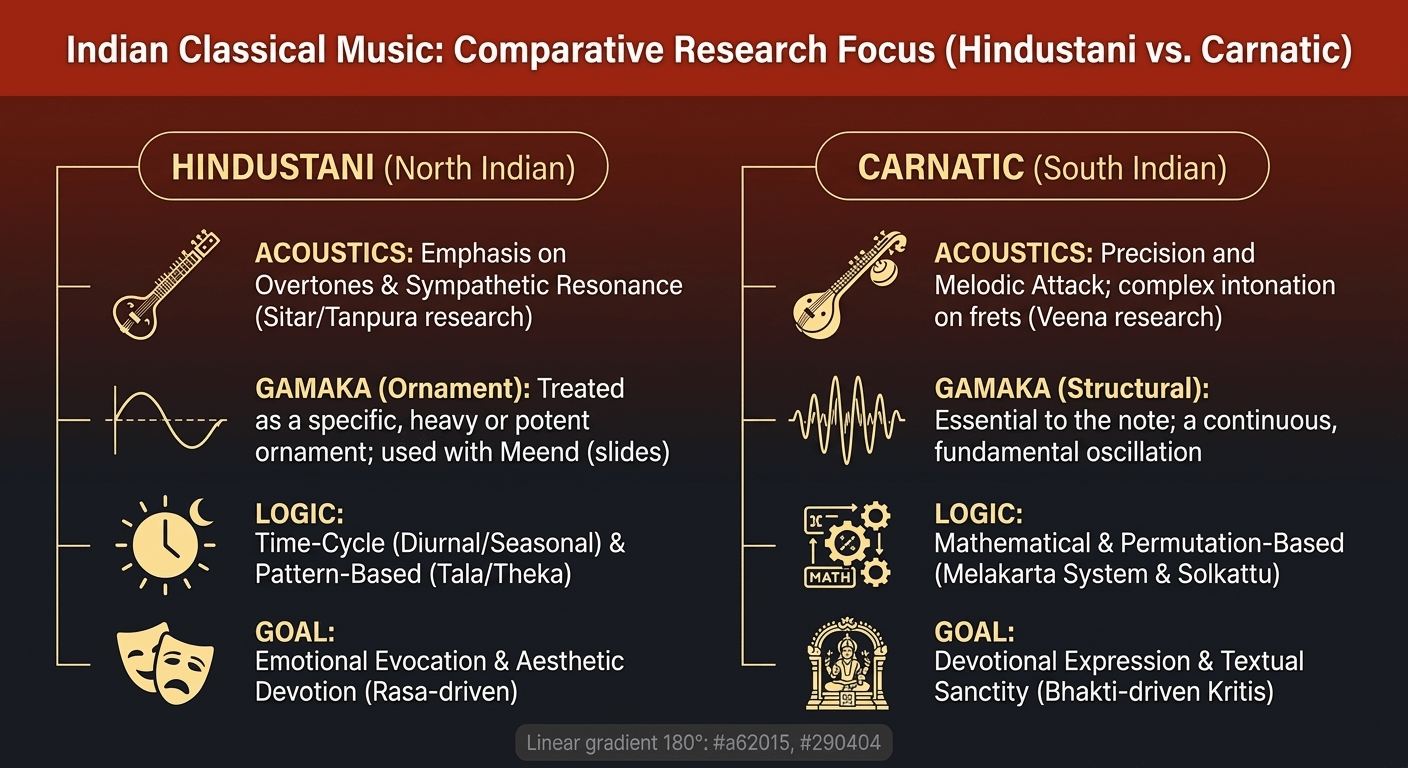
Quick Facts
- Carnatic and Hindustani music originated from the same ancient tradition, diverging around the 12th and 13th centuries.
- Carnatic music relies on the Melakarta system with 72 parent ragas, while Hindustani uses the Thaat system with 10 parent scales.
- Carnatic performances emphasize composed pieces (kritis), whereas Hindustani focuses heavily on improvisation (alap).
- The two systems share the same seven swaras (notes) but differ significantly in ornamentation techniques (gamaka vs. meend).
- Both traditions have distinct rhythmic approaches, with Carnatic singers keeping the tala themselves and Hindustani relying on the tabla player.
People ask this question all the time. What is the difference between Carnatic and Hindustani music? If you grew up in India, you probably have a rough idea. One is from the South, one is from the North. But the actual differences go much deeper than geography.
Both systems started from the same source. Around the 12th and 13th centuries, what was once a single tradition of Indian classical music began splitting into two branches. The northern branch absorbed Persian and Central Asian influences during the Mughal period. The southern branch stayed closer to the temple and bhakti traditions. Over 700 years, they evolved into two distinct musical languages.
Table of Contents
- [The Short Answer](#the-short-answer)
- [The Raga Systems](#the-raga-systems)
- [How Rhythm Works Differently](#how-rhythm-works-differently)
- [The Ornamentation](#the-ornamentation)
- [The Instruments](#the-instruments)
- [The Languages](#the-languages)
- [Performance Style](#performance-style)
- [Which One Should You Listen To?](#which-one-should-you-listen-to)
- [The Overlap](#the-overlap)
- [The Historical Divergence](#the-historical-divergence)
- [Raga Presentation and Structure](#raga-presentation-and-structure)
- [Key Differences at a Glance](#key-differences-at-a-glance)
The Short Answer
If you want the simplest possible explanation: Carnatic music is built around compositions. Hindustani music is built around improvisation.
In a Carnatic concert, the singer performs composed pieces (kritis, varnams, padas) and improvises within and around those compositions. The composition is the star. In a Hindustani concert, the singer takes a raga and explores it freely for 20 to 40 minutes, with the composition serving as just a launching point.
The Raga Systems
This is where things get technical, but I will keep it simple.
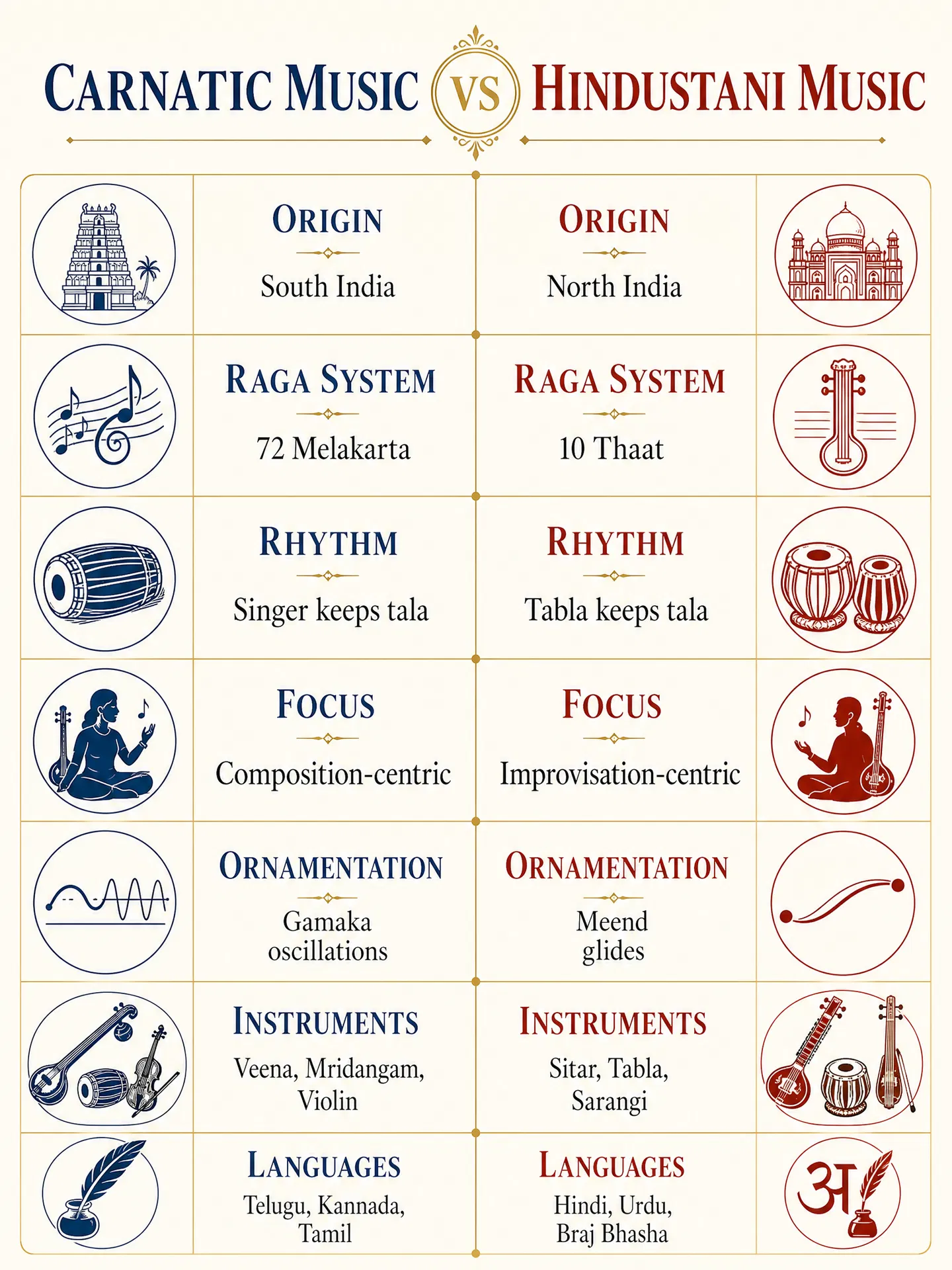
Both systems use ragas (melodic frameworks), but they organize them differently:
- Carnatic music uses the Melakarta system with 72 parent ragas. Every raga in the system can be traced back to one of these 72 scales.
- Hindustani music uses the Thaat system with just 10 parent scales. It is a simpler classification, but the ragas themselves are no less complex.
The ragas often share names across the two systems but sound completely different. Raga Kapi in Carnatic music, for example, uses different ornamentations than its Hindustani counterpart.
How Rhythm Works Differently
In Carnatic music, the singer keeps the tala (rhythm cycle) themselves, usually by counting with hand gestures. You will see Carnatic singers tapping their thigh or counting on their fingers while they sing. The tala system is deeply embedded in the singer's body.
In Hindustani music, the tabla player keeps the tala. The singer is free to float above the rhythm, sometimes singing phrases that stretch across multiple cycles before landing back on the beat. This gives Hindustani music its characteristic meditative quality.
The Ornamentation
This is the biggest audible difference for most listeners.
Carnatic music uses gamakas, which are heavy, continuous oscillations between notes. When a Carnatic singer sings a note, it is rarely a plain, straight tone. It shakes, it bends, it oscillates. This gives Carnatic music its characteristic "wavy" sound.
Hindustani music uses meend, which are smooth, slow glides from one note to another. The transitions are more gradual and linear. This gives Hindustani music its characteristic "flowing" quality.
If Carnatic ornamentation is like a vibrating string, Hindustani ornamentation is like water flowing downhill.
The Instruments
Carnatic music traditionally features:
- Veena (the oldest stringed instrument in the tradition)
- Mridangam (barrel-shaped drum)
- Violin (adopted from the West in the 18th century)
- Ghatam (clay pot percussion)
- Flute (bamboo, side-blown)
Hindustani music traditionally features:
- Sitar (long-necked plucked string)
- Tabla (pair of hand drums)
- Sarangi (bowed string)
- Harmonium (keyboard, used for accompaniment)
- Bansuri (bamboo flute, end-blown)
The Languages
Carnatic compositions are primarily in:
- Telugu (the majority of the Trinity's compositions)
- Kannada (Dasarapadas and Haridasa literature)
- Tamil (Tevaram, Tiruppugazh)
- Sanskrit (used across all regions)
Hindustani compositions are primarily in:
- Hindi and Braj Bhasha (most khayal bandishes)
- Urdu (ghazals, qawwali)
- Sanskrit (dhrupad compositions)
- Punjabi (light classical forms)
Performance Style
A typical Carnatic concert lasts 2 to 3 hours and follows a fairly fixed format. You start with a varnam, move through several kritis of increasing complexity, reach a main piece (Ragam Tanam Pallavi), have a percussion solo, and end with lighter devotional pieces.
A typical Hindustani concert is more open-ended. The artist might spend 45 minutes on a single raga, starting with a slow, unmetered alap and gradually building intensity through jod, jhala, and finally a composed piece with tabla accompaniment.
Which One Should You Listen To?
There is no right answer here. But here are some general pointers:
- If you like structured, rhythmically complex music with lots of variety in a single concert, try Carnatic.
- If you like meditative, slowly unfolding music that builds over time, try Hindustani.
- If you like devotional content with philosophical depth, Carnatic devotional music (especially the Haridasa tradition) is a great entry point.
- If you like instrumental music, Hindustani has a slight edge with its sitar and sarod traditions.
The Overlap
Despite all these differences, the two systems share far more than they differ. Both use the same seven swaras (Sa Ri Ga Ma Pa Dha Ni). Both believe in the spiritual power of sound. Both have produced extraordinary artists who have dedicated their lives to the pursuit of musical truth.
Many modern artists, including Medha Vidyabhushan, draw from both traditions. Her international performances often include explanations of how both systems relate to each other, helping global audiences understand the full picture of Indian classical music.
Frequently Asked Questions
Which is older, Carnatic or Hindustani music?
Both evolved from the same ancient tradition described in the Natya Shastra (2nd century BCE) and Sangita Ratnakara (13th century CE). They began diverging around the 12th-13th centuries. Neither is "older" than the other since they share the same roots.
Can a Carnatic musician sing Hindustani music and vice versa?
Yes, many musicians are trained in both systems. However, the ornamentation techniques (gamaka vs meend) and performance conventions are different enough that switching between them requires dedicated practice. Some artists like Shankar Mahadevan and Bombay Jayashri are known for their comfort in both traditions.
Is one system more difficult than the other?
Neither is inherently more difficult. Carnatic music demands precision in rhythm and ornamentation. Hindustani music demands patience and the ability to develop a raga over extended periods. They test different musical abilities.
Why does Carnatic music sound "faster" than Hindustani music?
Carnatic concerts typically include more compositions in a given time period, and the rhythmic patterns (kalpanaswaram, niraval) tend to be faster and more mathematically complex. Hindustani music deliberately takes time to unfold a raga slowly, which gives it a more meditative pace.
Which system is better for meditation and relaxation?
Both have ragas specifically suited for meditation and calm. In Carnatic music, ragas like Neelambari and Anandabhairavi are known for their soothing qualities. In Hindustani music, ragas like Yaman, Bhimpalasi, and Darbari are popular for relaxation. Medha Vidyabhushan's devotional renditions in Carnatic ragas are specifically noted for their calming effect.
The Historical Divergence
The split between Carnatic and Hindustani music is deeply rooted in the historical and cultural shifts of the Indian subcontinent. Prior to the 12th century, Indian classical music was largely a unified tradition, heavily influenced by ancient texts like the Natya Shastra and Sangita Ratnakara. However, the arrival of Persian and Central Asian influences during the Mughal period catalyzed a transformation in the northern regions. This led to the development of Hindustani music, which absorbed these new elements, resulting in a more improvisational and fluid style.
In contrast, the southern regions remained relatively insulated from these external influences. Carnatic music stayed closely tied to the temple and bhakti (devotional) traditions, preserving a more structured and composition-centric approach. This historical divergence explains why, despite sharing the same foundational concepts like ragas (melodic frameworks) and talas (rhythmic cycles), the two systems sound so distinct today. For a deeper understanding of the foundational elements, you can explore the shruti, swara, and tala basics.
Raga Presentation and Structure
While both systems utilize ragas to evoke specific emotions (rasas), their presentation and structural organization differ significantly. In Carnatic music, the melodic framework is governed by the Melakarta system, which categorizes 72 parent ragas. Each raga has a defined ascending (arohana) and descending (avarohana) pattern, and the performance is heavily structured around compositions.
Hindustani music, on the other hand, relies on the Thaat system, which groups ragas into 10 parent scales. The presentation of a raga in Hindustani music is highly improvisational, typically beginning with a slow, unmetered alap, followed by jod and jhala, and culminating in a composed piece (gat) with rhythmic accompaniment. This structural difference highlights the varying emphasis on composition versus improvisation in the two traditions. To learn more about specific ragas, check out our raga guide for beginners.
Key Differences at a Glance
To better understand the distinctions between Carnatic and Hindustani music, here is a comparison of their core elements:
| Feature | Carnatic Music | Hindustani Music |
|---|---|---|
| Primary Focus | Compositions (Kritis, Varnams) | Improvisation (Alap, Khayal) |
| Raga System | Melakarta (72 parent ragas) | Thaat (10 parent scales) |
| Ornamentation | Gamaka (heavy, continuous oscillations) | Meend (smooth, slow glides) |
| Rhythm (Tala) | Kept by the singer (hand gestures) | Kept by the tabla player |
| Key Instruments | Veena, Mridangam, Ghatam | Sitar, Tabla, Sarangi |
| Primary Languages | Telugu, Kannada, Tamil, Sanskrit | Hindi, Urdu, Braj Bhasha, Sanskrit |
Understanding these differences not only enhances your appreciation of Indian classical music but also helps you navigate the rich repertoire of both traditions. Whether you are drawn to the structured complexity of Carnatic music or the meditative flow of Hindustani music, both offer profound musical experiences. For those interested in the rhythmic aspects, our tala guide for beginners provides further insights.
Published by Medha Naada
This guide is published by Medha Naada, Medha Vidyabhushan's official portfolio. It combines the credited sources below with plain-language listening or learning prompts. Historical details, song credits, and public records are limited to the cited material.
A written guide can support listening and preparation, but a qualified teacher remains the right source for personal vocal technique, pronunciation feedback, or repertoire decisions.
How this guide is supported
This comparison is a simplified starting point for listeners. The cited research supports high-level regional and historical framing, while the examples and listening recommendations are editorial.
- Saraga: Open Datasets for Research on Indian Art Music. Ajay Srinivasamurthy, Sankalp Gulati, Rafael Caro Repetto, and Xavier Serra, eMusicology. High-level regional and historical context for Carnatic and Hindustani traditions within Indian art music.
- Unity in diversity. Shailaja Khanna, The Hindu. A Sangeet Natak Akademi workshop account of broad differences in raga treatment, concert presentation, and composition use.