Musical Journey · 2026-05-28 · 12 min read
Performing Carnatic Music Internationally: What It Takes to Bring Indian Classical Music Abroad
Taking Carnatic music to international audiences involves more than just booking a flight. Here is what the experience is really like, from the challenges of cross-cultural performance to the joy of connecting with listeners who have never heard a raga before.
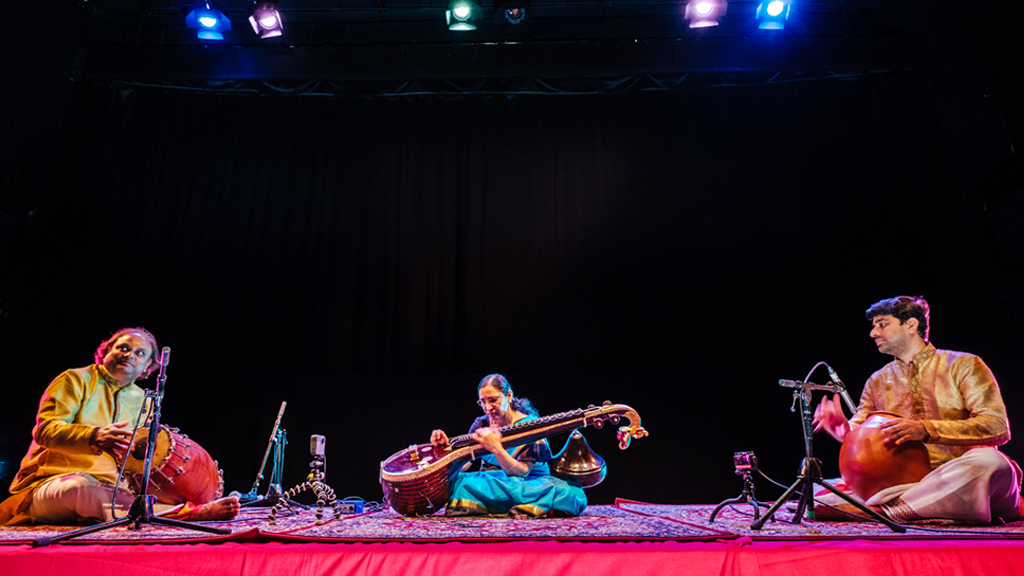
Quick Facts
- The first major Carnatic concert in the US took place in 1962 at New York's Town Hall.
- The global audience for Carnatic music is estimated to include over 100,000 rasikas outside India.
- Major international festivals include the Cleveland Thyagaraja Festival (USA) and the Darbar Festival (UK).
- International concerts often feature shorter durations (90-120 minutes) compared to traditional Indian concerts.
- Academic studies show that listening to specific ragas can reduce stress and anxiety, explaining its cross-cultural appeal.
- Digital platforms like YouTube and Spotify have democratized access, allowing artists to reach millions globally.
Carnatic music was born in the temples and courts of South India. For centuries, it remained largely within that geographical and cultural context. But over the past few decades, something remarkable has happened: this ancient art form has found audiences in concert halls, community centres, and living rooms across the world, from Edison, New Jersey to Bern, Switzerland.
This is not just a story about musicians getting on planes. It is about what happens when a deeply rooted cultural tradition encounters new contexts, new listeners, and new ways of being heard.
Table of Contents
- [The story behind Carnatic music abroad](#the-story-behind-carnatic-music-abroad)
- [Who attends these concerts?](#who-attends-these-concerts)
- [Major international festivals and venues](#major-international-festivals-and-venues)
- [The performer's experience](#the-performers-experience)
- [The NRI community's role](#the-nri-communitys-role)
- [Cross-cultural connections](#cross-cultural-connections)
- [Medha Vidyabhushan's international journey](#medha-vidyabhushans-international-journey)
- [The digital dimension](#the-digital-dimension)
- [What the future holds](#what-the-future-holds)
- [The Evolution of Concert Formats](#the-evolution-of-concert-formats)
- [Comparing Traditional and International Concerts](#comparing-traditional-and-international-concerts)
The story behind Carnatic music abroad
The journey of Indian classical music to the West began in earnest in the late 1950s and 1960s. As one Quora user noted: "It started in the late 50s and the 60s when Hindustani musicians like Ravi Shankar and Ali Akbar Khan, and Carnatic musician S. Balachander toured in the west. This first raised the interest of western musicians."
The first major Carnatic concert in the United States took place in 1962, when a group led by Veena Balachander performed at New York's Town Hall. The New York Times critic Robert Shelton wrote at the time: "A Western listener approaches this music with the awe deserved by a tradition older than Western art music, with an appreciation, if not an understanding, of the mystique of a music that is steeped in myth and religion."
Since then, the international Carnatic music circuit has grown enormously. As Bala Shankar wrote in The Hindu: "Over the past three decades, Carnatic music has been exported to the U.S., the U.K., West Asia, Far East and Australia in many forms, concerts being the primary one." He noted that this circuit has become a "huge financial market," allowing audiences abroad to listen to top artists live while providing musicians with significant income.
Who attends these concerts?
The audience for Carnatic music abroad is diverse, but it can be broadly divided into three groups:
- The South Indian diaspora: This is the primary audience. Families who have settled abroad maintain their cultural connection partly through music. Parents bring their children, who may have been born in the US or UK, to concerts as a way of passing on their heritage.
- Students and practitioners: Many people of Indian origin living abroad learn Carnatic music through online classes or local teachers. They attend concerts as both listeners and students studying the art form.
- Non-Indian classical music enthusiasts: A smaller but growing group of listeners who discover Carnatic music through world music festivals, university courses, or online platforms.
One Quora user estimated the global audience: "The Cleveland Aradhana is attended by about 10,000 people, give or take a little. If we apply the 10% rule for rasikas residing outside India, we get 100,000 more rasikas worldwide."
Major international festivals and venues
Several established events serve as anchors for the international Carnatic music community:
Cleveland Thyagaraja Festival (USA): One of the largest Carnatic music events outside India, held annually in Cleveland, Ohio. It draws thousands of attendees and features top artists from India.
Darbar Festival (UK): Based in London, Darbar presents both Carnatic and Hindustani music to diverse audiences. It has become one of the most important platforms for Indian classical music in Europe.
Carnatic Music Festivals in Singapore and Malaysia: Southeast Asia has a large Tamil diaspora that actively supports Carnatic music through regular concerts and festivals.
Temple-based concerts in the US: Hindu temples across America regularly host Carnatic concerts, particularly during festivals like Navaratri, Rama Navami, and Thyagaraja Aradhana.
The performer's experience
For a Carnatic musician, performing internationally is both exciting and challenging. The experience differs significantly from performing in Chennai or Bengaluru.
Adapting to different audiences
In India, a Carnatic concert audience is typically knowledgeable. They keep tala, they recognize ragas, and they respond vocally to impressive passages. Abroad, the audience may include people hearing a raga for the first time alongside seasoned rasikas who have been listening for decades.
This creates an interesting challenge: how do you satisfy both groups simultaneously? Some musicians address this by briefly explaining the raga or the meaning of the composition before performing it. Others let the music speak for itself, trusting that emotional communication transcends cultural barriers.
"If you love world music, vocal improvisation, and cross-cultural artistry, you'll be amazed by this performance. As an Opera Singer, I was completely captivated by the emotion, precision, and devotion in her voice." - Maggie Renee, Juilliard-trained opera singer, reacting to a Carnatic performance on YouTube
Breaking traditional barriers
The presentation of Carnatic music abroad is evolving to become more inclusive. According to The Hindu, artists in the diaspora are breaking traditional barriers. Hardial Rai, founder of the London-based non-profit ZerOclassikal, told the publication about doing away with strict dress codes: "Why should they carry that baggage to the stage? They do not wear those clothes in daily life. It should be only about music."
You are looking at a significant shift. In India, Carnatic concerts have traditionally followed strict conventions about dress, stage setup, and audience behaviour. Abroad, these conventions are being relaxed to make the music more accessible to diverse audiences.
Practical challenges
Beyond the artistic considerations, international performances involve practical challenges:
- Coordinating with accompanists who may be based in different countries or time zones.
- Adapting to different acoustic environments (community halls, churches, university auditoriums) that were not designed for Indian classical music.
- Managing jet lag while maintaining vocal quality.
- Navigating visa requirements and travel logistics.
- Working within shorter time slots (international concerts are often 90 minutes rather than the traditional 2-3 hours).
The NRI community's role
The Non-Resident Indian (NRI) community plays a crucial role in sustaining Carnatic music abroad. They are not just the audience; they are the organizers, sponsors, and cultural ambassadors who make international concerts possible.
Many NRI families ensure their children learn Carnatic music, creating a new generation of practitioners and listeners born outside India. Online classes have made this easier than ever, with teachers in Chennai or Bengaluru conducting lessons via video call for students in California or London.
"Seeking to re-craft their lives and identities, this displaced generation has ensured that all their children, regardless of religious background, are taught Carnatic music in some form. The rites of passage, from the vidyarambham to the arangetram, are strictly observed by them." - Scroll.in, on the Sri Lankan Tamil diaspora
YouTube has also become a primary venue for the global Carnatic community to connect. Videos of "NRI Kids Carnatic Music Violin Performance" in the USA and events like the "Malaysia International Carnatic Music Festival" and the "Global Carnatic Confluence NRI Winter Series" demonstrate a thriving, active global community passing the tradition to the next generation.
Cross-cultural connections
One of the most interesting aspects of Carnatic music abroad is how it connects with other musical traditions. The raga system has parallels with scales used in other cultures, creating unexpected bridges.
At the Darbar Festival in London, a performance by Jayanthi Kumaresh and Aruna Sairam highlighted that the raga Simhendramadhyamam is "capable of powerful cross-cultural communication" due to its similarities with scales used by gypsy and flamenco musicians in Spain.
These connections are not forced or artificial. They emerge naturally when musicians from different traditions encounter each other and recognize shared musical DNA beneath the surface differences.
Medha Vidyabhushan's international journey
Among the young Carnatic vocalists keeping the tradition alive on international stages is Medha Vidyabhushan. She has performed in the United States (Edison, New Jersey and North Hempstead, New York) and Switzerland (Bern), receiving a Certificate of Recognition from the Town of North Hempstead for her contribution to Indian classical music and Haridasa Sahitya.
Her international performances focus on Dasarapadas and Haridasa keertanas, bringing the devotional compositions of Karnataka's poet-saints to audiences who may never have heard them before. The response has been overwhelmingly positive, demonstrating that the emotional power of these 500-year-old songs transcends language and cultural barriers.
The digital dimension
While physical concerts remain important, digital platforms have transformed how Carnatic music reaches international audiences. YouTube, Spotify, and Instagram allow artists to build global followings without touring.
A musician in Bengaluru can upload a performance that reaches listeners in Berlin, Boston, and Bangkok within seconds. This has democratized access to Carnatic music in ways that were unimaginable even 20 years ago.
For artists like Medha Vidyabhushan, whose official YouTube channel showed 11,111,431 views on October 1, 2026, the digital audience can extend far beyond a touring schedule. Her Spotify artist profile displayed 2,441 monthly listeners on October 1, 2026, showing that listeners also discover Carnatic devotional music through streaming platforms and curated playlists.
What the future holds
The international presence of Carnatic music is growing, driven by several factors:
- The South Indian diaspora continues to expand, creating larger audiences in more cities.
- Digital platforms make discovery and access easier than ever.
- World music festivals and cross-cultural collaborations introduce Carnatic music to new listener demographics.
- Young artists who are comfortable with both traditional performance and digital media are bridging the gap between the concert hall and the smartphone screen.
The challenge going forward is to grow the audience without diluting the music. The best international Carnatic performances demonstrate that this is possible: you can present the music accessibly without compromising its depth or authenticity.
Frequently Asked Questions
Do you need to understand the language to enjoy a Carnatic concert?
No. While understanding the lyrics adds a layer of meaning, the emotional communication of a raga works independently of language. Many non-Indian listeners report being deeply moved by Carnatic performances without understanding a single word. The melody, rhythm, and emotional expression communicate directly.
How is performing abroad different from performing in India?
The main differences are audience composition (mix of knowledgeable and new listeners), venue acoustics (not always designed for Indian classical music), concert duration (often shorter), and cultural context (less shared musical vocabulary). Musicians often adapt by providing brief explanations and choosing compositions with strong melodic appeal.
What are the biggest international Carnatic music festivals?
The Cleveland Thyagaraja Festival (USA), Darbar Festival (London), Singapore Indian Fine Arts Society concerts, and various temple-based events across the US, UK, and Australia are among the most established. Many cities with significant South Indian populations also have regular concert series.
Can non-Indians learn Carnatic music?
Absolutely. Many non-Indian students learn Carnatic music through online classes or in-person lessons. The pedagogical system created by Purandaradasa is universal and does not require any specific cultural background to follow. What it does require is patience, regular practice, and ideally a good teacher.
How has COVID affected international Carnatic music?
The pandemic accelerated the shift to digital platforms. Many concerts moved online, and virtual festivals became common. While live concerts have resumed, the hybrid model (combining in-person and online audiences) has become standard. This has actually expanded access, allowing people who cannot travel to attend concerts virtually.
The Evolution of Concert Formats
As Carnatic music has expanded globally, the traditional concert format has undergone subtle transformations to accommodate new contexts. While the core elements of the performance remain intact, the presentation style often adapts to the expectations of international venues.
- Shorter Durations: International concerts frequently run for 90 to 120 minutes, compared to the traditional 3-4 hours in India.
- Educational Elements: Performers often include brief explanations of the ascending and descending patterns (arohana and avarohana) or the emotional essence (raga-rasa) of the pieces.
- Collaborative Ventures: Festivals like Darbar in the UK actively promote collaborations between Carnatic and Hindustani musicians, or even Western classical artists, fostering a broader appreciation of Indian classical music.
Comparing Traditional and International Concerts
The experience of performing and attending a Carnatic concert varies significantly depending on the location. Here is a quick comparison - the table highlights some of the key differences between traditional settings in South India and international venues.
| Feature | Traditional Setting (South India) | International Setting |
|---|---|---|
| Audience Demographics | Predominantly knowledgeable rasikas | Mix of diaspora, students, and new listeners |
| Concert Duration | Typically 3 to 4 hours | Usually 90 to 120 minutes |
| Venue Acoustics | Designed for Indian classical music | Often adapted from Western classical or community halls |
| Presentation Style | Strict adherence to traditional conventions | More flexible, often including educational explanations |
| Dress Code | Traditional attire expected | Smart casual or relaxed attire common |
These adaptations ensure that the music remains accessible while preserving its intricate rhythmic structures and spiritual depth. As artists like Medha Vidyabhushan continue to share the devotional compositions of the Haridasa tradition with the world, the global footprint of Carnatic music will undoubtedly continue to grow.
Published by Medha Naada
This guide is published by Medha Naada, Medha Vidyabhushan's official portfolio. It combines the credited sources below with plain-language listening or learning prompts. Historical details, song credits, and public records are limited to the cited material.
A written guide can support listening and preparation, but a qualified teacher remains the right source for personal vocal technique, pronunciation feedback, or repertoire decisions.
How this guide is supported
This article’s practical reflections on taking Carnatic music abroad are editorial. The cited reporting supports broader context about diaspora concert circuits and evolving audience access.
- Carnatic music export: Positive outcomes and areas of concern. Bala Shankar, The Hindu. Reported context about Carnatic music concert circuits in international markets.
- Carnatic music loosens up a bit. Lakshmi Anand, The Hindu. Reported examples of diaspora organizations adapting concert presentation for varied audiences.