Carnatic Music · 2026-08-23 · 7 min read
Ragam Tanam Pallavi Explained: A Beginner's Guide to Carnatic Improvisation
Understand Ragam Tanam Pallavi without the jargon. This beginner guide explains raga alapana, tanam, pallavi, neraval, kalpana swaras, and tani avartanam, plus how to listen with confidence.
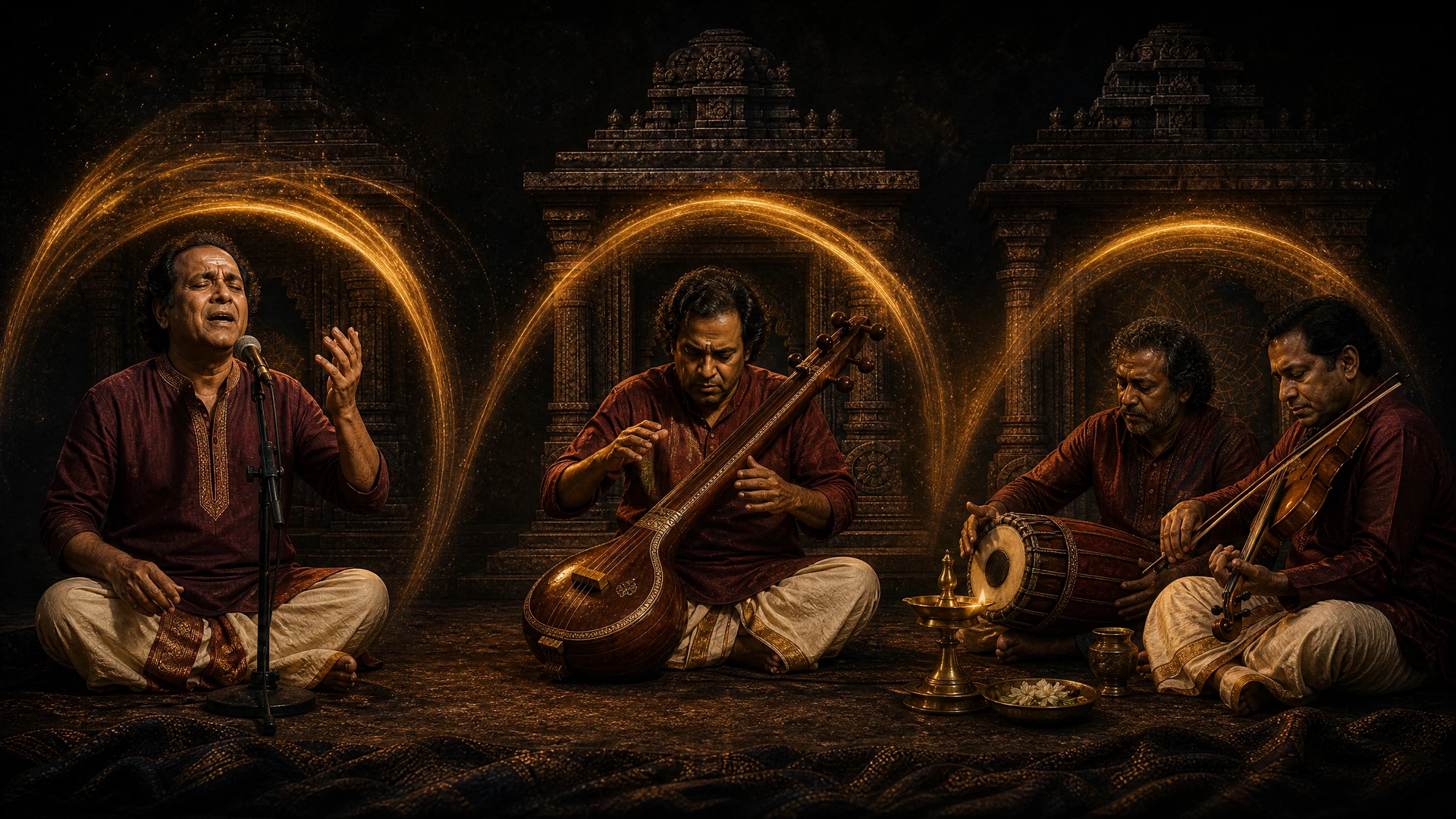
Quick Facts
- Ragam Tanam Pallavi, often shortened to RTP, is a major Carnatic format centered on extended improvisation.
- The three title words point to a raga exploration, a rhythmically charged continuation, and a short central lyric line.
- An RTP is not a fixed checklist. Artists and concert contexts shape its length, sequence, and degree of elaboration.
- You can enjoy an RTP before you understand its technical vocabulary.
- Listening for return points and changes in texture is often more helpful than trying to identify every raga immediately.
Table of Contents
- [What Is Ragam Tanam Pallavi?](#what-is-ragam-tanam-pallavi)
- [The Three Parts](#the-three-parts)
- [How Improvisation Works Here](#how-improvisation-works-here)
- [What You May Hear Around an RTP](#what-you-may-hear-around-an-rtp)
- [A First-Time Listening Method](#a-first-time-listening-method)
- [How RTP Connects to Medha's Repertoire](#how-rtp-connects-to-medhas-repertoire)
- [Let the Form Reveal Itself Slowly](#let-the-form-reveal-itself-slowly)
What Is Ragam Tanam Pallavi?
Ragam Tanam Pallavi is one of the places where a Carnatic musician has broad room to create in the moment. It is often treated as intimidating because listeners encounter many new words at once. A better first description is simpler: one raga is explored in depth, rhythmic energy gradually enters, and a short lyric line becomes the center of a larger musical conversation.
Mahadevan Ramesh's long-form introduction to Carnatic concert practice describes RTP as an extended elaboration of a chosen raga. The article also makes an important point that beginners should keep in mind: a so-called typical concert is never entirely fixed. The form has recognisable landmarks, but a musician shapes them differently depending on the raga, the tala, the accompanists, the audience, and the available time.
If terms such as raga, tala, neraval, or kalpana swara are new, open the Carnatic glossary. You do not need to memorize them before listening. They are simply signposts.
The Three Parts
The title gives you the broad map. Think of it as three changing kinds of attention rather than three boxes to tick.
| Part | What you hear | A helpful way to listen |
|---|---|---|
| Ragam | A lyric-free raga exploration, often beginning unmetered | Notice which notes or turns keep returning |
| Tanam | A more rhythmically energized raga development | Feel the pulse arriving, even before a full lyric begins |
| Pallavi | A short line of text set to a specific tala | Listen for the line returning after each new idea |
In ragam, the artist introduces the raga's world without rushing to a song. The violin may answer or echo the vocal ideas. In tanam, a distinct rhythmic liveliness enters the raga development. In pallavi, a short lyric line becomes the musical home point for rhythmic and melodic invention.
The Raga Guide for Beginners helps with the melodic side, while the Tala Guide explains why the return to a tala cycle can feel so satisfying.
How Improvisation Works Here
Improvisation does not mean random notes. It means working creatively inside a shared musical grammar. An RTP may include several kinds of improvisation, each with a different texture.
| Term | Plain-English meaning | What to notice as a listener |
|---|---|---|
| Alapana | Free raga exploration without a fixed beat cycle | Melodic phrases settling and expanding |
| Neraval | Developing one chosen lyric line while keeping its tala setting | The same words receiving new melodic shapes |
| Kalpana swaras | Improvised solfa passages that return to a planned point | Numbers of notes, momentum, and a satisfying landing |
| Raga malika | A movement through more than one raga | The color shift when a new raga arrives |
| Tani avartanam | A percussion-centered tala exploration | Rhythmic dialogue and the eventual return to the song |
What makes this special is the balance between freedom and return. A phrase may travel far, but the artist and accompanists know where it needs to land. You might notice that the most exciting moments are often followed by a clear sense of resolution, as if several people have reached the same doorway together.
What You May Hear Around an RTP
An RTP can arrive as the central large-form item of a concert, but it does not always appear in the same place or at the same length. Some concerts feature a compact version. Others give it substantial space. Some artists explore a raga malika; others remain with one raga. A tani avartanam may follow the pallavi, depending on the performance design.
This is why it is useful to avoid saying that every RTP must follow one exact order. The framework is traditional, but the lived performance is responsive. It also explains why two listeners can hear the same form differently: one listens for raga detail, another for rhythmic architecture, and another for the emotional arc.
A First-Time Listening Method
You do not need a technical score to follow an RTP. Try this calm method instead.
- During the opening raga section, notice one phrase that seems to return. Let your ear become familiar with its contour.
- When the energy changes, ask whether you can feel a more definite rhythmic motion. That is often the tanam shift.
- When a lyric line appears, listen for it as the anchor. You may not know the language, but you can hear its return.
- When swara passages become quicker, listen for the landing point rather than counting every note.
- When percussion takes focus, enjoy the texture. You do not need to decode every pattern to feel a completed tala cycle.
There is no need to pretend that every long improvisation is immediately clear. A curious listener can simply recognize a change, wait for a return, and come back to the same recording another day.
How RTP Connects to Medha's Repertoire
Medha Vidyabhushan's recorded devotional repertoire is often built around composed Kannada sahitya rather than a full RTP presentation. Still, RTP listening sharpens the same skills that make her performances compelling: hearing raga shape, sensing tala, recognising a return, and noticing how devotion lives inside musical detail.
Start with a familiar song such as Toogire Rayara. Listen first to the composition as a whole. Then try the Featured Performance Notes on the homepage and see how raga, tala, language, and lyrical context change your attention. RTP is not a test you pass. It is a reminder that a raga can keep revealing new possibilities.
Frequently Asked Questions
Is Ragam Tanam Pallavi a song?
It includes a short lyric line in the pallavi section, but RTP is primarily an improvisational performance framework rather than one fixed composition.
Does every Carnatic concert include an RTP?
No. Concert duration, repertoire choices, artist preference, and context all matter. Some concerts include an extensive RTP, some feature a shorter version, and some do not include one.
What is the difference between alapana and tanam?
Both explore the raga. Alapana is generally lyric-free and unmetered, while tanam brings a more rhythmically energized character to the development.
Why does the violin repeat the vocalist?
In many Carnatic settings, the violin responds to or reflects the main artist's phrases. The exact relationship is musical dialogue, not mechanical copying.
Do I need to understand tala to enjoy RTP?
No. Tala knowledge deepens the experience, but you can begin by listening for recurrence, contrast, energy, and resolution.
Let the Form Reveal Itself Slowly
RTP rewards return visits. The first time, hear the changing textures. The next time, find the pallavi line. Later, you may begin to recognise how a raga takes shape or how a rhythmic phrase finds its way home. That gradual familiarity is part of the pleasure.
Published by Medha Naada
This guide is published by Medha Naada, Medha Vidyabhushan's official portfolio. It combines the credited sources below with plain-language listening or learning prompts. Historical details, song credits, and public records are limited to the cited material.
A written guide can support listening and preparation, but a qualified teacher remains the right source for personal vocal technique, pronunciation feedback, or repertoire decisions.
How this guide is supported
This listening guide simplifies a complex performance form. The cited sources support the broad RTP components and improvisation context; the listening steps are editorial prompts, and no one concert order is presented as mandatory.
- A Gentle Introduction to South Indian Classical Music, Part IV. Mahadevan Ramesh. Ragam Tanam Pallavi as an extended raga elaboration, including alapana, tanam, the pallavi line, neraval, kalpana swaras, raga malika possibilities, tani avartanam, and the non-fixed nature of concert design.
- Gender, new creativity and Carnatic music in London. J. Hornabrook, South Asian Diaspora. Scholarly context for RTP performance and improvised pallavi and swara variations in contemporary Carnatic practice.