Song Meaning · 2026-09-19 · 7 min read
Swagatham Krishna: Meaning, Mohanam, and Oottukkadu Venkata Kavi
A clear guide to Swagatham Krishna, its devotional text, Mohanam setting, Adi tala, rhythmic close, Oottukkadu Venkata Kavi context, and Medha Vidyabhushan’s official release.
Quick Facts
- Swagatham Krishna is attributed to Oottukkadu Venkata Kavi, also called Oottukkadu Venkatasubba Iyer.
- The Oottukkadu Venkata Kavi Research Center lists it in Mohanam and Adi tala.
- Its text welcomes Krishna, then gathers images of Mathura, Nandagopa, Kaliya, Gokula, heroic deeds, and Vraja.
- The charanam includes rhythmic syllables. The Research Center identifies the work as using both tishram and chaturashram in its gait treatment.
- Translation is an entry point, not a substitute for the Sanskrit sound or a teacher’s chosen version.
Swagatham Krishna welcomes and praises Krishna through connected layers: story-filled words, Mohanam’s five-swara frame, and an Adi tala charanam that becomes rhythmically animated.
Begin with a credited composition entry, a reliable meaning note, and the recording you are hearing.
Table of Contents
- [What Swagatham Krishna Says](#what-swagatham-krishna-says)
- [The Krishna Images in the Text](#the-krishna-images-in-the-text)
- [Mohanam as the Melodic Frame](#mohanam-as-the-melodic-frame)
- [Adi Tala and the Rhythmic Close](#adi-tala-and-the-rhythmic-close)
- [Oottukkadu Venkata Kavi Context](#oottukkadu-venkata-kavi-context)
- [A Four-Pass Listening and Practice Path](#a-four-pass-listening-and-practice-path)
- [Medha’s Janmashtami Release](#medhas-janmashtami-release)
- [Conclusion](#conclusion)
What Swagatham Krishna Says
The pallavi opens with “svāgatam krṣhṇa,” or “welcome, Krishna,” followed by “sharaṇagatam krṣhṇa.” The opening welcomes Krishna and places the address in a devotional relationship of refuge or surrender. English renderings vary, while the Oottukkadu Research Center preserves the Sanskrit transliteration without fixing every phrase in English.
English can orient a listener but cannot contain every shade of the original. Read the meaning once, then hear the repeated sounds of svāgatam and krṣhṇa. The welcome is a musical return as well as a statement.
The opening names Krishna through Mathura, a gentle face, and Madhusudana, the slayer of Madhu. Tenderness and strength arrive together.
Start with sound and sense together
Make three brief notes: the transliterated line, a short English sense, and one sound you noticed. For the opening, “welcome and refuge” and “the returning Krish-na sound” are enough. The Languages of Carnatic Compositions guide gives broader context for using translation carefully.
The Krishna Images in the Text
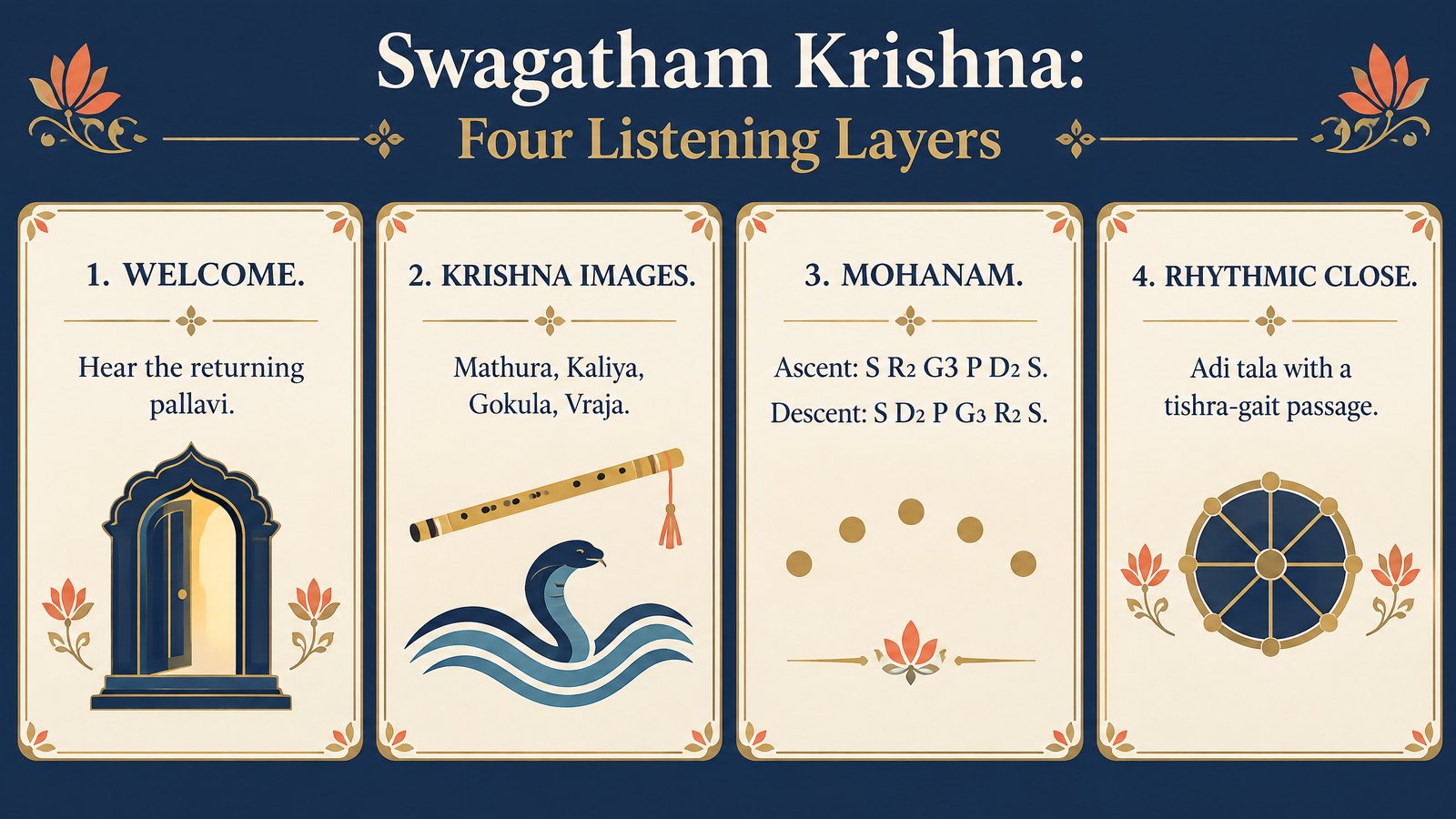
The anupallavi brings flowers, fragrance, a kasturi mark, Nandagopa, and the gopikas into view. The charanam names Mushtika and Chanura, Kuvalayapida, Kaliya dancing, Gokula’s protection, and Vraja. Specialist entries agree on this broad progression, though spellings and English choices differ.
The result is not one linear story. It is a garland of scenes: Krishna as welcomed presence, beautiful figure, protector, dancer on Kaliya, and beloved of Vraja. On a first listen, choose one image rather than trying to identify every name.
| Textual layer | What it brings into view | A first-listen prompt |
|---|---|---|
| Pallavi | Welcome, Mathura, Madhusudana | How does the return establish the welcome? |
| Anupallavi | Fragrance, kasturi, Nandagopa, gopikas | Which image receives a lingering phrase? |
| Charanam | Kaliya, Gokula, heroic deeds, Vraja | How does the text expand from welcome into memory? |
| Rhythmic passage | Solkattu and patterned movement | What changes when words give way to syllables? |
For a seasonal frame, see the Krishna Janmashtami and Carnatic Music listening guide. It explains festival context without assigning one song to every observance.
Mohanam as the Melodic Frame
Both the Research Center and Karnatik identify the raga as Mohanam and the tala as Adi. Karnatik gives the familiar outline as ascending S R2 G3 P D2 S and descending S D2 P G3 R2 S, describing Mohanam as a janya of Harikambhoji. The listed ascent and descent use five swaras each; Ma and Ni are absent.
An outline is a doorway, not the entire raga. Hear a phrase rise, turn, and settle before looking for named swaras. The Raga Guide for Beginners and Hamsadhwani and Mohanam comparison keep attention on phrase and return.
Hear shape before labels
Pause after a short phrase and hum only its direction: did it rise, turn, or come down? Replay it and notice where it settles. If you know swaras, trace it against Mohanam afterward. If not, a plain description is already useful.
Adi Tala and the Rhythmic Close
Adi tala gives the song a recurring time frame. On a first listen, sense the pulse, especially when the pallavi returns. If you already keep tala, use a light steady cycle rather than chasing every fast detail.
The charanam makes rhythm unmistakable. The Research Center prints rhythmic syllables after the Krishna descriptions and marks part of the passage tishragati. Its rhythm overview names Svaagatam krshna among works using tishram and chaturashram. The close can therefore feel like a change of gait, not simply a faster repeat.
Sangeeta Sudha connects the song’s Krishna scenes and rhythmic vocabulary with its popularity in dance repertoire. This is context, not a claim that every rendition follows one dance presentation.
For study, learn sahitya and rhythmic syllables in separate blocks with a teacher. Avoid combining notation from one source with a recording from another without checking the version. The basic Carnatic notation guide explains why written swaras need sound and tala context.
Oottukkadu Venkata Kavi Context
Oottukkadu Venkata Kavi is generally placed in the eighteenth century. The Research Center gives approximate dates of 1700 to 1765 and notes that works and family transmission are major evidence. Its life page says 500-plus compositions have been discovered, with 300-plus published by Needamangalam Krishnamurthy Bhagavatar, a descendant of the composer’s brother’s family.
Swagatham Krishna therefore belongs to a substantial body of work associated with melody, rhythm, poetry, dance, and narrative interests. The Center identifies this particular piece as one using changes of gait. That is a stronger listening connection than a sweeping claim about all Mohanam or Krishna compositions.
A Four-Pass Listening and Practice Path
Pass one: greet the refrain
Listen through without pausing. Each return of the pallavi is the welcome. Do not translate the whole charanam yet.
Pass two: choose one image
Read a short meaning note and select Kaliya dancing, Mathura, or Gokula’s protection. Listen again for that one image.
Pass three: hear Mohanam’s route
Follow one phrase to its high point and back toward rest. Compare it with the Mohanam outline only after you can describe its direction.
Pass four: separate the ending
Replay the solkattu. First notice its energy, then keep only the broad beat. A student can ask a teacher where tishra movement begins and how it relates to the Adi tala cycle.
The What Is a Kriti? guide is a helpful companion for hearing pallavi, anupallavi, and charanam as related sections.
Medha’s Janmashtami Release
Medha Vidyabhushan’s official September 4, 2026 Reel, “Swagatham Krishna OUT NOW,” presents her release on Sri Krishna Janmashtami and credits Sri Oothukkadu Venkatasubba Iyer as original-song composer. It is a performance context, not proof of the work’s historical dating, text, raga, tala, or translation. Those claims above rely on composition and specialist text sources.
Frequently Asked Questions
What does Swagatham Krishna mean?
The refrain welcomes Krishna and joins that welcome to devotional turning toward him. English sources phrase the second part differently, so “welcome” and refuge or surrender are better heard as a broad sense than a fixed one-to-one translation.
Who composed Swagatham Krishna?
It is attributed to Oottukkadu Venkata Kavi, also called Oottukkadu Venkatasubba Iyer. The Research Center lists it on a dedicated composition page.
Which raga and tala are used in Swagatham Krishna?
The cited composition and specialist lyric entries list Mohanam and Adi. The five-swara outline helps with orientation, but phrase and return matter too.
Why are rhythmic syllables heard near the end?
The charanam contains a rhythmic passage. The Research Center marks part of it as tishragati and names the work among examples using tishram and chaturashram.
Is Swagatham Krishna only for Janmashtami?
No. Medha Vidyabhushan’s 2026 release connects her performance with Janmashtami, but that is one release context. The piece can also be heard in concerts, study, dance settings, and devotional listening at other times.
Conclusion
Swagatham Krishna begins with welcome and opens into a many-sided Krishna: beautiful, protective, playful, and heroic. Mohanam gives the melody a five-swara frame, while Adi tala and the charanam’s changing gait bring rhythm forward. Begin with the refrain, one translated image, and one melodic return. The rest can clarify with each attentive listen.
Published by Medha Naada
This guide is published by Medha Naada, Medha Vidyabhushan's official portfolio. It combines the credited sources below with plain-language listening or learning prompts. Historical details, song credits, and public records are limited to the cited material.
A written guide can support listening and preparation, but a qualified teacher remains the right source for personal vocal technique, pronunciation feedback, or repertoire decisions.
How this guide is supported
This guide uses the composer research center and specialist composition sources for text, raga, tala, and rhythmic context. Medha's Reel supports only the dated release connection and its visible credit.
- Svāgatam Krṣhṇā. Oottukkadu Venkata Kavi Research Center. Attribution, transmitted text, Mohanam, Adi tala, and the printed rhythmic passage, including its tishragati marking.
- Rhythm in Oottukkadu Venkata Kavi's compositions. Oottukkadu Venkata Kavi Research Center. The research center's identification of Swagatham Krishna among works using tishram and chaturashram.
- Swagatham Krishna song record. Karnatik. Independent specialist support for Mohanam, Adi tala, the listed scale outline, lyric text, and one credited English meaning.
- Swagatham Krishna OUT NOW. Medha Vidyabhushan. The September 2026 Janmashtami release context and the original-song composer credit visible in the official Reel.