Learning Guide · 2026-10-01 · 9 min read
Is a Carnatic Student Ready for an Arangetram? A Guru-Led Preparation and Repertoire Checklist
A guru-led decision guide for judging Carnatic arangetram readiness through reliability, repertoire, rehearsals, stamina, and next-step learning.
Quick Facts
- An arangetram is a student’s first formal entry onto the public stage, not a graduation from learning.
- The guru’s judgment matters more than a calendar, a composition count, or a family deadline.
- Readiness means dependable shruti, tala, recall, listening, and recovery when something changes.
- Repertoire should reveal settled strengths, not copy a standard programme.
- A thoughtful debut begins a more independent, still guru-guided musical life.
An arangetram can be a joyful public acknowledgment of a student’s work. It can also bring quiet pressure: the student wants to make the guru proud, the parent wants the occasion to go well, and a date can start to feel like proof of readiness. It is not. The more useful question is, can this musician share a sustained recital with steadiness, understanding, and room to respond?
The word is commonly understood as entering or ascending the stage. That image matters because an entry is not an arrival. A student need not sound like a senior concert artist. They do need to be ready for the particular musical responsibility their guru is willing to place before them. Use this as a conversation framework, not a pass-or-fail scorecard. It can serve vocal and instrumental students, with details adapted by the guru.
Table of Contents
- [Decide Whether This Is the Right Next Step](#decide-whether-this-is-the-right-next-step)
- [Have the Guru-Led Readiness Conversation](#have-the-guru-led-readiness-conversation)
- [Test Reliability Under Performance Pressure](#test-reliability-under-performance-pressure)
- [Build a Repertoire That Fits This Musician](#build-a-repertoire-that-fits-this-musician)
- [Rehearse With Accompanists and Run Mock Concerts](#rehearse-with-accompanists-and-run-mock-concerts)
- [Conclusion](#conclusion)
Decide Whether This Is the Right Next Step
Begin by separating musical readiness from visibility. A student may have learnt many pieces and enjoy singing for relatives, yet still need time to make choices without continuous prompting. Another may have a smaller working repertoire but remarkably dependable command of it. Neither case is settled by age, years of lessons, or the number of varnams and kritis already learnt.
Let the student answer first: Do I want to take responsibility for this performance? Which parts feel inviting, and which feel fragile? Can I receive specific correction without losing the thread of my music? A parent can then ask the guru whether the student is ready for a public debut of a defined scope, not whether they have “finished” Carnatic music. The guru may recommend proceeding, postponing, or arranging an intermediate performance. Each is a constructive answer.
Look for willingness alongside skill. The student should be prepared to practise details repeatedly, listen closely to musical partners, and simplify an idea if needed. Reluctance to do that work is useful information, not a fault. No invitation, family expectation, or comparison with another learner should overrule the teacher-student assessment.
Have the Guru-Led Readiness Conversation
Make the decision meeting specific. Instead of asking, “Is my child ready?”, bring the student’s own hopes, observed strengths, and recurring difficulties. The guru can turn broad impressions into musical priorities. This table is a discussion tool, not a set of minimum requirements.
| Area | Ask the guru | Useful outcome |
|---|---|---|
| Core musicianship | Which ragas, talas, speeds, and registers stay dependable when the student is tired or nervous? | A clear sense of what can be presented confidently and what needs more work. |
| Repertoire recall | Can the student begin, continue, and finish each item without notation or cue dependence? | A smaller, firmer performance set if needed. |
| Manodharma | Which creative elements are natural now, and where should the student remain with the composition? | Permission to be musically truthful rather than ambitious for appearance’s sake. |
| Ensemble work | What must the student signal, hear, and recover with accompanists? | A rehearsal plan built around listening, not only solo practice. |
| Stamina and mindset | Can the student sustain attention, pitch, rhythm, and courtesy across the agreed scope? | A realistic programme and mock-concert plan. |
Ask the guru to name the next observable step, not simply to say “practise more.” It may be a clean rendition at two speeds, steadier returns to the tonic, a secure lyric line, or a short improvisation that lands correctly. Parents help most by protecting practice time, keeping comparison out of the room, and allowing musical decisions to remain with guru and student.
Test Reliability Under Performance Pressure
A stage does not create musicianship. It shows how consistently it holds. Shruti is the pitch reference against the drone. A practical check is whether the student can enter securely, sustain phrases or bowing, and return convincingly to that reference after a pause, an accompaniment response, or a distraction. Recordings can reveal patterns, while the guru’s ear supplies the musical context a recording cannot.
Tala is the rhythmic cycle that anchors a composition. Reliability is more than correct hand gestures. The student should know where a lyric or instrumental phrase begins in the cycle, retain the pulse through rests, and complete a phrase at its intended place. The beginner’s tala guide and raga guide are useful refreshers, but readiness has to be demonstrated live.
Test recovery, too. If a line is missed, a string needs adjustment, or an idea does not land as expected, can the student listen, locate the pulse, and rejoin without panic? A debut should never rest on flawless recall alone.
Manodharma belongs only at the level the guru has heard consistently. Raga alapana explores characteristic phrases without a fixed tala; neraval and kalpana swaras ask the performer to preserve both raga character and rhythmic placement. A brief, clear creative passage is more convincing than a long, uncertain one. Ragam-Tanam-Pallavi is not a compulsory badge of readiness.
Build a Repertoire That Fits This Musician
Repertoire breadth does not mean collecting a prescribed list. It means giving a listener a truthful sense of the student’s range while protecting the quality of every item. The guru may balance raga, tala, pace, mood, language, and compositional form, but no composer, rare raga, or elaborate form should become a quota.
Start with the student’s most dependable music. Include pieces that show clear raga identity, stable laya, and expressive control. Then consider whether the selection contains a substantial composition that can bear deeper attention, and music that allows the student to reset concentration. The guide to what a kriti is can help families understand why a composed item is more than a song on a list.
For text-based pieces, readiness includes respectful pronunciation and a working understanding of the words. The student need not lecture from stage, but should know the basic meaning, devotional address or speaker, and emotional direction of what they render. Check Tamil, Telugu, Kannada, and Sanskrit texts with the guru or a trusted language source, rather than a quick online gloss. Reading Carnatic notation may support home practice, but notation is not a substitute for internalised music.
Keep a reserve plan. If a demanding item remains unreliable in rehearsal, replacing it is discernment, not defeat. A debut repertoire becomes convincing when every selection has a reason to be there.
Rehearse With Accompanists and Run Mock Concerts
In a vocal recital, the familiar core team is a lead performer, violin, and mridangam, sometimes with additional percussion. Instrumental settings differ, but the principle does not: accompanists are active musical partners, not background support. Share the current repertoire, pitch, tala, key lyric or landing points, and guru-approved scope of improvisation before the first joint rehearsal. Do not assume an accompanist can infer prepared endings or preferred speed changes on the spot.
Use early sessions to work on individual joins: how an alapana begins and concludes, where neraval or swaras may occur, what follows a percussion feature, and how a piece is restarted if necessary. Then run an uninterrupted mock concert. It is the most candid stamina test because it asks the student to hold pitch, tala, listening, memory, posture, and emotional focus as one responsibility.
A useful mock-concert cycle is simple:
- Set the intended scope with the guru, including only material the student is ready to own.
- Run it without lesson-style stopping, with accompanists where possible and the expected drone and instrument setup.
- Note, do not litigate, slips during the run. Track where concentration thinned, pitch drifted, tala became uncertain, or ensemble cues blurred.
- Debrief in order: the student speaks first, accompanists identify communication needs, and the guru sets only the next few priorities.
- Revise selected pressure points, then return to a complete run when the guru judges it useful.
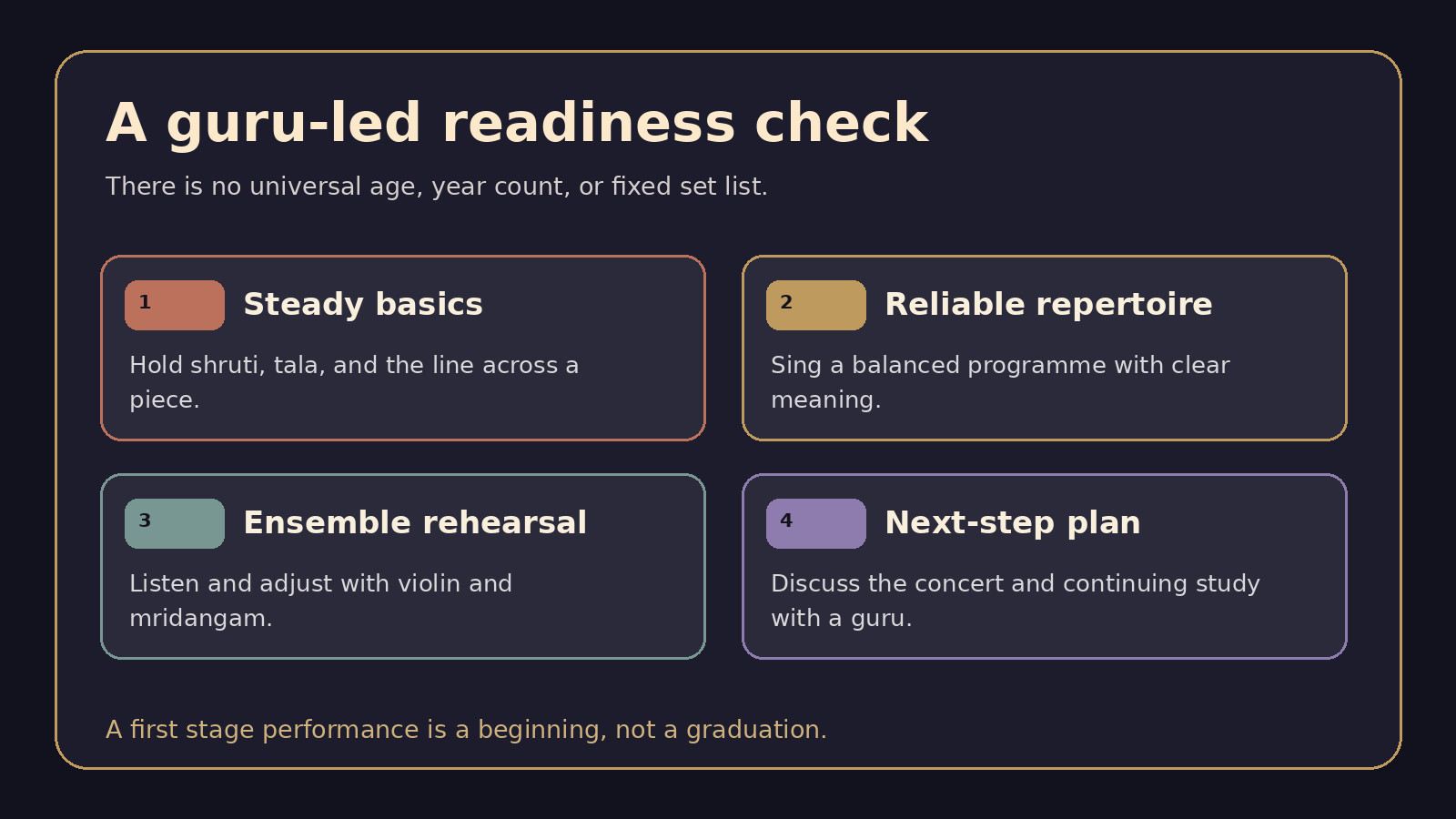
Stamina is not merely continuing for a long time. It is maintaining musical quality late in the agreed programme. Build it through focused sections and full runs chosen by the guru, not by chasing a generic duration. If accuracy consistently unravels, reduce the load, clarify the repertoire, or strengthen fundamentals. Pushing through an unsuitable scope does not prove readiness.
Frequently Asked Questions
Does an arangetram require a fixed number of years of study?
No. Students arrive with different prior exposure, practice conditions, instruments or voices, learning pace, and guru lineages. A fixed timeline hides the question that matters: whether this student can present the agreed scope reliably and with understanding.
Must every arangetram include Ragam-Tanam-Pallavi?
No. Ragam-Tanam-Pallavi is an important, highly improvised form, but it is not a universal entry ticket. Include it only when the guru believes the student can meet its raga, laya, and ensemble demands with ease. A well-shaped programme without it is stronger than a strained inclusion.
How can a parent help without taking over?
Offer practical steadiness: time, a quiet practice environment, thoughtful listening when invited, and respect for the guru’s sequence of work. Avoid using another student’s repertoire or debut as a benchmark. Let the student answer musical questions and receive feedback directly.
What should be rehearsed with accompanists?
Rehearse pitch, tala, starting points, endings, tempo changes, planned creative sections, and recovery cues. Just as importantly, rehearse listening. The goal is not to script every response but to make the student alert enough to work with real musicians in real time.
What happens after the debut?
The student returns to study. A useful post-debut conversation asks what held well, what felt new under performance pressure, and which ragas, compositions, or manodharma skills deserve patient development next. Applause is not a final assessment.
Conclusion
A Carnatic arangetram is ready to happen when a guru can stand behind the student’s particular musical scope, and the student can carry it with steadiness, listening, and humility. No universal number of years, items, or advanced forms confers that readiness. Choose depth over display, rehearse the realities of collaboration, and treat the stage as the next lesson in a lifelong practice.
Published by Medha Naada
This guide is published by Medha Naada, Medha Vidyabhushan's official portfolio. It combines the credited sources below with plain-language listening or learning prompts. Historical details, song credits, and public records are limited to the cited material.
A written guide can support listening and preparation, but a qualified teacher remains the right source for personal vocal technique, pronunciation feedback, or repertoire decisions.
How this guide is supported
Educational decision guide as of October 1, 2026. It does not certify readiness or prescribe a duration of study, repertoire count, concert length, required advanced form, or one-size-fits-all standard. It intentionally excludes event logistics and health advice. A student’s guru remains the authority on individual readiness, repertoire, pronunciation and meaning, improvisation, and performance scope.
- Events Reports, Department of Music. Central University of Tamil Nadu. Defines Rangapravesham or Arangetram as a student’s first stage performance and explains the stage-entry meaning of the term.
- The Advanced School of Carnatic Music (ASCM). The Music Academy, Madras. Documents an advanced practical Carnatic curriculum focused on manodharma, guided listening, student assessment, and developing performers.
- Performance Format for Carnatic Concerts: sections of a Kutcheri. Jameela Siddiqi for Darbar. Supports the explanation of kriti, alapana, kalpanaswaram, percussion participation, and the usual violin, mridangam, and drone-based ensemble context.
- Improvisation in Carnatic Music. Mohan Ayyar. Defines manodharma and its main components, including raga alapana, neraval, kalpana swara, and Ragam-Tanam-Pallavi, informing the bounded improvisation checklist.