Learning Guide · 2026-09-22 · 9 min read
How to Learn a Carnatic Kriti by Ear: A Practice Method Between Lessons
A teacher-aligned five-pass method for retaining an assigned Carnatic kriti between lessons through shruti, phrase boundaries, tala, sahitya, and careful self-checking.
Quick Facts
- This is a between-lessons retention method for a kriti your teacher has assigned and demonstrated.
- Begin with the teacher’s sung version, the shruti chosen in class, and the tala framework already taught.
- A three-section phrase map is a private listening aid. It is not a universal notation system or a replacement for musical detail.
- Practise in short units of sound and sahitya, then compare one recording with the teacher’s model at the next lesson.
- A recording, notation page, or app can support recall, but none can replace a teacher’s correction of pronunciation, gamaka, pace, or version.
After a Carnatic music lesson, it is common to remember the opening of a kriti but lose the next turn. The aim between lessons is not to construct a separate version from memory. It is to keep the teacher’s version close enough for refinement at the next lesson.
That aim fits the aural-oral emphasis discussed in Carnatic pedagogy. Learning by ear is described as the usual route into raga and tala; visual aids are useful when they do not displace listening. The Music Academy, Madras likewise describes guided listening within a practical, performance-focused course. Use the written cues below as a way back to sound, not as the music itself.
Table of Contents
- [Start with the Taught Version](#start-with-the-taught-version)
- [Make a Three-Section Phrase Map](#make-a-three-section-phrase-map)
- [The Five-Pass Between-Lessons Method](#the-five-pass-between-lessons-method)
- [Compare and Prepare a Question](#compare-and-prepare-a-question)
- [Keep a Small Practice Log](#keep-a-small-practice-log)
- [Conclusion](#conclusion)
Start with the Taught Version
A kriti carries more than a recoverable note sequence. A learner has to hold together pitch, phrase shape, tala placement, sahitya, and the way a teacher has shaped a line. Carnaticstudent identifies raga, tala, and bhava as basic concerns for practice and appreciation, and notes that kritis may have linked sections such as pallavi, anupallavi, and charanam. Those labels orient the ear, but they do not contain the full route of a particular lesson.
Begin with sound. Use a class recording only if your teacher has shared or permitted it. If there is an approved reference, listen to that version rather than searching for a matching title online. Different renditions can have different phrase divisions, speeds, textual choices, or musical routes. For now, retain the version you are learning.
Set a tanpura app or an acoustic tanpura to the shruti your teacher gave you. Locate Sa before singing. The aim is to make the pitch centre audible again. The portfolio’s shruti and tanpura practice guide is a useful companion.
Keep only the approved audio, a notebook, and the sahitya or notation your teacher supplied nearby. If you are unsure of a word, landing, raga label, or tala count, mark it with a question mark. Do not fill the gap by guessing. The Carnatic notation guide explains why written material is helpful but incomplete without sound.
Make a Three-Section Phrase Map
A phrase map is a one-page sketch of the route you can currently hear. It does not claim to capture every swara, gamaka, or pause. Divide the sheet into three broad areas: opening, middle, and return or later section. If your teacher has named the sections, use those names. Otherwise, A, B, and C are enough. They are memory handles, not a theory statement.
In each area, use only three cues: the opening words or syllables, an arrow for the direction you hear, and one landing or breath point. For example, “opening words | rises, turns | rests here” is more useful than a dense personal code. The map must be readable while listening. If it makes you stare at paper, simplify it.
First listen without stopping. On the second pass, pause only at a natural-sounding edge, hum the phrase once, and add one cue. If the boundary remains unclear, draw a light line and a question mark. Your teacher can later tell you whether it is a true boundary, a held connection, or simply a place that needs more listening. This keeps the page in service of the ear. The research on customised visual tools similarly argues that visual supports can assist learning without compromising the primacy of aural instruction.
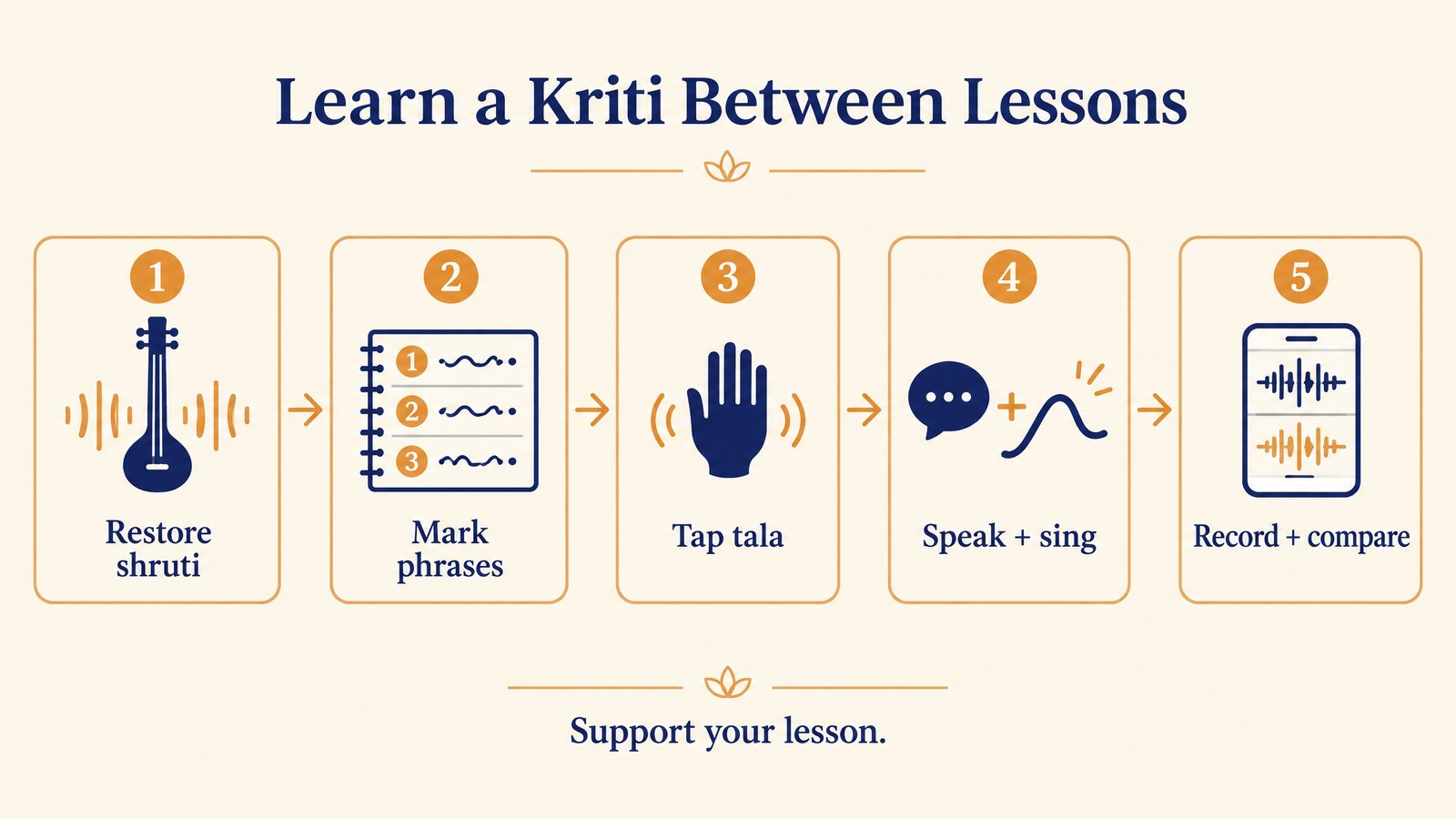
The Five-Pass Between-Lessons Method
Use the five passes on one short section at a time. A first session may cover only the opening and one later phrase. Return to that material the next day before adding more. This is between-lesson practice, not a substitute for lessons.
| Pass | Do this | Listen for | Ask your teacher if |
|---|---|---|---|
| 1. Restore shruti | Hear the tanpura, find Sa gently, then hear the teacher’s phrase once. | Whether the beginning of the phrase feels anchored to the same pitch centre. | You cannot locate the opening pitch without copying another recording. |
| 2. Identify boundaries | Mark a brief cue only after a natural-sounding edge. | Where a phrase begins, turns, breathes, or returns. | The line seems to break differently on every listen. |
| 3. Tap tala | Use the hand action or light pulse your teacher taught. Add singing only when that pulse remains steady. | Where words and melodic arrivals meet the cycle. | Counting makes the phrase collapse or you lose the taught pattern. |
| 4. Speak and sing sahitya | Speak one short unit at the taught pace, then sing it slowly. Join units only when both remain clear. | Vowel length, consonant joining, and the natural placement of the word. | You know the tune but cannot speak the words clearly, or the reverse. |
| 5. Record and compare | Make one plain recording and compare it with the approved model or bring it to the next lesson. | One difference in pitch, boundary, tala, or text. | You need repeated guesses to make your version match. |
The sequence is deliberate. Shruti comes first because a phrase recalled at an unstable pitch is difficult to judge. Boundaries come before long runs so you can check one part against the teacher’s model before joining it to the next. Tala is a framework, not a race. Revisit the tala guide for beginners if basic cycle language helps, while keeping your teacher’s hand action as the immediate reference.
Speaking the sahitya separately in pass four is useful because it reveals whether the difficulty is text, melody, or their connection. Use the syllable division shown or taught. A translation may help you understand the text, but it should not decide pronunciation or phrase division. The languages of Carnatic compositions guide offers context for approaching the words with care.
Compare and Prepare a Question
In the last pass, make one honest recording at a comfortable pace. Listen through once without stopping. Then name only one question: “Does the second phrase return where my teacher placed it?” or “Is this vowel held for the same duration?” One precise question is more useful at a lesson than a long list of doubtful corrections.
Bring the map and that question to class. A teacher can hear what the page cannot show: the curve of a gamaka, an approach to a note, a joined word, or the intended tala placement. Ask for the smallest helpful correction first, listen again, and revise just that part of the map.
Vidya Subramanian Academy draws an important boundary in its self-study material. Its audio-visual resources are intended to facilitate practice at a learner’s own pace, while complex compositions are described as best learned through live lessons. Treat the comparison stage in the same spirit. It keeps home practice connected to teaching rather than turning it into a private substitute.
Keep a Small Practice Log
Below the phrase map, add three short lines after a session: the date, the section you touched, and one next question. For example: “Tuesday, opening through first return, check the boundary before the final word.” This is not a scorecard. It prevents you from restarting an entire kriti whenever one detail becomes uncertain.
Start the next session by replaying yesterday’s small unit. If it remains clear, add the next one. If it does not, return to the first two passes. A short repeatable session is more valuable than a long run-through built on uncertain recall. The portfolio’s practice routine for working adults can help frame a manageable habit.
Frequently Asked Questions
Can I learn a Carnatic kriti only from notation?
Notation can remind you of text, order, or a broad swara route, but it cannot fully convey the teacher’s phrase shape, gamaka, pronunciation, or timing. Use it with sound and teacher guidance rather than in place of them.
How long should one between-lessons practice session be?
Practise for as long as you can listen accurately. Ten focused minutes on two small units can be more useful than repeating an uncertain full composition. Stop while you still know what you need to ask next.
Should I use another singer’s recording if I forget a phrase?
Not as a quick replacement for the version your teacher taught. Mark the gap, revisit an approved reference if one was shared, and ask at the next lesson. Another rendition may be valuable listening, but it can introduce a different route when you are retaining one assigned version.
What if I can sing the words but lose the tala?
Return to the teacher’s hand action or pulse without singing. Listen through the short phrase, tap it once, and add only the first unit of sahitya. If it remains unclear, bring that exact location to the teacher.
Is a phrase map the same as Carnatic notation?
No. A phrase map is a personal sketch made from a lesson. It uses a few words, arrows, and boundaries to help you find sounds again. It does not replace established notation, oral teaching, or the detailed musical knowledge carried in a rendition.
Conclusion
To memorise a teacher-assigned kriti by ear, keep the task small and faithful. Restore the taught shruti, hear one phrase, map only what you recognize, add tala carefully, and speak and sing sahitya in short units. Then record one attempt and carry one clear question to the next lesson. The method is a practical bridge between lessons, not a rigid notation system or a substitute for teaching.
Published by Medha Naada
This guide is published by Medha Naada, Medha Vidyabhushan's official portfolio. It combines the credited sources below with plain-language listening or learning prompts. Historical details, song credits, and public records are limited to the cited material.
A written guide can support listening and preparation, but a qualified teacher remains the right source for personal vocal technique, pronunciation feedback, or repertoire decisions.
How this guide is supported
This is a teacher-aligned retention guide for a composition already assigned in a lesson. The sources support aural-oral learning, guided listening, and the limited role of self-study aids. The five-pass method and phrase map are conservative Medha Naada editorial guidance.
- Customised pedagogical tools to aid aural-oral transmission: RagaCurve and gesture. Charulatha Mani, Finnish Journal of Music Education. Peer-reviewed context for aural-oral Carnatic learning and for visual aids that remain subordinate to listening and teacher guidance.
- The Advanced School of Carnatic Music. The Music Academy, Madras. Institutional context for practical Carnatic instruction and guided listening within an advanced learning programme.
- A Brief Introduction to Carnatic Music. Ludwig Pesch, Carnaticstudent. Learner-facing context for raga, tala, bhava, and linked kriti sections such as pallavi, anupallavi, and charanam.
- Free Self-Study Audio-Visual Lessons. Vidya Subramanian Academy. First-party educator guidance that self-paced resources can support practice while complex compositions are best learned through live lessons.