Devotional Tradition · 2026-10-01 · 9 min read
Thiruppavai for Margazhi: A 30-Day Carnatic Listening Path for Beginners
A gentle day-by-day Margazhi route through Andal’s 30 Thiruppavai pasurams, with trustworthy text guidance and Carnatic listening prompts.

Quick Facts
- Thiruppavai is Andal’s sequence of 30 Tamil pasurams, traditionally sung through the Tamil month of Margazhi.
- This route is sequential: one pasuram each day, from Margazhi Thingal to Vanga Kadal.
- Start with words, not a tune: use a stable Tamil or Romanised text alongside a translation.
- Carnatic settings vary: a raga and tala belong to a particular musical rendering, not automatically to every recitation of a pasuram.
- Begin gently: listen once for the text, once for the musical shape, and leave analysis for another day.
Margazhi is a natural time to meet Thiruppavai, whether it is already part of your home or you are opening this Tamil devotional poem for the first time. The Tamil Nadu Hindu Religious and Charitable Endowments Department describes Andal’s 30 hymns as being sung through Margazhi. That gives the work a distinctive seasonal home: not a generic Krishna playlist, but a month-long movement through one ordered text.
For a Carnatic beginner, the inviting part is that the route is already built in. There are thirty pasurams and, in the traditional order, thirty days. The challenging part is equally important: text, devotional recitation, and Carnatic concert treatment overlap, but they are not identical. Let the text lead. Music can illuminate it without turning every day into a raga-identification exercise.
Table of Contents
- [How to begin with a text, transliteration, and translation](#how-to-begin-with-a-text-transliteration-and-translation)
- [The 30-day listening path](#the-30-day-listening-path)
- [Why Carnatic settings differ from recital repertoire](#why-carnatic-settings-differ-from-recital-repertoire)
- [A light daily practice that honours the sequence](#a-light-daily-practice-that-honours-the-sequence)
- [Conclusion](#conclusion)
How to begin with a text, transliteration, and translation
Choose one dependable textual base before you press play. The Prapatti Romanised edition of Tiruppavai supplies the complete sequence in a consistent scholarly-style transliteration. Keep it open beside an English aid such as Oppiliappan Koil Sri Varadachari Sathakopan’s annotated commentary. The first is for following the Tamil sounds and word divisions; the second is for returning to meaning after listening.
Do not switch among five spellings of the same line just because recordings spell Tamil differently. Pick one Romanisation for the month. Notice its conventions, especially letters such as zh, L, N, and doubled consonants. Read the first line silently, hear it sung, then find that line on the page. This small loop is more useful than attempting to reproduce every sound at once. If you are learning to sing rather than simply listen, ask a Tamil-speaking teacher to check the sounds that a Roman spelling cannot explain.
Three simple rules keep the learning respectful and manageable:
- Treat the Tamil text as primary. Translation explains; it does not replace the pasuram.
- Use one recording for continuity when possible. A reliable recorded sequence can help you hear how one day leads to the next.
- Mark only what you can hear. Circle a repeated name, a phrase ending, or a return to the refrain. If you want help seeing lyric under melody, this introduction to reading Carnatic notation is a useful companion, but notation is optional here.
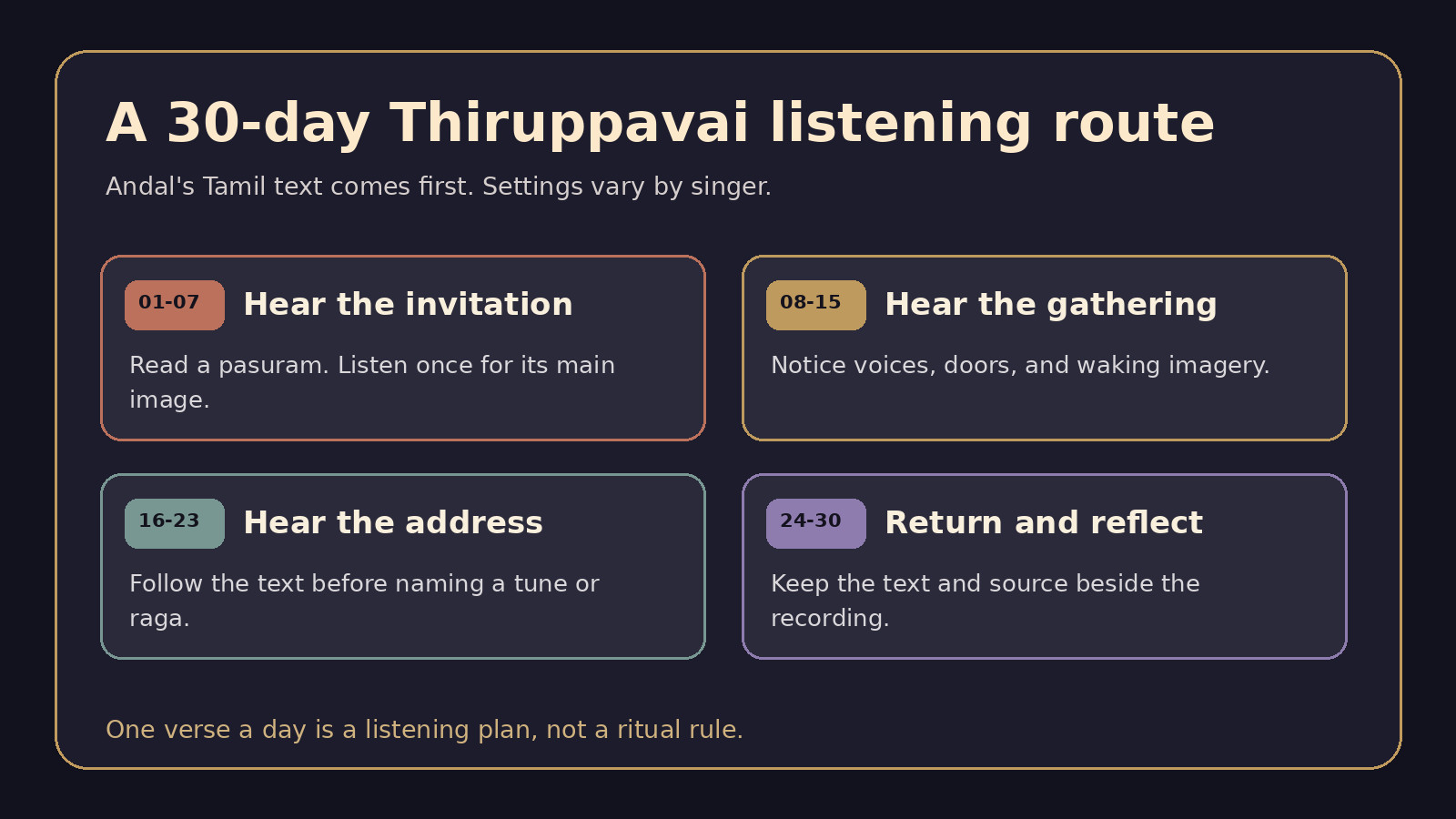
The 30-day listening path
Use the table as a route, not a test. The opening words identify each pasuram even when an album uses slightly different Roman spelling. If you begin mid-month, start at Day 1 and continue for thirty days rather than trying to catch up.
| Day | Pasuram opening | Gentle listening prompt |
|---|---|---|
| 1 | Margazhi Thingal | Hear the opening invitation. Which words feel like a gathering call? |
| 2 | Vaiyattu Vazhvirgal | Listen for the shift from invitation to shared commitments. |
| 3 | Ongi Ulagalandha | Let the recurring divine name settle before seeking every detail. |
| 4 | Aazhi Mazhai Kanna | Notice how the singer shapes the rain imagery with pace and emphasis. |
| 5 | Maayanai Mannu | Follow the movement between singing aloud and holding a thought inwardly. |
| 6 | Pullum Silambina Kaan | Listen for the morning soundscape: birds, conch, and awakening. |
| 7 | Keesu Keesu | Hear the busy, conversational energy before trying to sing along. |
| 8 | Keezhvaanam Vellendru | Listen for dawn arriving through images rather than explanation. |
| 9 | Thoomani Maadathu | Notice the intimate act of calling at a door. |
| 10 | Notru Suvargam | Track the playful urgency of asking someone to wake. |
| 11 | Katru Karavai | Hear how the address to one companion enlarges into a group voice. |
| 12 | Kanaitthu Ilam Kattrerumai | Pause over the animal imagery and its unhurried detail. |
| 13 | Pullin Vaai Keendanai | Listen for praise and invitation occupying the same verse. |
| 14 | Ungal Puzhakkadai | Let the images of pond, flower, and temple bell set the scene. |
| 15 | Elle Ilam Kiliye | Enjoy the dialogue. Where does the voice sound teasing or affectionate? |
| 16 | Nayaganai Ninra | Notice the threshold: the group now speaks at the gate. |
| 17 | Ambarame Thanneere | Listen to the successive addresses without rushing their order. |
| 18 | Undu Mada Kalitran | Hear the request to Nappinnai as a change in dramatic focus. |
| 19 | Kuthu Vilakkeriya | Follow the still interior scene before looking for musical flourish. |
| 20 | Muppathu Moovar | Listen for direct appeals and the names that carry them. |
| 21 | Ettra Kalangal | Stay with the overflowing milk image and its sense of abundance. |
| 22 | Angan Maa Gnalathu | Notice the image of rulers approaching with humility. |
| 23 | Maari Malai Muzhanjil | Hear the lion image unfold slowly; do not force a literal reading. |
| 24 | Anru Ivvulagam | Count the acts of praise you can recognise in the text. |
| 25 | Oruthi Maganai | Listen for the narrative tension in this address to Krishna. |
| 26 | Maale Manivanna | Notice how requests for the observance are voiced as a list. |
| 27 | Koodaarai Vellum | Hear the communal warmth in gifts, food, and being together. |
| 28 | Karavaigal Pin Sendru | Listen for humility in the speakers’ description of themselves. |
| 29 | Sirram Sirukale | Let the early-morning arrival and wish for service become the focus. |
| 30 | Vanga Kadal | Return to the whole path: Andal names the thirty-verse Tamil garland. |
Why Carnatic settings differ from recital repertoire
A pasuram is the text. A Carnatic setting is one musician’s or tradition’s musical realisation of that text. The setting may give it a raga, tala, melodic turns, pauses, sangatis, and a performance length. It can be beautiful and carefully taught, but it should not be mistaken for the only way the pasuram exists.
That matters because Thiruppavai may be heard as devotional recitation, in a complete seasonal sequence, in a bhajan-style presentation, or as a concert arrangement. A concert listener may be tempted to ask, “What is the raga of this pasuram?” Better questions are: “Whose setting is this?” and “Does this recording identify its raga and tala?” A label on one album describes that version, not a universal rule for the text.
Keep the distinction clear as you choose a recording: Andal is the author of the pasurams, while the musical arrangement you hear belongs to a particular singer or tradition. Check the recording credit before sharing a raga or tala label. A devotional text need not behave like a fixed concert kriti. For context, see what makes a Carnatic kriti.
For this month, postpone comparisons among versions. First hear where syllables land, where a line is repeated, and where the refrain resolves. Later, use the beginner’s raga guide to name broad melodic colour and the tala guide to feel the pulse without turning the pasuram into a counting drill.
A light daily practice that honours the sequence
Give each day ten quiet minutes, or less if that is what you have. Read the pasuram opening from your chosen text. Listen once without following lyrics. On the second pass, track the Romanised lines with a finger and notice one feature from the table. Then read only a short portion of the accompanying translation.
Keep a one-line notebook, not an elaborate score: “Day 6: the conch image arrived after the birds,” or “Day 19: I noticed the lamp before the melody.” This preserves attention without claiming mastery. If you are observing Margazhi, place the listening within your own family or temple practice. If you are discovering it, listen as a guest: retain the order, pronounce cautiously, and let interpretation deepen gradually.
A missed day is not a failed observance. Resume with the next pasuram, or repeat the day that stayed with you. The lasting habit is not perfect coverage. It is learning to recognise a line of Tamil, a collective voice, and a musical setting as related but distinct forms of attention.
Frequently Asked Questions
Do I need to know Tamil to begin?
No. Begin with the Tamil script if you read it, or a consistent Romanised text if you do not. Use translation after the first listen. Over time, recognising openings and repeated phrases is a meaningful first step, even before you understand every word.
Must I listen before dawn?
No. Early-morning Margazhi practice is important to many observant communities, but a beginner listening route should fit real life. Choose a quiet, repeatable time and approach the text with attention rather than treating the schedule as a performance requirement.
Is there one correct raga for each pasuram?
Not across all Carnatic renderings. A recording or notation may name a raga and tala for its own setting. Follow those labels within that version, but do not turn them into permanent labels for Andal’s words without checking the source and tradition.
Should I sing along with the recording?
Listen first. When a refrain or short phrase feels familiar, hum softly with it while keeping the text visible. For precise diction and full singing, learn from a qualified teacher or a trusted tradition rather than relying on auto-generated lyrics.
Where does tala fit into a beginner’s practice?
Let tala come after the words are comfortable. You may tap gently when the recording makes the pulse clear, but stop if counting pulls attention away from the pasuram. The goal is a responsive ear, not a tempo test.
Conclusion
Thiruppavai rewards a slow, ordered Margazhi listen. Thirty days turn an unfamiliar body of Tamil poetry into recognisable voices, images, names, and phrases. Begin with a dependable text, let translation support rather than replace it, and receive Carnatic music as a considered setting rather than a shortcut around the words. By Day 30, the aim is simple: to have travelled Andal’s sequence with more care than you began with.
Published by Medha Naada
This guide is published by Medha Naada, Medha Vidyabhushan's official portfolio. It combines the credited sources below with plain-language listening or learning prompts. Historical details, song credits, and public records are limited to the cited material.
A written guide can support listening and preparation, but a qualified teacher remains the right source for personal vocal technique, pronunciation feedback, or repertoire decisions.
How this guide is supported
This is a beginner listening guide, not a ritual manual, definitive theological commentary, pronunciation certification, or substitute for learning from a qualified Srivaishnava teacher. It distinguishes Andal’s Tamil text from later Carnatic settings and deliberately does not assign one canonical raga, tala, tempo, or recording to any pasuram. Translation is offered only as a listening aid; readers should consult the linked specialist text and commentary for fuller interpretation.
- Hindu Religious and Charitable Endowments Department Policy Note 2022-23. Government of Tamil Nadu, Hindu Religious and Charitable Endowments Department. States that Saint Andal sang 30 hymns called Thiruppavai, sung through the Tamil month of Margazhi, and notes temple recitation activity.
- tiruppavai. Sunder Kidambi. Provides a complete, consistently Romanised text of all 30 pasurams in their traditional order, including the opening words used in the day-by-day route.
- SrI Andal’s ThiruppAvai: Annotated Commentary in English. Oppiliappan Koil Sri Varadachari Sathakopan. Provides an English annotated commentary with a contents list covering pasurams 1 through 30 and identifies the work as Andal’s Thiruppavai.