Concert Guide · 2026-10-01 · 11 min read
Tyagaraja Aradhana Pancharatna Kritis: A First-Time Participant’s Group-Singing Guide
A January-ready guide to joining a Tyagaraja Aradhana goshti gaanam, from the five Pancharatna Kritis to Varali care and group etiquette.
Quick Facts
- The Ghana Raga Pancharatna Kritis are five compositions by Tyagaraja, commonly sung together in a Tyagaraja Aradhana goshti gaanam.
- The usual sequence is Jagadanandakaraka in Nata, Dudukugala in Gaula, Sadhinchene in Arabhi, Kanakanaruchira in Varali and Endaro Mahanubhavulu in Sri.
- All five are customarily listed in Adi tala, but the version, pitch and practical cues belong to the local organiser and your guru.
- A goshti gaanam is shared singing, not five back-to-back solo performances. Listening, blend and steady tala matter as much as knowing the words.
- Give Kanakanaruchira in Varali extra, unhurried preparation. Its historical association with careful transmission still shapes how participants approach it.
When Tyagaraja Aradhana approaches, the five Pancharatna Kritis become a practical question for many first-time participants: how do you join a group without losing your place?
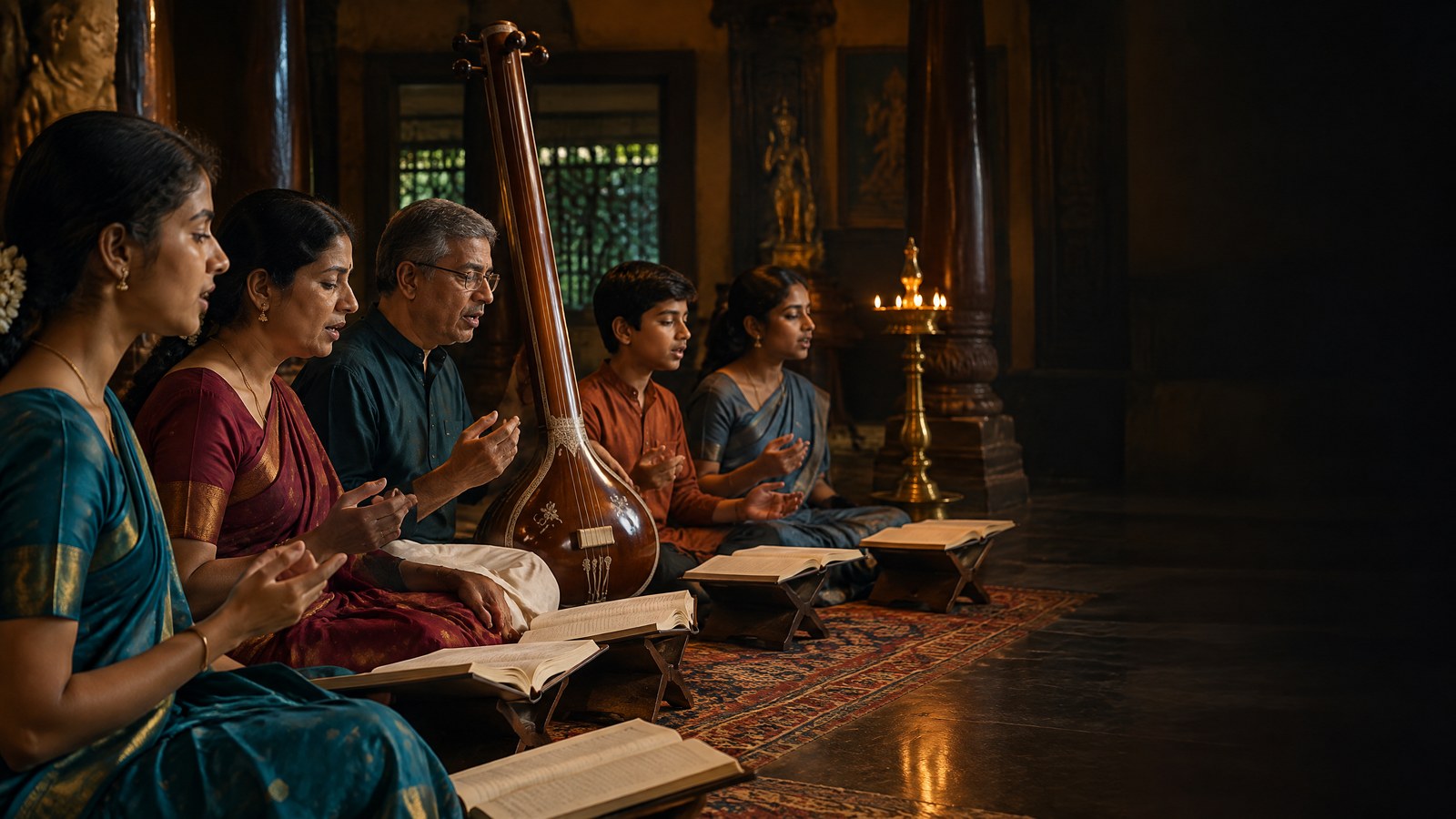
For a first-time singer, the Pancharatnams can look intimidating on paper: five long kritis, several charanams, different ragas, and a room full of musicians who seem to know exactly when to move. The more useful frame is simpler. You are joining a collective homage. The Madras Music Academy’s Aradhana account describes gathered vidwans and vidushis singing the Ghana raga Pancharatna Kritis as a musical homage to Tyagaraja. Your job is to arrive prepared enough to contribute respectfully, listen well enough to stay with the group, and let your guru’s version lead the way.
Table of Contents
- [The five Pancharatna Kritis: a shared map](#the-five-pancharatna-kritis-a-shared-map)
- [Build a January preparation plan with your guru](#build-a-january-preparation-plan-with-your-guru)
- [How to join the goshti without losing the thread](#how-to-join-the-goshti-without-losing-the-thread)
- [Why Varali needs extra care](#why-varali-needs-extra-care)
- [Sahitya and meaning: sing with attention, not anxiety](#sahitya-and-meaning-sing-with-attention-not-anxiety)
- [Conclusion](#conclusion)
The five Pancharatna Kritis: a shared map
Pancharatna means “five gems.” In this context, it refers to Tyagaraja’s five Ghana raga kritis, a group that has become central to Aradhana observances. The widely used order below is the one a new participant should recognise before walking into a rehearsal. The titles have more than one romanised spelling, so treat the event handout or your guru’s notation as the spelling and text to follow.
| Usual order | Kriti | Raga | Tala | Composer | A useful first-time cue |
|---|---|---|---|---|---|
| 1 | Jagadanandakaraka | Nata | Adi | Tyagaraja | The opening kriti; it is in Sanskrit and establishes the shared start. |
| 2 | Dudukugala | Gaula, also written Gowla | Adi | Tyagaraja | Settle back into the common pulse after the opening piece. |
| 3 | Sadhinchene | Arabhi | Adi | Tyagaraja | Keep an eye on the lead at each return and section change. |
| 4 | Kanakanaruchira | Varali | Adi | Tyagaraja | Use your prepared version and listen especially closely for its characteristic movement. |
| 5 | Endaro Mahanubhavulu | Sri | Adi | Tyagaraja | A collective salutation to great souls and a natural communal close. |
The order is a map, not permission to override a local tradition. A programme may have a prayer or another composition before the five. For example, some organisations place Sri Ganapathini before the Pancharatnams, while making clear that it is not one of the five. Printed editions and lineages can also differ in charanam order or in which sangatis and swara passages they use. Do not use a recording from another school to “correct” the group.
It helps to know what a kriti contains before you confront a page of notation. Start with this short guide to what a kriti is in Carnatic music, then return to the version your teacher has taught. That one version is far more valuable to a goshti than five partly learned versions.
Build a January preparation plan with your guru
Start earlier than the week of the Aradhana if you can. The goal is not a hurried recital-level polish. It is reliable recall: the opening phrase, the words, the tala, the returns, and the moments where your group changes section. A short, focused plan is kinder to both voice and memory than repeatedly running the entire set without a purpose.
-
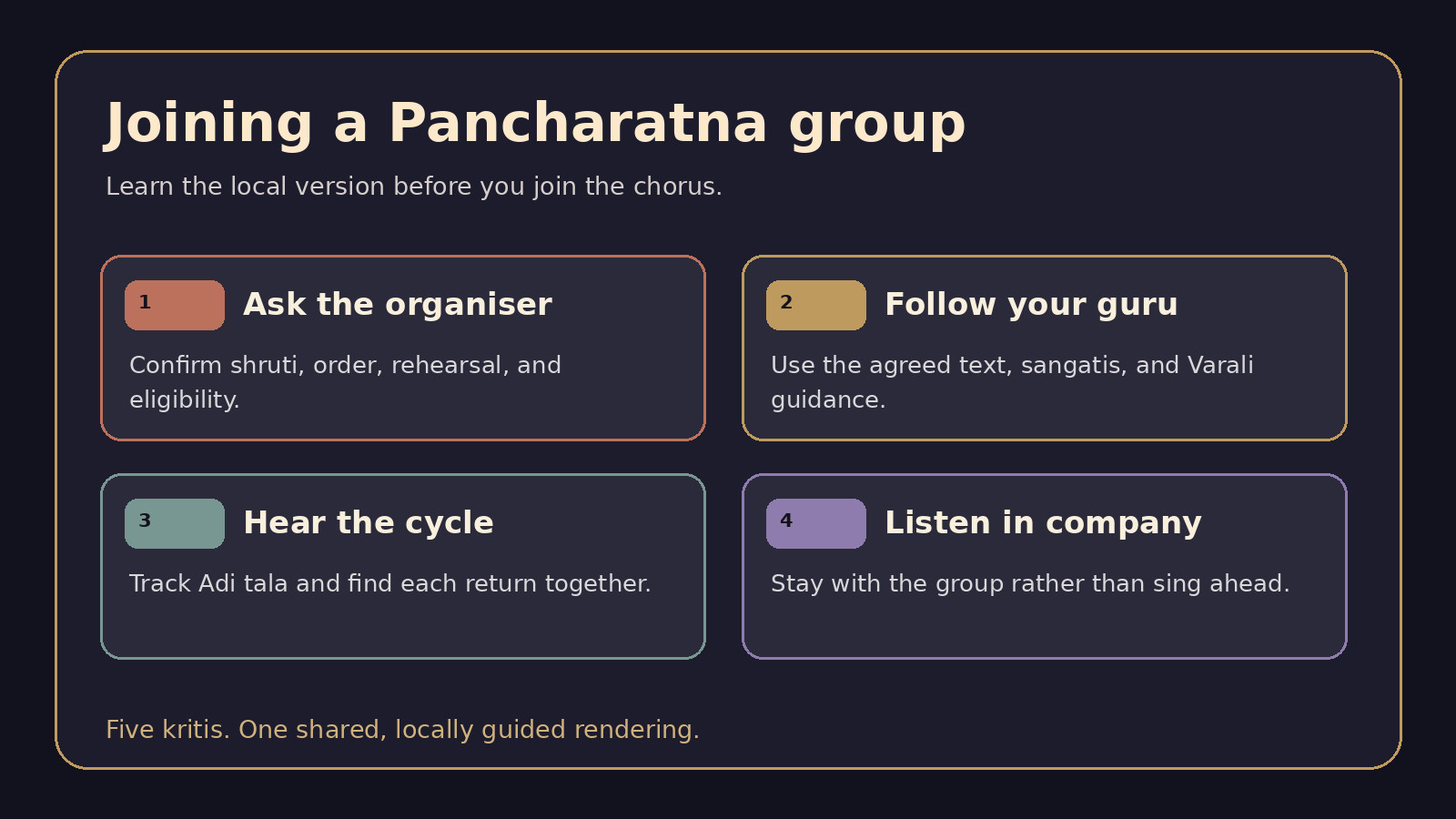
Get the event facts first. Ask the organiser or your teacher for the date, reporting time, dress guidance, shruti arrangement, eligibility, whether notation is allowed, and whether a dedicated practice is required. Some community events divide singers by shruti or standardise a particular rendering. That makes early confirmation essential.
-
Create one guru-approved packet. Keep one clean copy of lyrics and notation, in the script or transliteration you read most securely. Mark the pallavi, anupallavi and each charanam, plus any agreed repeats. If you need help navigating the page, use this primer on reading Carnatic notation alongside, not instead of, your lesson.
-
Ask precise musical questions. Work through the first line and return line of each kriti with your guru. Confirm the charanam sequence, sangatis expected in the group, how much of any swara passage is to be sung, and where the text enters in relation to Adi tala. “Which version do we use at this Aradhana?” is a much better question than “Which YouTube version is correct?”
-
Practise in small passes. One day, rehearse only pallavis and the first lines of charanams. Another day, speak the words in tala. Then sing two adjacent kritis without stopping, because that is where attention often slips. Use a quiet hand motion or finger count to internalise the eight-beat cycle. This beginner’s Adi tala guide can help you understand the framework.
-
Attend the group rehearsal as a listening rehearsal. Learn the starting pitch, pace, leader’s gestures, page-turn rhythm and ending cue. If you can, stand or sit where you can see an experienced singer without blocking anyone’s view. Familiarity with these ordinary details lowers the pressure on the day.
How to join the goshti without losing the thread
A goshti gaanam works because each participant makes room for the collective sound. You do not need to sing louder to be present. Aim for a comfortable, supported voice that joins the pitch rather than competing with it. The ensemble is your safety net, but it also asks you to be alert.
Before singing begins, tune discreetly to the announced shruti and put your materials in the order of the programme. Follow the event’s seating or standing instructions. Once the leader gives the start, watch the lead singers more than your own page. Their breath, head movement or hand cue often reveals a turn before the printed line does.
Keep tala in a way that is clear to you and unobtrusive to others. If the group’s visual tala is small, match it. If you lose your place, do not rush through guessed syllables to catch up. Listen for the next pallavi or the next clearly familiar phrase, re-enter lightly, and continue. This is both musically safer and less distracting than trying to force a recovery.
A few habits make a real difference:
- Blend before embellishing. Add only the sangatis and gamakas your group has rehearsed.
- Look up at transitions. Charanam changes and swara sections are where a page alone may not be enough.
- Leave space for the lead. The leader establishes pace and phrasing; your role is to reinforce that shared decision.
- Protect the atmosphere. Keep phones silent, turn pages quietly, and follow the organiser’s cues for when to sit, stand, begin and finish.
If a raga feels abstract, do not try to reduce it to a bare scale on the spot. Read this raga guide for Carnatic beginners for the idea of raga identity, then hear how your teacher applies that identity in these exact compositions.
Why Varali needs extra care
Kanakanaruchira is the fourth kriti, in Varali, and it deserves a little extra patience before a first goshti. Varali’s identity depends greatly on how notes are approached and ornamented. A participant who knows only approximate pitches can unintentionally flatten the character of the raga, even while keeping the words and tala moving. Slow, teacher-led repetition is more useful here than trying to copy a fast group recording.
There is also a historical reason Varali is discussed with special care. Accounts of the early choral Pancharatnam at Tiruvaiyaru recount a custom against learning Varali directly from a guru. In the 1949 story, Maharajapuram Viswanatha Iyer reportedly sang from an upper floor while musicians below followed, a workaround to that custom. The same account notes more muted participation in this piece than in the other four.
That history is context, not a reason to make Varali mysterious or to bypass your teacher. Learning practices today vary by guru and community. Respect the approach your guru chooses, ask for a slow demonstration of the phrases that identify the raga, and confirm exactly what the event expects you to sing. On the day, let the experienced Varali voices set the contour. A steady, attentive contribution is better than an anxious attempt to project every phrase.
Sahitya and meaning: sing with attention, not anxiety
The Pancharatnams are not merely a raga checklist. Their sahitya gives the group singing its purpose. Jagadanandakaraka is in Sanskrit; the other four are in Telugu. You do not need to produce a scholarly translation before participating, but you should know which text you are saying and where its words divide.
Ask your guru for an approved lyric sheet and a concise explanation of each kriti’s central address or idea. For a new participant, that is enough to avoid treating the words as filler between musical phrases. Pronounce consonants and vowel lengths as your teacher models them. Keep word boundaries intact even when the melodic line stretches a syllable. Roman transliteration is a bridge, not a universal pronunciation system, so do not assume that an English-looking spelling tells you everything.
A small ritual before rehearsal can help: read the pallavi aloud, mark one difficult word division, then sing it once in tala before opening the full notation. It turns “I have to memorise five long songs” into the more manageable task of understanding the next phrase. In a group homage, that attention to sahitya is part of the offering.
Frequently Asked Questions
Do I need to know every charanam before I join a goshti gaanam?
Follow the organiser’s participation rules and your guru’s advice. Some events expect full preparation, while others welcome learners in supervised sections. If you are approved to participate, learn as much of the agreed version as possible and have a clear plan for rejoining after a difficult passage.
Is the Pancharatna order always exactly the same?
The Nata, Gaula, Arabhi, Varali and Sri sequence is the commonly published order. Preliminary items, charanam ordering and local rendition choices can differ. The programme leader’s order is the one to follow in the room.
Are all five Pancharatna Kritis in Adi tala?
Yes, the standard five are commonly listed in Adi tala. That shared tala is helpful, but it does not make every entry, phrase length or section transition identical. Learn each kriti’s own text and phrasing with your guru.
Why should I be quieter or more cautious in Varali?
The point is not to disappear. Varali calls for particularly careful pitch, gamaka and phrasing because its character is easy to blur with approximate singing. Listen to the established group sound and sing the material you have genuinely learned.
May I use notation during the group singing?
Bring it only if the organiser permits it, and use the approved local version. Secure it in programme order and practise turning to the next page without fuss. Your eyes should still return regularly to the lead singers and tala cues.
Conclusion
Your first Pancharatna goshti need not be a test of whether you can out-sing the room. It is preparation meeting participation: learn the five-piece map, commit to your guru’s version, keep Adi tala steady, and let the ensemble guide you when the page becomes busy. Arrive especially prepared for Varali, and arrive ready to listen. In that shared attention, the five kritis become what an Aradhana asks of them: a collective musical homage.
Published by Medha Naada
This guide is published by Medha Naada, Medha Vidyabhushan's official portfolio. It combines the credited sources below with plain-language listening or learning prompts. Historical details, song credits, and public records are limited to the cited material.
A written guide can support listening and preparation, but a qualified teacher remains the right source for personal vocal technique, pronunciation feedback, or repertoire decisions.
How this guide is supported
This is a first-time participant guide, not a definitive edition of the Pancharatna Kritis. It reports the commonly published five-piece order, raga and tala list and explains why local organisers and a participant’s guru remain the authority for shruti, notation, charanam order, sangatis, swara passages, pronunciation, eligibility and event etiquette. It does not claim that Tyagaraja himself fixed the present collective format, offer authoritative lyric translations, or prescribe a universal method for learning Varali.
- Tyagaraja Aradhana 2024. The Music Academy, Madras. Documents the Academy’s 2024 programme: puja and nagaswaram followed by goshti gaanam of Tyagaraja’s Ghana raga Pancharatna Kritis by gathered musicians as a musical homage.
- How did the Pancharatna kritis originate?. Sriram V., The Hindu. Identifies the five titles, Nata, Gaula, Arabhi, Varali and Sri ragas, and Adi tala; also supports the language distinction, choral-history context, lineage variation caveat and the historical account of Varali’s special challenge.
- Pancharatna Kritis. Chicago Tyagaraja Utsavam. Lists the standard five with their ragas and Adi tala and illustrates participant-facing group practice, including rehearsals, participation guidelines and locally standardised renderings.
- Tyagaraja Aradhanai. Indira Gandhi National Centre for the Arts. Government cultural institution event record stating that vocalists and instrumentalists from across Delhi would gather to sing Tyagaraja’s Pancharatna Kritis.