Song Meaning · 2026-09-19 · 8 min read
Devaki Kanda Mukunda: A Purandara Dasa Keerthane for Krishna Listening
A careful Devaki Kanda Mukunda guide with Kannada and Roman text routes, Krishna-name context, the Purandara Vittala ankita, Pilu and Adi source notes, and official Medha listening paths.
Quick Facts
- The curated Purandaradasa song record classifies Devaki Kanda Mukunda as a Keerthane and places it under Krishna Stuti and Nama Smarane.
- Its lyric record identifies Purandara Vittala as the ankita, or devotional signature, and prints the closing line with that name.
- The cited printed-text record gives Pilu as the raga and Adi as the tala; a separate Carnatic lyric record independently lists the same setting.
- Medha Vidyabhushan’s official Reel presents her release as written by Sri Purandara Dasaru and composed by Sri Govindacharya. That is a credit for this recording context, not a claim that every performance uses one fixed tune.
- A useful first listen is to follow the refrain, then pick one group of Krishna names in a charana rather than trying to absorb every word at once.
Devaki Kanda Mukunda begins with a compact address: “son of Devaki, Mukunda.” The song unfolds Krishna through names, attributes, and narrative associations. Each return to the refrain gives the ear a home point, while each charana adds a new lens. This guide stays close to the available text witnesses and separates them from performance-specific credits.
Table of Contents
- [Start with the Refrain](#start-with-the-refrain)
- [Where to Read the Lyrics in Kannada, English, or Telugu](#where-to-read-the-lyrics-in-kannada-english-or-telugu)
- [What the Krishna Names Are Doing](#what-the-krishna-names-are-doing)
- [What Purandara Vittala Tells a Listener](#what-purandara-vittala-tells-a-listener)
- [Raga, Tala, and Recording Credits](#raga-tala-and-recording-credits)
- [A Practical Listening and Practice Plan](#a-practical-listening-and-practice-plan)
- [Conclusion](#conclusion)
Start with the Refrain
The opening, dEvaki kanda mukunda, calls Krishna by two names. “Devaki kanda” identifies him as Devaki’s child. “Mukunda” is a devotional name for Krishna or Vishnu. The lyric text then moves quickly from that intimate birth reference to a wide devotional portrait: the one who raises up the world, bears conch and discus, has lotus-like eyes, loves Rukmini, protects the Pandavas, and destroys Kamsa.
That movement is worth hearing before it is translated word by word. The refrain is personal and direct. The charanas expand its frame. A listener can notice the composition changing scale without needing to settle every theological detail on the first pass.
The source text also contains the phrase navanIta chOra, commonly read as “butter thief.” It recalls the Krishna of childhood stories. Elsewhere, shanKha chakra-dhara names the bearer of conch and discus. The song therefore places playful, child-centered imagery beside the iconography and epic associations of Vishnu. It does not need to choose only one image of Krishna.
Where to Read the Lyrics in Kannada, English, or Telugu
The most reliable starting point is the curated song record. It links to a Kannada PDF and an English-script PDF. Here “English” means Roman transliteration, not a full English prose translation. The latter is still useful because it lets readers sound out the Kannada text while listening.
For a brief orientation, the refrain appears as follows:
| Reading route | Opening line | Best use |
|---|---|---|
| Kannada | ದೇವಕಿ ಕಂದ ಮುಕುಂದ | Read the original script alongside the song record |
| Roman transliteration | dEvaki kanda mukunda | Follow syllables while listening |
| Plain English sense | “O Mukunda, child of Devaki” | Understand the direct address without mistaking it for a line-by-line critical translation |
| Telugu reading support, editorial phonetic aid rather than a source edition | దేవకి కంద ముకుంద | Compare each phrase against the Kannada or Roman source text |
The Telugu line is a phonetic reading aid, not a newly edited Telugu lyric edition. Use the Kannada and Roman-script PDFs as the text-checking base, and ask a language teacher about a word or pronunciation when accuracy matters.
For the whole song, follow the original PDF’s separation into pallavi and five charanas. The guide to languages in Carnatic compositions offers a broader way to approach a text without treating one English gloss as the entirety of its meaning. Readers looking for the devotional-song context can also begin with What Are Dasarapadas?.
What the Krishna Names Are Doing
The charanas work like a chain of short invocations. Each phrase calls up a feature, relationship, or story, but the song does not narrate every episode. The listener supplies connections through memory, reading, or repetition.
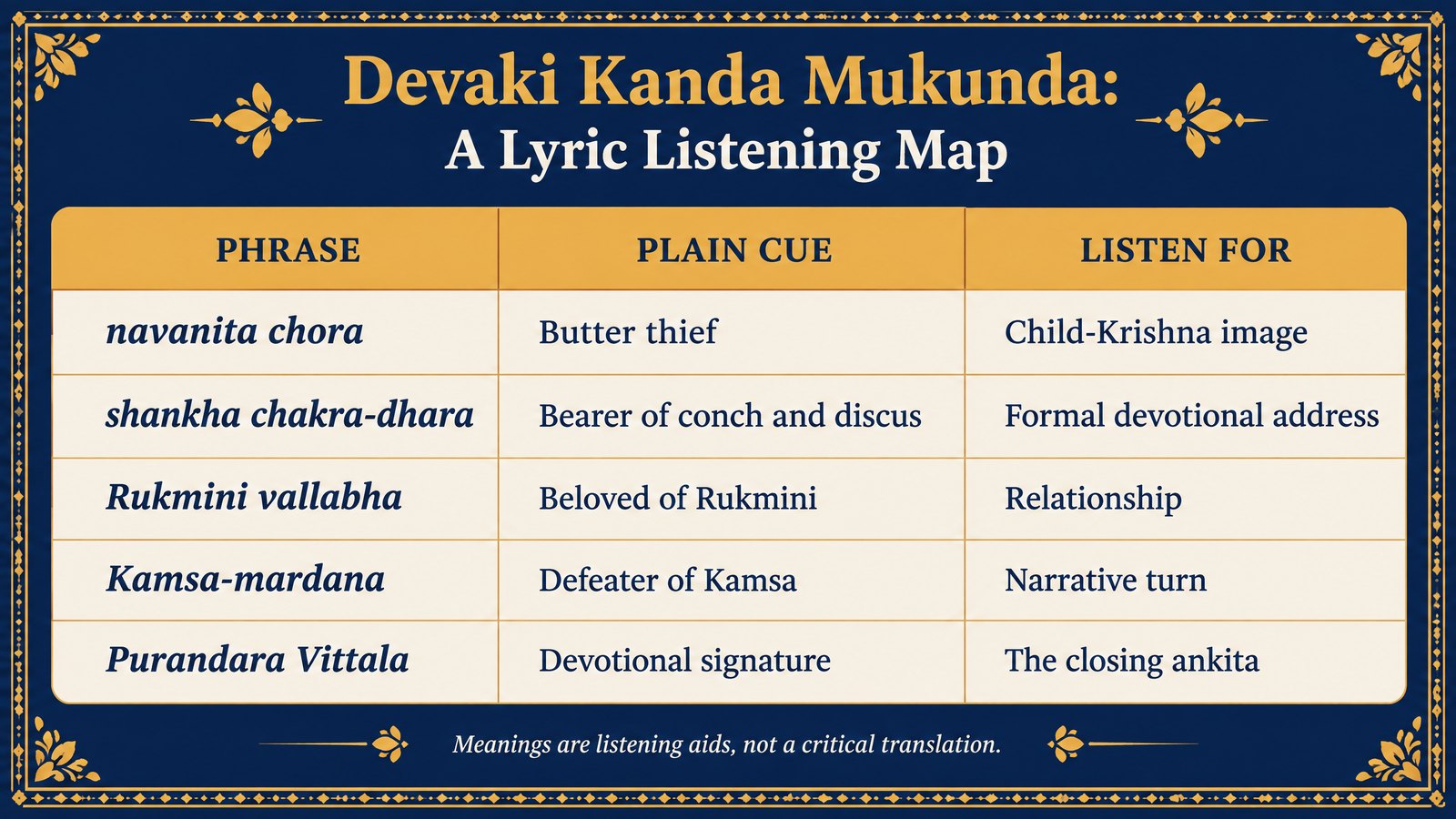
| Lyric cluster in transliteration | Plain listening cue | What it adds to the portrait |
|---|---|---|
| navanIta chOra | Listen for the child-Krishna image | The familiar butter-thief association |
| shanKha chakra-dhara | Notice the formal devotional address | Krishna/Vishnu as bearer of conch and discus |
| rukumiNi vallabha, pAnDava pOsha | Hear relationships named in sequence | Rukmini’s beloved and protector of the Pandavas |
| kamsa-mardana | Listen for a narrative turn | The defeat of Kamsa |
| puranda viTTala | Notice the closing signature | The composer’s devotional ankita in the final charana |
A plain-language gloss is an entry point, not a replacement for Kannada. For example, jagadOddhAra is often rendered as “uplifter” or “sustainer of the world,” but one English word cannot carry every devotional shade.
This naming practice also connects the song with the library’s Hari Narayana meaning guide. Both pieces invite attentive listening to divine names, but they should not be flattened into the same song or treated as interchangeable texts.
What Purandara Vittala Tells a Listener
An ankita is a signature name used by a composer. The final charana reads puranda viTTala sakala guNa pUrNa, and the record labels the ankita “Purandara Vittala.” It is part of the praise of Krishna while also identifying the devotional voice associated with Purandara Dasa.
The signature is not merely a historical label outside the lyric. It is audible in the final movement, gathering the preceding Krishna epithets into the composer’s chosen devotional address.
This does not make every occurrence of “Vittala” a simple author tag in every Haridasa composition. Context still matters. But here the supplied lyric and song record make the association explicit. For wider background, see the library’s guide to Purandara Dasa’s compositions and its article on Purandara Dasa and the Pandharpur Vittala connection.
Raga, Tala, and Recording Credits
The source PDF cites three named editions and gives rAga: pIlu and tALa: Adi. Karnatik independently identifies Pilu and Adi tala. This supports describing the printed setting as Pilu in Adi, not claiming identical phrasing or tempo in every rendition.
The official Medha Reel says that her release is written by Sri Purandara Dasaru and composed by Sri Govindacharya. This recording documentation should remain separate from the lyric edition’s raga and tala notation. Her official site also lists “Devaki Kanda Mukunda” among its video highlights.
A Practical Listening and Practice Plan
Begin with one five-minute session. First, listen through without pausing and return only to the refrain. On the second pass, follow the Roman PDF and mark one name you recognize, perhaps Govinda, RukumiNi vallabha, or kamsa-mardana.
On the third pass, choose one charana. Read it slowly from the Roman text, then listen for where the phrase begins and settles. If learning to sing it, use a teacher’s version or a well-credited recording as the musical model. Text guides words and order, but cannot fully capture pronunciation, pauses, gamaka, or shaping. The notation guide explains why written symbols and sung realization need each other.
Frequently Asked Questions
Where can I find Devaki Kanda Mukunda lyrics in Kannada?
Use the Kannada PDF linked from the curated song record. It identifies the song as a Keerthane and prints the pallavi and five charanas.
Is there an English translation of Devaki Kanda Mukunda?
The linked English PDF is Roman transliteration, not a complete prose translation. Use it with the Kannada text and a brief phrase-by-phrase sense.
Can Telugu readers follow the song?
Yes. The Telugu-script opening here is a phonetic aid. Use the Kannada and Roman PDFs as the complete-text base, then seek language help for meaning or pronunciation.
What does Purandara Vittala mean in this song?
It is the ankita named by the curated record and heard in the last charana. In context, it functions as Purandara Dasa’s devotional signature within the lyric.
What raga and tala are listed for Devaki Kanda Mukunda?
The cited lyric PDF lists Pilu and Adi tala, and Karnatik independently lists the same raga and tala. These are documented song-setting details, not instructions that every rendition must sound identical.
Conclusion
Devaki Kanda Mukunda offers a route into Krishna-centered Dasarapada listening: begin with Devaki’s child, follow the chain of names, and wait for Purandara Vittala at the close. Keep the Kannada and Roman sources beside the recording, and let one charana at a time become familiar.
Published by Medha Naada
This guide is published by Medha Naada, Medha Vidyabhushan's official portfolio. It combines the credited sources below with plain-language listening or learning prompts. Historical details, song credits, and public records are limited to the cited material.
A written guide can support listening and preparation, but a qualified teacher remains the right source for personal vocal technique, pronunciation feedback, or repertoire decisions.
How this guide is supported
This lyric guide distinguishes source text, transliteration, name-level explanation, printed raga and tala details, and Medha's recording credit. The Telugu line is explicitly an editorial phonetic aid rather than a source edition.
- Devaki Kanda Mukunda curated song record. Purandaradasa Songs, Lyrics, and Resources. Keerthane classification, Purandara Vittala ankita, Krishna Stuti and Nama Smarane categories, and links to the Kannada and Roman-script text.
- Devaki Kanda Mukunda Roman-script lyric PDF. Purandaradasa Songs, Lyrics, and Resources. The pallavi and five charanas, printed source references, closing Purandara Vittala line, and the listed Pilu and Adi setting.
- Devaki Kanda lyric and setting record. Karnatik. Independent support for Purandara Dasa attribution, Kannada text, Pilu raga, and Adi tala.
- Devaki Kanda Mukunda official Reel. Medha Vidyabhushan. Medha's release context and its visible writer and recording-composer credits only.