Song Meaning · 2026-09-19 · 8 min read
Innum En Manam: How a Charukeshi Pada Varnam Tells Its Story
Explore the meaning of Innum En Manam and hear how its Tamil text, Charukeshi raga, Adi tala, and pada varnam form shape a direct address to Krishna.

Quick Facts
- Innum En Manam is a Tamil varnam attributed to Lalgudi G. Jayaraman, in Charukeshi raga and Adi tala.
- Its opening asks Krishna whether it is fair to behave as if he does not know the speaker's heart.
- The text calls Krishna Yadava, Madhava, lotus-eyed one, gem-hued one, and beautiful flute-player.
- A pada varnam gives substantial attention to sahitya, or lyric text, as well as swara passages.
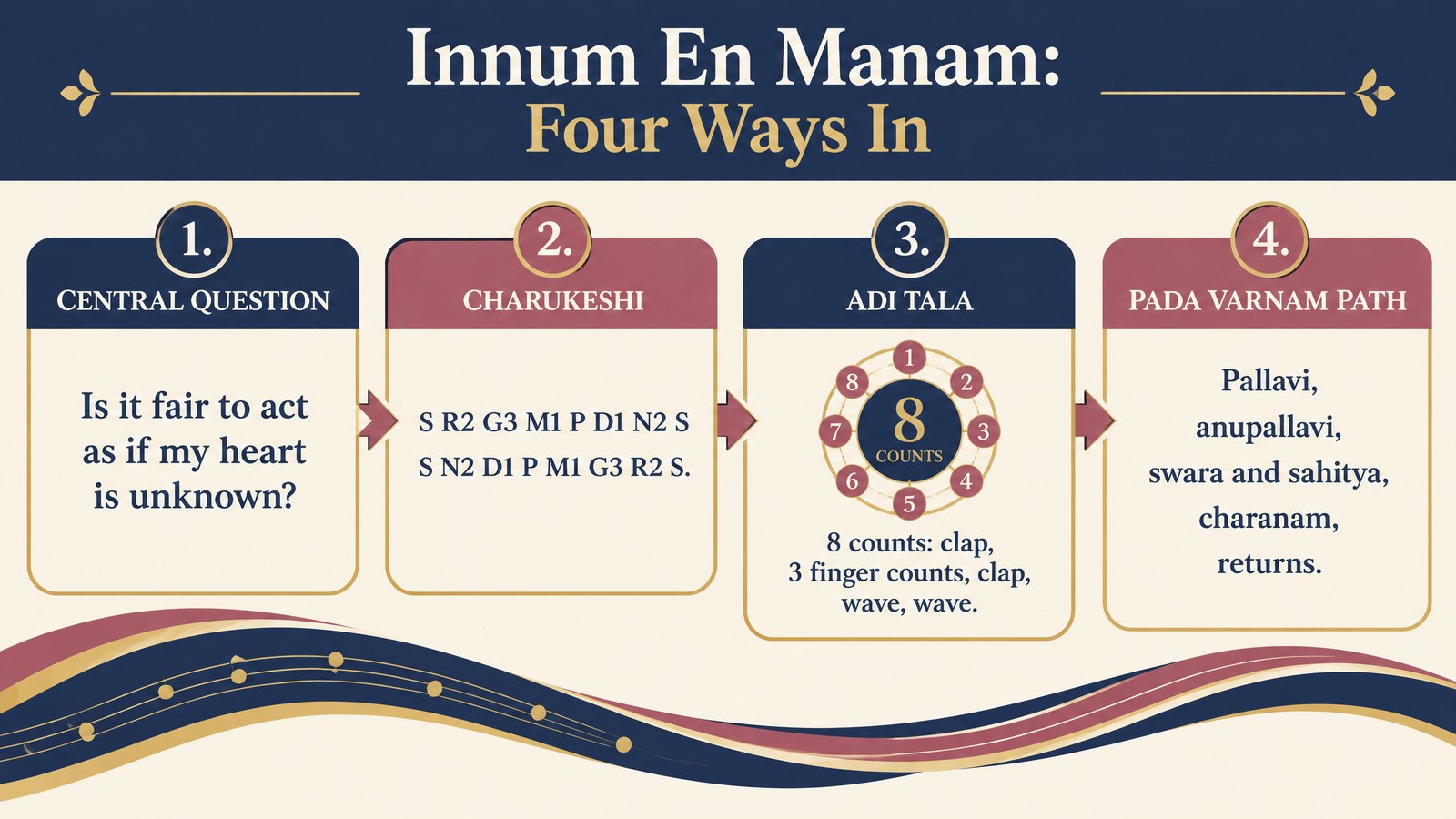
- Charukeshi is catalogued as the 26th melakarta: S R2 G3 M1 P D1 N2 S / S N2 D1 P M1 G3 R2 S.
Varnams appear in different learning and performance contexts. This guide stays with one work: Innum En Manam, a direct address to Krishna, who should already understand the speaker's heart.
The Karnatik composition record identifies the work as a Tamil varnam in Charukeshi and Adi tala by Lalgudi Jayaraman. Medha Vidyabhushan's official performance supplies current performance context only.
Table of Contents
- [The Direct Meaning of Innum En Manam](#the-direct-meaning-of-innum-en-manam)
- [The Lyric's Dramatic Voice](#the-lyrics-dramatic-voice)
- [Why This Is a Pada Varnam](#why-this-is-a-pada-varnam)
- [Charukeshi and Adi Tala](#charukeshi-and-adi-tala)
- [A Practical Listening and Practice Path](#a-practical-listening-and-practice-path)
- [Conclusion](#conclusion)
The Direct Meaning of Innum En Manam
The title comes from the opening phrase innum en manam. Its force becomes clear only in the full pallavi, commonly transliterated as innam en manam ariyadavar pola irundidal nyayama, Yadava Madhava? A close plain-English reading is: “Yadava, Madhava, is it fair for you to act as though you do not know my heart?”
That wording depends on the whole sentence. Nyayama? asks whether something is just or fair. Pola means “as if” or “like.” The speaker does not simply state that Krishna is unaware. The question challenges his apparent indifference: why act as if he did not know?
The anupallavi sharpens the complaint: munnam payinratho in nadagam ellam? It asks, in effect, “Was this whole drama rehearsed beforehand?” The charanam calls Krishna the beautiful flute-player and asks him to relieve her grievance. Names and images make the addressee clear, but the tone remains intimate rather than ceremonial.
A careful translation boundary
No English gloss can carry every shade of Tamil poetic address. A public translation by music writer Suja supports the core reading. A reported lecture by bilingual Tamil writer, musician, and dance scholar Sujatha Vijayaraghavan identifies pola as central in this line. This guide does not claim a new critical translation.
The Lyric's Dramatic Voice
The text moves between complaint and longing. Krishna is named as Yadava and Madhava, then pictured through the flute, butter, peacock feather, flower-like eyes, and gem-like complexion. Later passages imagine him coming close and taking the speaker's hand.
This permits both devotional and dramatic attention. The work does not force a listener to choose one. In a dance setting, the changing address can invite abhinaya. In a vocal setting, it can guide the ear toward a repeated word, a pause, or the moment when a line returns. The library's languages of Carnatic compositions guide offers further context on why translation is a starting point rather than the entire experience of a composition.
Why This Is a Pada Varnam
A varnam commonly includes a pallavi, anupallavi, a swara passage, charanam, and further swara passages that return to the charanam. The Varnam bridge guide explains how this form joins raga movement, tala continuity, and longer musical memory.
Innum En Manam is explicitly labelled a pada varnam in the notation document linked by Karnatik. The notation is version-specific and should be used with sound and teacher guidance. That label helps a listener notice how strongly its sahitya matters. The lyric can carry a detailed scene while the swara passages give Charukeshi room to unfold. It is not useful to reduce the work either to a fast technical piece or to a text without musical architecture.
| Section or feature | What to hear | First question |
|---|---|---|
| Pallavi | The central challenge, “Is this fair?” | Where does the question seem to settle? |
| Anupallavi | The “drama” image and Krishna's descriptive names | Which word receives space or emphasis? |
| Swara passage and sahitya | A shift between swara movement and continuing text | Can you hear how the text returns? |
| Charanam | Flute imagery, grievance, and hoped-for closeness | Which image changes the scene for you? |
Charukeshi and Adi Tala
Charukeshi is catalogued as the 26th melakarta, with the ascent S R2 G3 M1 P D1 N2 S and descent S N2 D1 P M1 G3 R2 S. This is an orientation, not the raga itself. A scale record cannot fully show phrase shape, resting points, timing, or gamaka. The notation guide and gamaka guide explain why written swaras remain a map rather than a complete performance.
Adi tala provides the recurring time-field. At a basic level it has eight counts. Carnaticstudent describes the familiar hand pattern as a clap, three finger counts, then a clap and two waves. When you listen, that cycle can make the return of a question feel organized rather than repetitive. The lyric stays emotionally unsettled while the tala keeps coming back.
| Listen for | A simple way to begin |
|---|---|
| Charukeshi movement | Follow whether a later version goes wider, higher, or takes a longer route before it returns. |
| Adi tala | Quietly count eight under one short passage, then stop if counting distracts from the phrase. |
| Raga and word together | Replay one lyric line and notice where the musical arrival changes its force. |
For a broader introduction to this rhythmic cycle, visit the tala guide for beginners. It is better to hear one complete return than to chase every individual swara on a first listen.
A Practical Listening and Practice Path
Start with Medha Vidyabhushan's official Short below. First, listen without counting and wait for the direct address. On a second pass, follow one returning line. Ask what makes it recognizable: words, a melodic landing, the pulse, or all three. On a third pass, hold pola, “as if,” in mind and notice whether the musical turn changes the question.
If a teacher has assigned this varnam, begin with the exact pallavi being taught. Speak the transliteration slowly, confirm Tamil pronunciation, and sing or play the route at a calm pace with shruti. Then mark its tala placement and learn the teacher's gamaka demonstration. Add speed only after the words, swaras, and pulse remain clear together.
Bring focused questions to a lesson: Which word should guide the phrase? Where does this section meet the tala cycle? Is this swara passage taught with sahitya? Which version belongs to this lesson? A recording can help you listen, but it cannot settle every difference in notation, pace, syllable division, or lineage.
Frequently Asked Questions
What does Innum En Manam mean?
In context, it asks Krishna whether it is fair to act as if he does not know the speaker's heart. Innum can carry “still,” and en manam means “my heart or mind,” but the full sentence gives the phrase its force.
Who composed Innum En Manam?
The Karnatik composition record credits Lalgudi Jayaraman. The Sangeet Natak Akademi music record also lists Lalgudi G. Jayaraman among its 2009 entries, giving institutional context for the composer named by the lyric source.
What raga and tala are used in Innum En Manam?
The composition record gives Charukeshi raga and Adi tala. Charukeshi is catalogued as the 26th melakarta, and Adi tala has eight basic counts in the introductory pattern used here.
Why is Innum En Manam called a pada varnam?
The notation document linked by Karnatik labels it a pada varnam. That label directs attention to sahitya alongside swara passages, while the work continues to develop raga and tala.
Can I learn this varnam from notation and videos alone?
Notation and recordings can support revision, but a teacher remains important for Tamil pronunciation, raga phrasing, gamaka, tala placement, and the exact lesson version. Use them as companions to guided study.
Conclusion
Innum En Manam comes into focus when its parts stay together. The Tamil text asks an intimate, insistent question. Charukeshi lets that question travel through melodic movement, and Adi tala gives its returns a steady frame. Begin with one line, one return, and one word such as pola. The larger story can emerge through repeated listening.
Published by Medha Naada
This guide is published by Medha Naada, Medha Vidyabhushan's official portfolio. It combines the credited sources below with plain-language listening or learning prompts. Historical details, song credits, and public records are limited to the cited material.
A written guide can support listening and preparation, but a qualified teacher remains the right source for personal vocal technique, pronunciation feedback, or repertoire decisions.
How this guide is supported
This guide keeps the Tamil text, translation aid, raga and tala record, pada-varnam designation, and first-party performance connection in separate evidence lanes. Notation remains version-specific and does not replace oral teaching.
- Innam En Manam varnam record. Karnatik. Tamil text, Lalgudi G. Jayaraman attribution, Charukeshi, Adi tala, and the linked notation direction.
- Charukeshi raga record. Karnatik. Charukeshi's 26th-melakarta classification and the documented ascent and descent used as a listening orientation.
- Chaarukesi Varnam notation. Shivkumar Kalyanaraman. The explicit composition-type label, pada varnam, together with the version-specific notation direction.
- Innum En Manam. Suja's Music To My Ears. A public Tamil text, transliteration, and a cautious English reading of the pallavi, anupallavi, and charanam.