Learning Guide · 2026-10-01 · 10 min read
Sahitya Before Speed: A Carnatic Singer’s Guide to Clear Pronunciation and Word Division
A practical Carnatic vocal guide to speaking sahitya slowly, marking padaccheda, preserving vowel and consonant distinctions, and using recordings and teacher feedback to make learned words intelligible.
Quick Facts
- Sahitya becomes clearer when you can speak each short unit accurately before asking it to travel through a fast melodic line.
- Padaccheda, or word division, helps you hear where one word ends and the next begins. It is not automatically a place to breathe or break the music.
- Long and short vowels, consonant identity, and joined sounds deserve attention even when a note is held.
- Roman transliteration is useful for reference, but a Roman spelling alone does not guarantee correct diction.
- A spoken recording, a sung recording, and a language-knowing teacher make a practical correction loop.
You may know the tune of a kriti well enough to keep tala and land on the right notes, yet still feel that the words blur as soon as the pace rises. That is a separate technical problem, and it deserves a separate kind of practice. The answer is not to attack every line harder. It is to return briefly to the words.
Carnatic music asks sahitya to live inside raga, tala, gamaka, and phrase shape. That is why a lyric can become indistinct even for a singer who knows what comes next musically. Slow, spoken work lets you find out whether the uncertainty lies in a vowel, a consonant, a word join, or simply an unexamined habit. It also makes the words more available for expression. For broader context on the composition itself, begin with what a kriti is.
This is not a method for memorising a whole song by ear or replacing the version your teacher taught. It is a diction-focused reset for a line you already know. Keep your teacher’s sahitya, notation, and musical setting close at hand.
Table of Contents
- [Why clarity starts before speed](#why-clarity-starts-before-speed)
- [Padaccheda: keep the words intact](#padaccheda-keep-the-words-intact)
- [Vowels, consonants, and the limits of Roman text](#vowels-consonants-and-the-limits-of-roman-text)
- [A practical speak-to-sing routine](#a-practical-speak-to-sing-routine)
- [Record, compare, and ask the right question](#record-compare-and-ask-the-right-question)
- [Conclusion](#conclusion)
Why clarity starts before speed
When a line is unclear, first remove the pressure to sing it beautifully. Say it at a calm speaking pace, in the order and division your teacher has given. Do this without tala at first. Your job is to make every syllable audible to yourself, not to make it dramatic.
Then speak it again while lightly keeping the pulse. Only after that should you sing it on the taught tune. This order reveals a useful distinction: a line that is clear when spoken but unclear when sung needs a melody-and-text adjustment; a line that is already muddled in speech needs language work before speed.
Treat one small unit at a time. A pallavi opening, a turn in the anupallavi, or two words before a landing is enough. Written material can help you locate the text, but it cannot supply every sound, join, or melodic decision. Use the Carnatic notation guide as a reminder of notation’s supporting role, then return to the taught sound.
Clarity is not the same as clipping. A vowel may be musically sustained, and a consonant may be softened by the flow of a phrase. The aim is to preserve the word inside that flow, not to turn every syllable into a detached beat.
Padaccheda: keep the words intact
Padaccheda means identifying the word divisions in the text. This matters because the visual gap on a handout, the musical phrase boundary, and the spoken word boundary do not always line up. A singer may need to carry a word over a tala point, or connect two syllables smoothly, while still knowing exactly what the words are.
Use a vertical bar in private notes to show a unit you have checked. It is a reading aid, not a command to insert a breath. The short cues below come from familiar Carnatic lyric texts in four languages. They illustrate what to investigate with a teacher, not a universal pronunciation lesson. Spellings are intentionally retained in broadly used Roman-style forms so that their limitations remain visible.
| Language | Short study cue | What to check before singing |
|---|---|---|
| Telugu | `banTu reeti kOlu | viyavaiyya raama` |
| Sanskrit | `vātāpi gaṇapatim | bhaje 'ham` |
| Tamil | `alai pAyudE kaNNA | en manam migha alai pAyudE` |
| Kannada | `jagadOddhAraNa | ADisidaLe yashOde` |
A useful question is: Can I point to each word I am singing? If not, slow down and seek a reliable text or teacher correction. Do not decide a split from where you happen to need air. In Sanskrit and Telugu especially, sounds can join across word boundaries through language-specific processes. The joined form may be correct, but it should still be understood as a join.
Meaning helps here, even if you are not translating the entire kriti yourself. A brief word-by-word explanation can prevent you from joining the wrong syllables or swallowing a word ending. For Kannada repertoire, the guide to Dasarapadas offers helpful context alongside language-aware teaching.
Vowels, consonants, and the limits of Roman text
Many Indian languages distinguish short and long vowels. In academic transliteration, a macron can signal length, as in a and ā, i and ī, or u and ū. That mark is a valuable alert, but it is not a licence to stretch any syllable at will. Musical duration may extend a syllable; the underlying vowel identity still needs to be recognisable.
Start by circling the vowels that your teacher corrects most often. Speak those words at an even pace, then sing them slowly on the actual notes. If the long vowel vanishes whenever the melody moves, isolate just that syllable and approach it again. The goal is proportion and identity, not exaggerated length.
Give consonants the same respect. Do not flatten every t, d, n, l, s, or sh into the nearest English habit. Sanskrit and South Indian languages can distinguish consonants by where and how they are articulated, and some texts contain doubled or clustered consonants that need a clean, unhurried approach. Ask a language-knowing teacher to demonstrate the mouth position and the amount of connection required in your line. Listen, imitate, record, and return for correction.
Roman text helps you find a lyric, compare editions, and make rehearsal notes. It does not reliably convey every regional sound, word join, consonant contrast, or convention of a script. The same sound may be represented as sh, ś, or ṣ in different systems, while a simple English-looking spelling can conceal a distinction that matters. Where possible, keep the original script beside a trusted transliteration and audio model.
A practical speak-to-sing routine
Use this brief routine on one difficult line, not on an entire kriti at once. Keep the pace comfortable enough that you can hear your own words. If a tala framework is still uncertain, review the beginner tala guide separately before adding the full line.
| Step | Do this | A productive result looks like |
|---|---|---|
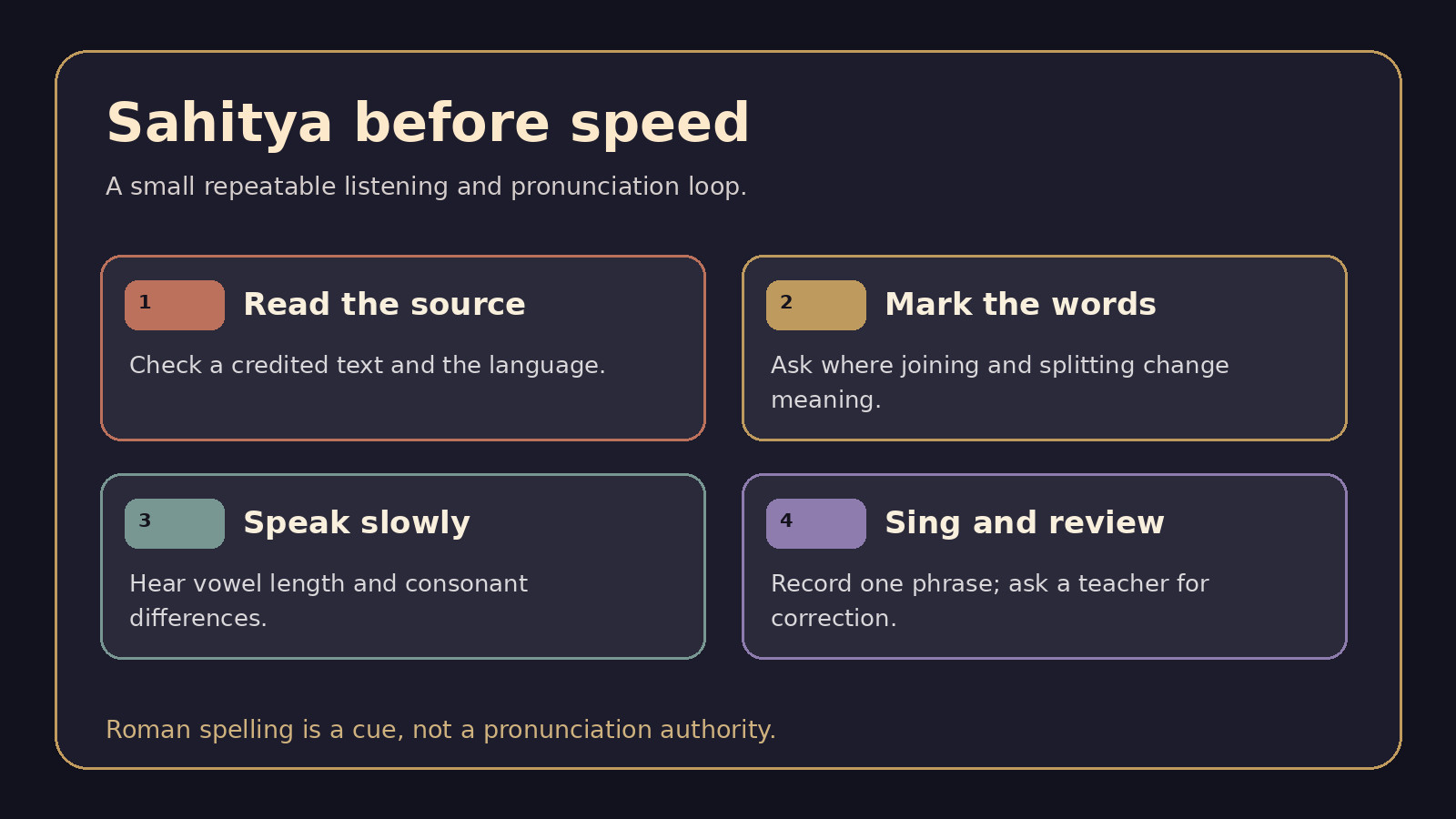
| 1. Read | Read the supplied text silently, then mark only the word divisions you have confirmed. | You know which marks are certain and which need a question mark. |
| 2. Speak | Say one unit three times, evenly and without tune. | Each vowel and final consonant is audible without strain. |
| 3. Connect | Speak the same unit with the gentle pulse or hand action taught in class. | The words stay intact while the pulse continues. |
| 4. Sing slowly | Use the taught melody at a reduced pace. | You can still identify each word, including joins. |
| 5. Rejoin | Add the next unit only after the first remains clear. | The musical connection has not erased the word boundary. |
| 6. Review | Record once, listen once, and note one question. | You have a specific correction to bring to class. |
Do not use speed as proof of progress. A clean slow line is usable material. A fast, blurred line gives you less to refine. Once the words stay clear at the slower pace, let tempo rise gradually within the version and kalapramanam your teacher has taught.
Record, compare, and ask the right question
Make two short recordings. In the first, speak the text with your marked divisions. In the second, sing the exact same unit. Listen to the spoken version before the sung one. This order prevents the attractiveness of the melody from hiding a missing vowel or an invented split.
On playback, check one layer at a time: word division first, then vowel identity, then consonants, then the fit with tala and melody. Avoid trying to repair everything in one session. Write a narrow question such as, “Does this join belong to the previous word?” or “Is this vowel length clear before the landing?”
Consult a language-knowing teacher when the original script and your Roman text seem to disagree, when an unfamiliar join changes what you think the words are, or when you cannot reproduce a consonant after careful listening. Also ask before copying diction from a random rendition online. Another singer may be using a different edition, pronunciation tradition, or musical setting. Teacher feedback is especially useful because it can hear the interaction between sound, raga phrase, and text that a written cue cannot settle.
Frequently Asked Questions
Should I separate every word clearly while performing?
No. Knowing the words is not the same as inserting gaps between them. Padaccheda helps you preserve the text underneath the musical flow. Follow the teacher’s phrasing for connection, breath, and tempo.
Is a Roman lyric sheet enough for correct pronunciation?
No. It can be an excellent map, but it is not a complete sound recording or language lesson. Compare it with original script when available, a trusted model, and correction from someone who knows the language and repertoire.
How slowly should I practise sahitya?
Slowly enough to hear every syllable and identify every word without guessing. The useful pace is the one at which pronunciation remains steady while you keep the taught pulse. It will differ from line to line.
What if the musical phrase crosses a word boundary?
Keep the musical phrase as taught, but write the underlying word division in your notes. Do not force a pause merely to make the division visible. Ask the teacher how the connection should sound in that composition.
When should I ask a language-knowing teacher for help?
Ask as soon as you are uncertain about vowel length, a consonant distinction, sandhi, word division, or meaning that affects your rendering. Early correction is easier than rehearsing an unclear version until it feels familiar.
Conclusion
Clear sahitya is built before speed. Speak the small unit, confirm its padaccheda, protect its vowels and consonants, then let it return to the taught melody and tala. Use Roman text as a helpful pointer rather than a verdict, and make recordings that expose one precise question at a time. With language-aware teacher feedback, the words can remain intelligible without losing their musical life.
Published by Medha Naada
This guide is published by Medha Naada, Medha Vidyabhushan's official portfolio. It combines the credited sources below with plain-language listening or learning prompts. Historical details, song credits, and public records are limited to the cited material.
A written guide can support listening and preparation, but a qualified teacher remains the right source for personal vocal technique, pronunciation feedback, or repertoire decisions.
How this guide is supported
This is conservative practice guidance, not a universal pronunciation key or a substitute for a teacher. The Roman forms are deliberately limited study cues, not guarantees of correct diction; spellings, sandhi, regional usage, and text settings require language-aware listening and correction. Bars show places to investigate word division, not mandatory breaths, melodic breaks, or performance pauses. The article makes no claim that one rendering, transliteration system, tempo, or translation fits every bani or edition.
- The effects of native language on Indian English sounds and timing patterns. H. Sirsa and M. A. Redford, open-access article hosted by PubMed Central. Open-access phonetic context for Telugu vowel-length contrast, illustrated long consonants, and variation between Indian language sound patterns. It does not prescribe lyric pronunciation.
- 8 Amazing Tips from Masters to Master a Carnatic Composition. Acharyanet. Specialist learner guidance to speak lyrics aloud with proper pronunciation and splits, understand meaning, record practice, and obtain teacher feedback.
- Carnatic Songs: banTu reeti kOlu. karnATik. Catalogue verification of the Telugu lyric example, its language label, and the text of Tyagaraja’s banTu reeti kOlu.
- Carnatic Songs: vaathaapi. karnATik. Catalogue verification of the Sanskrit vAtApi gaNapatim example, including its language, composer, raga, tala, and lyric text.
- Carnatic Songs: jagadOddhaaraNaa. karnATik. Catalogue verification of the Kannada jagadOddhaaraNaa example, including language, Purandara Daasar attribution, raga, tala, and text.