Listening Guide · 2026-10-01 · 9 min read
Where to Start with Annamacharya: A Venkateswara Sankirtana Listening Path
A clear four-song path into Annamacharya’s Telugu Venkateswara sankirtanas, with text clues, raga and tala context, and TTD archive listening.
Quick Facts
- Tallapaka Annamacharya was a fifteenth-century Telugu saint-composer whose sankirtanas are closely associated with Lord Venkateswara.
- Begin with four Telugu pieces, not a giant playlist: a hill vision, a compassionate Lord, an invitation to listen, and a philosophical reflection.
- Learn the pallavi, or opening refrain, first. It is the most reliable doorway into an unfamiliar text.
- Treat raga and tala labels as useful listening information, while remembering that a printed text and a modern rendition are not the same thing.
- The next stop after this guide is TTD’s public Sri Venkateswara Recording Project catalogue, plus an optional contemporary Medha Vidyabhushan rendition.
If you are looking for a first way into Annamacharya, start by narrowing the field. His name can lead to vast playlists, devotional clips, lyrics pages, concert programmes, and several different spellings of the same title. That abundance is generous, but it can make a newcomer feel as though every song must be understood at once. It does not.
If you have arrived with a song title or one familiar refrain, it helps to know where to find a trusted text and a listening path before opening another playlist.
This is a Telugu Venkateswara listening path, rather than another route through Purandara Dasa or the Kannada Haridasa repertoire. Those are rewarding worlds in their own right, and this introduction to Dasarapadas is a useful separate starting point. Here, the aim is simpler: hear a small group of Annamacharya texts, understand what each one is asking you to notice, and then keep exploring from a reliable institutional archive.
Table of Contents
- [Why this path begins with text, not a definitive recording](#why-this-path-begins-with-text-not-a-definitive-recording)
- [A four-stop Venkateswara listening path](#a-four-stop-venkateswara-listening-path)
- [Read the Telugu without turning it into a barrier](#read-the-telugu-without-turning-it-into-a-barrier)
- [Hear a setting, then find the source](#hear-a-setting-then-find-the-source)
- [Conclusion](#conclusion)
Why this path begins with text, not a definitive recording
TTD describes Annamacharya as a fifteenth-century saint-composer from Tallapaka and identifies his work with the praise of Lord Venkateswara. Its Annamacharya Project overview also makes an important listener’s point: the work now lives through research, publication, music, and recording. In other words, a sankirtana is more than one familiar audio track.
For a first encounter, keep three layers distinct:
- The sahitya, the Telugu words and their imagery.
- The musical setting, including a raga and tala named in a catalogue, notation, or performance tradition.
- The rendition, which is one singer’s or instrumentalist’s realised version of that setting.
This distinction is freeing. You can love a recording without mistaking it for the only possible musical identity of a centuries-old text. It also makes comparison meaningful. When two singers take different speeds, repeat different lines, or give the refrain a different emphasis, first ask what remains constant: the words, the Venkateswara reference, and the shape of the poem. For the basic vocabulary behind this approach, see What Is a Kriti in Carnatic Music?.
A four-stop Venkateswara listening path
Take these in order once, preferably with the title in front of you. Every selection below is attributed to Tallapaka Annamacharya and is in Telugu. The raga and tala are commonly listed settings that help you recognise what you are hearing. They are not a claim that every present-day rendition must unfold identically.
| Stop | Telugu opening or listener cue | Text doorway | Commonly listed musical setting |
|---|---|---|---|
| 1 | Adivo Alladivo Sri Hari Vasamu | A vision of Venkata hill as Sri Hari’s abode, with the sacred landscape placed before the listener’s eyes. | Madhyamavati, Adi tala |
| 2 | Kondalalo Nelakonna Koneti Rayudu | The Lord who dwells among the hills is portrayed as compassionate and responsive to devotees. | Hindolam, Adi tala |
| 3 | Vinaro Bhagyamu Vishnu Katha | An invitation to hear Vishnu’s story. Its final verse brings in Sri Venkateswara’s name. | Shuddhadhanyasi, Adi tala |
| 4 | Brahmam Okate, also heard with Tandanana Ahi | A reflection on one divine reality shared by all, ending with a Venkateswara reference. | Bowli, Adi tala. Specialist catalogues also list Nadanamakriya for this text. |
Start with Adivo Alladivo because it asks you to look. Even before every word is clear, you can follow the movement from “there, behold” to a sacred place. Next, Kondalalo Nelakonna keeps the hill setting but shifts toward the Lord’s generosity. The phrase Koneti Rayudu is a title for Venkateswara, and the refrain gives you a compact phrase to return to.
With Vinaro Bhagyamu, the action changes from seeing to hearing. Its opening is effectively an invitation: listen, this is the good fortune of hearing Vishnu’s story. That makes it an ideal third stop for a listening guide. Do not rush past the final Venkateswara line. It ties a broad Vishnu narrative back to the deity at the centre of this path.
Then take Brahmam Okate as the reflective side door. The refrain’s idea is oneness, while the verses press that thought through social difference, everyday experience, and the shared world. It is not merely a slogan. Let the recurring rhythmic words tandanana ahi do their work before chasing a polished English equivalent.
Read the Telugu without turning it into a barrier
You do not need to become fluent in Telugu before listening. You do need a small method that keeps a translation from flattening the song. This path stays deliberately with Telugu texts, so there is no Sanskrit, Kannada, or Tamil translation detour to manage.
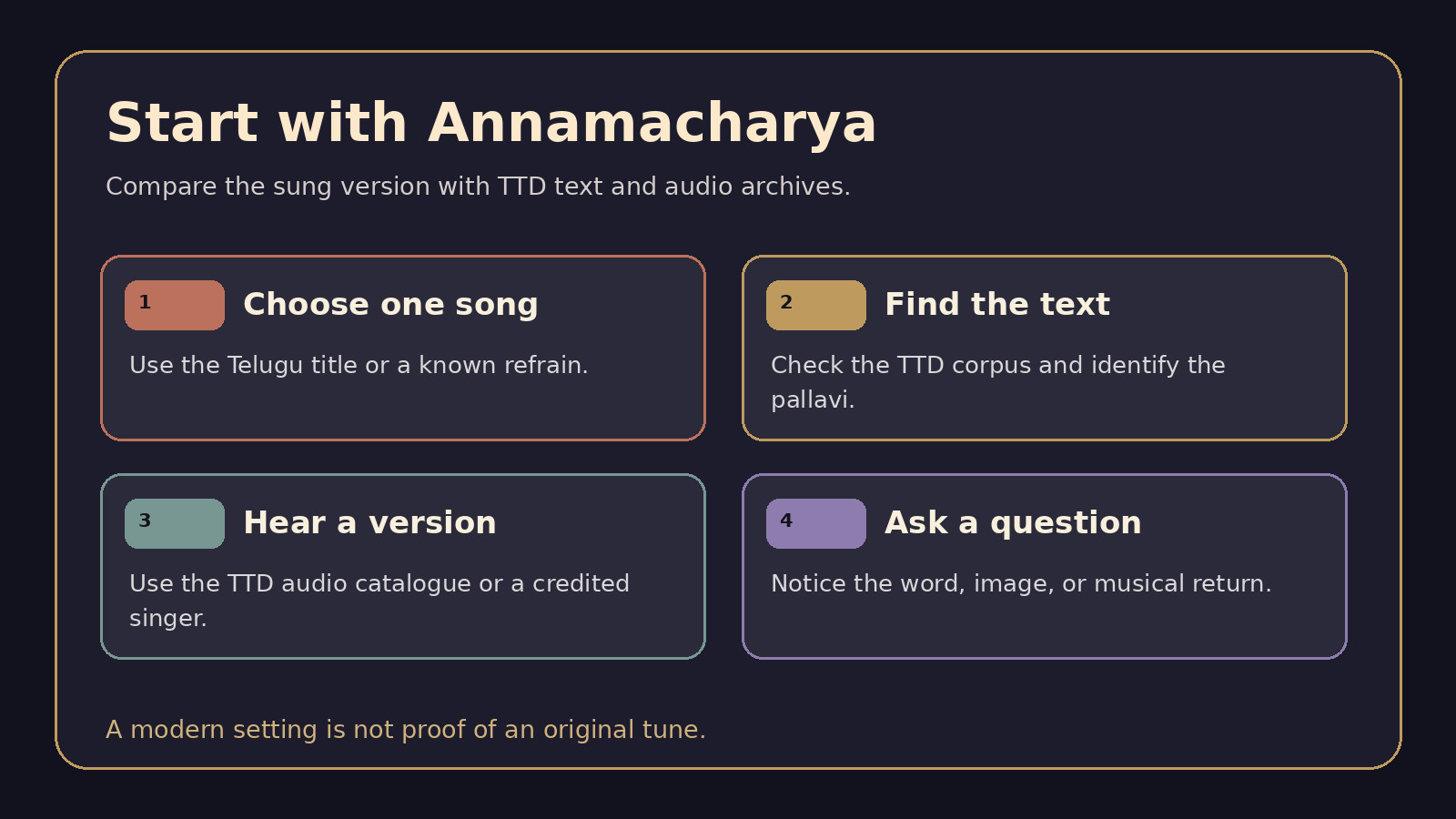
First, learn the pallavi as sound. Say it slowly, then find it in the lyric text. A transliteration is a bridge, not a substitute for the Telugu script. Second, circle names and place words you recognise: Venkateswara, Venkata, Sri Hari, Vishnu, and Koneti Rayudu. Third, read a plain prose meaning for just one verse, then listen again. The goal is not to memorise a dictionary. It is to hear what has changed in your attention.
A short working glossary helps:
- Sankirtana / keerthana: a devotional song or composition.
- Sahitya: the literary text or lyrics.
- Raga: the melodic framework. Start with this beginner’s raga guide if the word is new.
- Tala: the rhythmic cycle. This tala guide explains how to listen for it without counting anxiously.
When you are ready for notation, use it to connect syllables and melody, not to turn the experience into homework. This guide to reading Carnatic notation can help.
Hear a setting, then find the source
The productive habit is to move back and forth between a recording and a text catalogue. TTD’s searchable Annamacharya Sankirtana catalogue presents a large Telugu corpus with composer and raga fields. Its Sri Venkateswara Recording Project listening catalogue publicly lists Annamayya albums and audio tracks. That makes it the right onward route when you want to go beyond a recommendation feed.
Try this five-step practice:
- Listen once to one song from the four-stop path without pausing.
- Open the TTD text catalogue and search the pallavi or key title word.
- Open the SVRP audio catalogue separately. Browse by album, composer, song, or singer rather than assuming that every title appears in one playlist.
- Write down the title spelling, performer, album, raga label, tala label if given, and the line that stayed with you.
- Compare a second rendition only after you know which text you are comparing.
The raga labels themselves offer a gentle listening lesson. Madhyamavati, Hindolam, and Shuddhadhanyasi are not interchangeable moods pasted onto the same poem. Let each track establish its own melodic world before naming an emotion. With Brahmam Okate, the fact that catalogues can list more than one raga is especially useful: it reminds us to ask which version, whose setting, and which textual source we are hearing.
Optional contemporary listening stop, clearly a rendition: after reading the text or hearing an archive track, watch Medha Vidyabhushan’s official “Brahmam Okate” YouTube Short. It is a present-day vocal rendition of Annamacharya’s text, not the source text, a manuscript, or proof that one musical setting is the only original. Let it be a concise return to the refrain, then go back to the words.
Frequently Asked Questions
Are these songs all in Telugu?
Yes. The four selections in this path are attributed to Annamacharya and presented as Telugu compositions. Roman spellings vary across catalogues and uploads, so search a distinctive part of the pallavi if an exact title search fails.
Do I need to know Telugu before I listen?
No. Start with the refrain, names, and one verse-level meaning. Hearing the Telugu cadence first, then reading a modest translation, is usually more helpful than trying to understand every word before pressing play.
Did Annamacharya leave one fixed tune for each sankirtana?
Do not assume that a familiar current rendition is the sole musical form of a text. For a listener, the careful approach is to name the catalogue setting you are hearing, compare versions respectfully, and keep the text distinct from a particular arrangement.
Where can I hear the TTD archive?
Use TTD’s public SVRP Annamacharya listening catalogue. It lists albums and tracks and provides filters for album, composer, song, and singer. Pair it with the separate TTD text catalogue when possible.
Is Medha Vidyabhushan’s Brahmam Okate short the original text?
No. It is an official Medha Vidyabhushan rendition of a text attributed to Annamacharya. It is a useful contemporary listening stop, but the Telugu text catalogue and published lyric sources are the places to consult for the words and their context.
Conclusion
A good first Annamacharya playlist is not a test of how much you know. It is a sequence of attention: see Venkata hill in Adivo Alladivo, hear generosity in Kondalalo Nelakonna, accept the invitation in Vinaro Bhagyamu, and sit with the oneness of Brahmam Okate. Keep the Telugu text nearby, identify the setting you are hearing, and let TTD’s catalogue take you further. That is a sturdier beginning than chasing the next viral rendition.
Published by Medha Naada
This guide is published by Medha Naada, Medha Vidyabhushan's official portfolio. It combines the credited sources below with plain-language listening or learning prompts. Historical details, song credits, and public records are limited to the cited material.
A written guide can support listening and preparation, but a qualified teacher remains the right source for personal vocal technique, pronunciation feedback, or repertoire decisions.
How this guide is supported
This is a listener’s orientation, not a critical edition, complete translation, or performance prescription. Historical and archive claims are limited to the cited TTD institutional pages; song text and commonly listed raga-tala details are cross-checked against specialist catalogues. Raga and tala labels are presented as listening and catalogue settings, not as proof of a single unbroken fifteenth-century tune. The Google Trends observation is limited to the live India page checked on October 1, 2026 and makes no volume, ranking, or trend-growth claim.
- Annamacharya Project. Tirumala Tirupati Devasthanams. Institutional context for Annamacharya as a fifteenth-century Telugu saint-composer, TTD’s publication and recording work, and its coordination with the Sri Venkateswara Recording Project.
- Annamacharya Keertana Sravanam by SVRP. Tirumala Tirupati Devasthanams, Sri Venkateswara Recording Project. Public TTD listening catalogue, including Annamayya album listings, track rows, and album/composer/song/singer search paths.
- Annamacharya Sankeerthanas. Tirumala Tirupati Devasthanams. Primary institutional Telugu corpus catalogue displaying composer-category, raga, and pallavi fields for Annamacharya sankirtanas.
- adivO alladivO. karnATik. Specialist lyric entry for Adivo Alladivo: Telugu attribution to Annamacharya, Madhyamavati, Adi tala, text, and a prose explanation of its Venkata-hill imagery.
- vinarO bhAgyamu. karnATik. Specialist lyric entry for Vinaro Bhagyamu: Annamacharya attribution, Shuddhadhanyasi, Adi tala, and the final reference to Sri Venkateswara.