Music Theory · 2026-09-22 · 8 min read
Nadai and Gati in Carnatic Music: How One Tala Can Feel Different
A listener-first guide to nadai or gati, explaining how internal beat subdivision can change the feel of a stable tala while distinguishing tala, jaati, kalam, and gait.
Quick Facts
- Tala is the recurring time cycle. An avartanam is one complete turn of that cycle.
- Nadai, also called gati, describes the internal subdivision or gait within each beat or akshara.
- In a simple Adi-tala illustration, chatusra nadai places four internal pulses in each beat, while tisra places three. The outer eight-beat cycle can remain the same.
- Jaati is not nadai: jaati changes the count of a laghu, while nadai or gati concerns subdivision within an akshara.
- Kalam concerns speed. A busier subdivision can make music seem to accelerate even when the tala markers remain steady.
A Carnatic piece can keep the same tala yet change its walk. The hand that marks the cycle may stay steady while music inside a beat moves in threes rather than fours. The result can feel denser, more lilting, or more angular without becoming a new tala.
That is nadai or gati: the internal pulse layer, not the whole cycle. The terms are often paired or used interchangeably. A scholarly account identifies nadai as Tamil and gati as Sanskrit, framing both through beat subdivision in the Carnatic rhythmic system.
Table of Contents
- [What Nadai or Gati Changes](#what-nadai-or-gati-changes)
- [One Stable Adi-Tala Grid, Several Internal Walks](#one-stable-adi-tala-grid-several-internal-walks)
- [Nadai Is Not Jaati, Tala, or Kalam](#nadai-is-not-jaati-tala-or-kalam)
- [How to Hear a Change of Gait](#how-to-hear-a-change-of-gait)
- [A Four-Pass Listening and Practice Path](#a-four-pass-listening-and-practice-path)
- [Conclusion](#conclusion)
What Nadai or Gati Changes
Start with two layers. Tala gives the repeating time-field. Nadai or gati tells you how the space inside a beat is being counted or articulated. A useful first image is a steady row of large stepping stones. Tala is the route and the return to its first stone; nadai is the number and character of the smaller steps taken between one stone and the next.
In an eight-beat Adi tala, the large cycle can continue as eight broad locations. Chatusra nadai places four equal internal pulses in each location; tisra places three. The external cycle has not become a three-beat tala. Its internal gait has changed.
The common labels are tisra for three, chatusra for four, khanda for five, misra for seven, and sankeerna for nine. Music Academy proceedings name these categories and document Adi-tala demonstrations in khanda nadai and shifts between nadais.
“Four pulses” does not require every note to equal one pulse. A phrase may sustain, rest, ornament, or distribute syllables differently. The grid is an underlying time measure, not a complete score.
For the larger frame first, visit the tala guide for beginners. It explains the hand gestures and recurring cycle that this article keeps deliberately stable.
One Stable Adi-Tala Grid, Several Internal Walks
The diagram below is a listening map, not a performance score. Each large cell is one of the eight broad beats in an Adi-tala cycle. The beat positions stay in place. Only the smaller units inside them change.
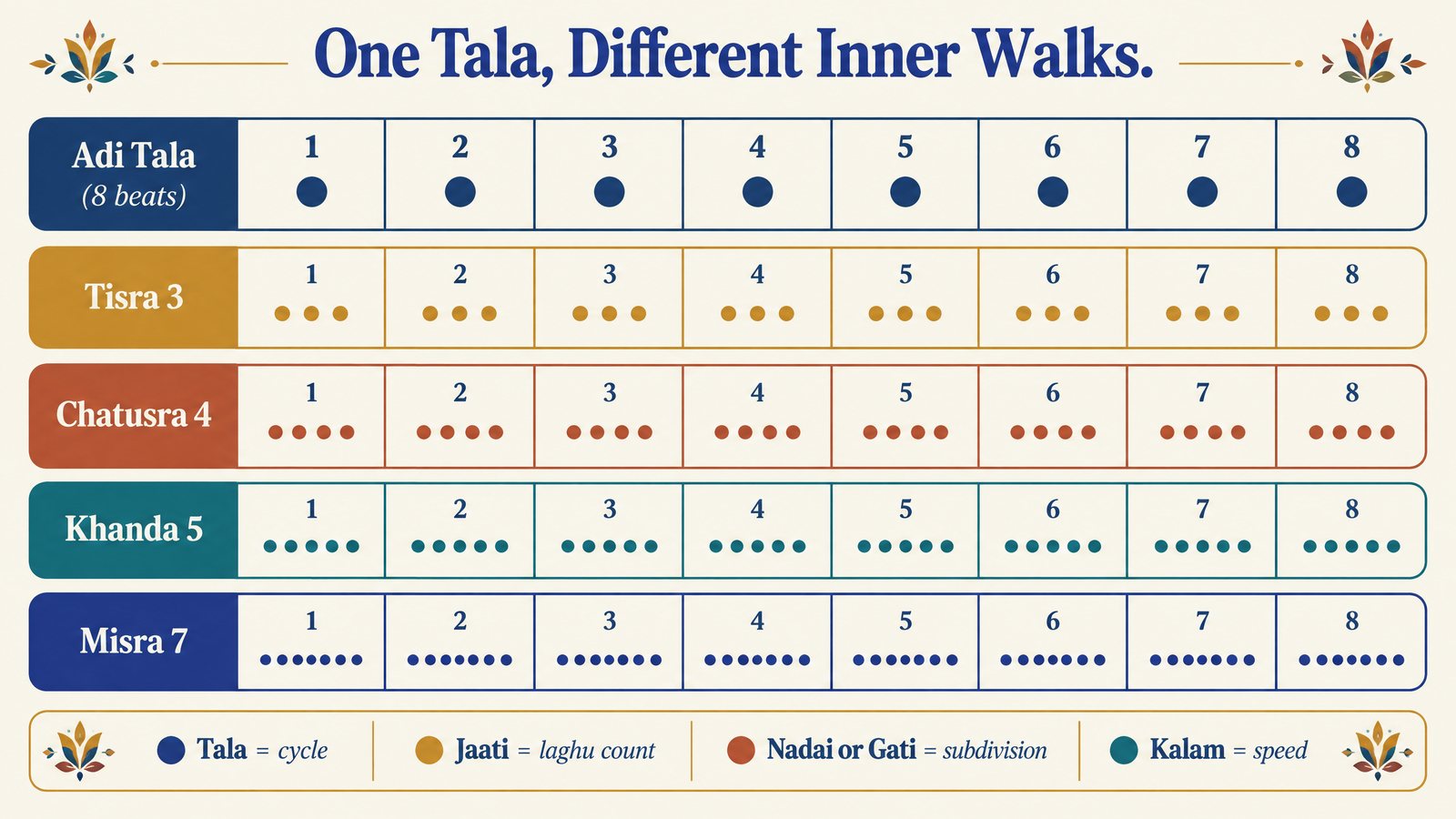
| In one eight-beat Adi-tala cycle | Internal units per beat in this simple grid | Total internal units across the cycle | First listening impression |
|---|---|---|---|
| Chatusra nadai | 4 | 32 | A four-pulse baseline, often the easiest place to establish the cycle |
| Tisra nadai | 3 | 24 | A three-way swing or lilt inside the same large return points |
| Khanda nadai | 5 | 40 | A tighter five-way internal motion |
| Misra nadai | 7 | 56 | A longer, less immediately square internal span |
| Sankeerna nadai | 9 | 72 | A highly packed nine-way internal span |
The numbers make the distinction visible, not audible by themselves. Phrase shape, emphasis, silence, lyric, accompaniment, and speed all affect the result. First retain the outer cycle, then notice that the smaller motion no longer divides into the same-sized groups.
A Music Academy report describes a varnam accommodated in Adi tala “without any damage to the basic structure” by changing and alternating nadais. That is a useful model, not a reason to call every fast passage a nadai shift.
If spoken rhythm helps you locate small units, the konnakol guide is a useful companion. It introduces solkattu as a listening and learning route, but spoken syllables should be learnt with a qualified teacher rather than reconstructed from a diagram.
Nadai Is Not Jaati, Tala, or Kalam
Ask one question at a time: What repeats? What is subdivided? What sets the laghu count? What is the overall speed?
| Term | What it describes | A plain question to ask | What it does not automatically tell you |
|---|---|---|---|
| Tala | The recurring rhythmic cycle | Where is the cycle beginning and returning? | The number of internal pulses in every beat |
| Jaati | The count within a laghu | How many counts does this laghu contain? | Whether each beat is moving in threes, fours, or fives internally |
| Nadai or gati | The subdivision or gait inside an akshara | How is the space inside this beat being counted? | A new tala cycle |
| Kalam | The overall speed or tempo level | Is the presentation broadly slower or faster? | The subdivision category by itself |
Tisra jaati and tisra nadai both use “three” but describe different things: the former is the laghu’s count; the latter is internal division of an akshara. Darbar separates them in the same way.
Speed alone cannot identify nadai. A performer can increase overall speed without changing subdivision, while four internal pulses becoming three can feel like a new pace with the broad tala markers steady.
For a related but different idea, see graha bhedam for listeners. That guide concerns a change of tonal reference, not a change in rhythmic subdivision. Keeping the two distinct makes both easier to hear.
How to Hear a Change of Gait
Do not count every fast sound first. Locate the large cycle through a light hand pattern, repeated phrase, accompaniment cue, or teacher’s demonstration. The aim is the larger return points.
Then test whether one broad beat settles into equal groups of four, three, five, seven, or nine. Try “one-two-three-four,” then “one-two-three,” while leaving the large beat unchanged. The contrast can be clearer than the labels.
A new gait may arrive through percussion, solkattu, or differently balanced melodic spacing. Rapid swaras alone do not prove a nadai shift. Ask whether the grouping persists while the cycle makes sense.
The mridangam listening guide can help when percussion is your clearest route to the framework. The tani avartanam guide offers a next step for hearing rhythmic architecture without expecting a first-time listener to decode every calculation.
A Four-Pass Listening and Practice Path
Pass one: hold the outer cycle. Choose a familiar tala and keep only its broad pulse. Do not speed your hand up to chase dense music.
Pass two: test four. Try a quiet four-pulse count inside one broad beat. You are checking a chatusra baseline, not transcribing the passage.
Pass three: test another grouping. If four resists, try three, then five. Stop where internal spacing becomes stable. This is observation, not proof of a formal label.
Pass four: return. Release the inner count and find the next large return. If the cycle is intact while the small count has changed, you have heard the central relationship.
For students, this prepares a lesson rather than replacing one. A teacher can distinguish nadai, kalam, phrase-level grouping, and other devices in a particular version. The Carnatic notation guide explains why notation needs sound and teacher-led context.
Frequently Asked Questions
Is nadai the same as gati?
They are commonly paired or used interchangeably for internal beat subdivision. The scholarly source gives nadai as Tamil and gati as Sanskrit. Follow a teacher’s preferred vocabulary in a lesson.
Does a change from chatusra to tisra nadai mean the tala has changed?
Not necessarily. Here, the outer tala cycle stays stable while internal subdivision moves from four units per beat to three. A real passage still depends on its composition, rendition, and teaching context.
Is tisra nadai the same as tisra jaati?
No. Tisra jaati is the count in a laghu; tisra nadai is three-way subdivision within an akshara. They answer different questions.
Is nadai just a faster speed?
No. Kalam is overall speed. A different subdivision can sound more active while the broad tala pulse is held. The two can interact, but are not identical.
Can I identify nadai by counting every note?
Not by that method alone. Notes may be sustained, ornamented, or separated by rests. Start with the tala cycle and stable internal spacing; confirm labels with a teacher or trustworthy performance context.
Conclusion
Nadai or gati is the internal walk inside a tala, not a replacement for the tala itself. Hold the large cycle steady, then notice whether the small units flow in fours, threes, fives, sevens, or nines. Once tala, jaati, kalam, and subdivision have separate jobs in your ear, the same Adi-tala cycle can reveal several distinct rhythmic worlds.
Published by Medha Naada
This guide is published by Medha Naada, Medha Vidyabhushan's official portfolio. It combines the credited sources below with plain-language listening or learning prompts. Historical details, song credits, and public records are limited to the cited material.
A written guide can support listening and preparation, but a qualified teacher remains the right source for personal vocal technique, pronunciation feedback, or repertoire decisions.
How this guide is supported
This is a listener map for internal beat subdivision, not a score or an analysis of any linked Medha recording. The sources support the named nadai categories and the distinctions among tala, jaati, subdivision, and speed.
- Exploring Nadai: The Concept of Beat Subdivision in South Indian Music. Heidi Chan, Lithuanian Academy of Music and Theatre. Scholarly context for nadai as a Tamil term, gati as a Sanskrit term, and subdivision within the Carnatic rhythmic system.
- Journal 2020-22: Contours of Khandam. The Music Academy, Madras. A documented lecture demonstration involving Adi tala, khanda nadai, catusra gati, and maintained kalapramana.
- 2007 Conference Proceedings. The Music Academy, Madras. The five named nadai categories and a reported example of changing nadais while retaining the basic Adi-tala structure.
- Carnatic Rhythms 101: How to Slap Your Thigh Like a Pro. Jahnavi Harrison, Darbar Arts Culture and Heritage Trust. Accessible learner-facing distinctions among tala, jaati, kalam, and gati or nadai.