Song Meaning · 2026-09-19 · 8 min read
Tappu Nodade Bandeya: Meaning, Text Context, and Prasanna Venkata Dasaru
Understand Tappu Nodade Bandeya, its Kannada refrain, attribution to Sri Prasanna Venkata Dasaru, Srinivasa address, and a careful listening path through Medha Vidyabhushan’s official performance.

Quick Facts
- Tappu Nodade Bandeya, Ennaya Tande can be understood as “Did You come without looking at my faults, O my father?”
- Public lyric references attribute the song to Sri Prasanna Venkata Dasaru and identify the ankita, or signature, as Prasanna Venkata.
- The text addresses Srinivasa through names including Sripati and Prasanna Venkata Ramana.
- The Sri Prasanna Venkata Dasaru Cultural and Charitable Trust provides Samagra Krutigalu resources; an Internet Archive record preserves Volume 2 of the collected corpus.
- Medha Vidyabhushan’s official September 10, 2026 Reel and official YouTube Short place the song in her performance context.
A short song can carry a large question. In Tappu Nodade Bandeya, the speaker does not begin with praise alone. The first move is vulnerable: can Srinivasa meet the devotee without first judging every fault? That directness helps explain why the refrain can stay with a listener even before every Kannada word is clear.
Table of Contents
- [What Does Tappu Nodade Bandeya Mean?](#what-does-tappu-nodade-bandeya-mean)
- [The Refrain and Its Text Context](#the-refrain-and-its-text-context)
- [Who Wrote the Song?](#who-wrote-the-song)
- [How the Appeal to Srinivasa Works](#how-the-appeal-to-srinivasa-works)
- [How to Listen or Practise with the Song](#how-to-listen-or-practise-with-the-song)
- [Conclusion](#conclusion)
What Does Tappu Nodade Bandeya Mean?
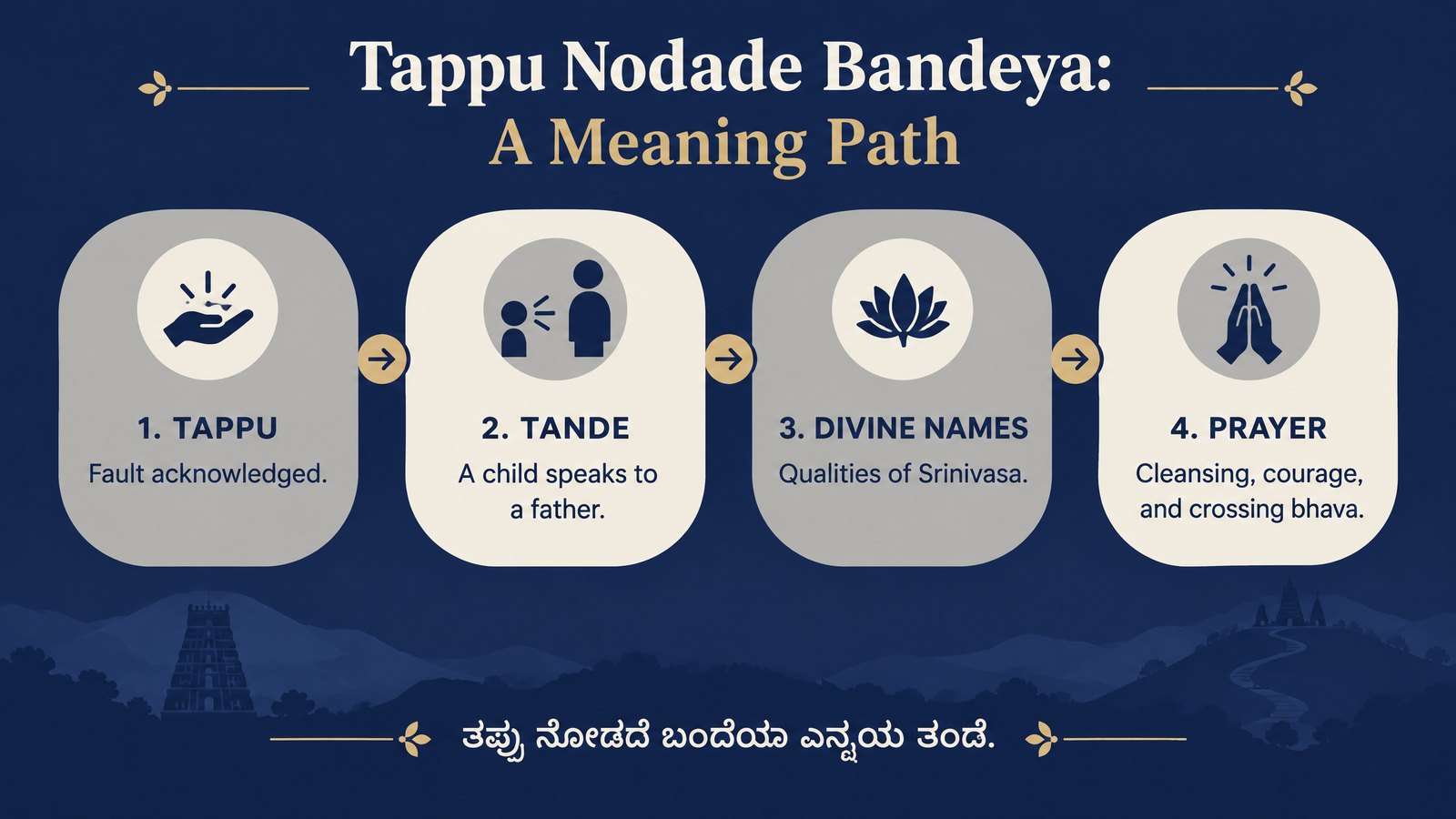
Tappu means fault, error, or wrong; nodade means without seeing or looking at; and bandeya asks, “did You come?” The fuller refrain includes ennaya tande, “my father.” A close plain-English rendering is therefore: “Did You come without looking at my faults, O my father?”
“Without seeing my faults,” “without noticing my faults,” and “without looking at my faults” are all helpful explanations. None replaces the Kannada. Keep the original refrain in view when comparing translations, especially when a performance gives the words a pace or emphasis that prose cannot carry.
The Refrain and Its Text Context
The opening is commonly printed as:
ತಪ್ಪು ನೋಡದೆ ಬಂದೆಯಾ ಎನ್ನಯ ತಂದೆ tappu nodade bandeya ennaya tande
Two public lyric transcriptions present the same refrain and three following stanzas. One identifies the work as the 86th composition in Sri Prasanna Venkata Dasara Samagra Keertanegalu, Volume 1, with the Prasanna Venkata ankita. They are reading aids, not a critical edition.
After the refrain, the language expands the appeal. The text calls on Sripati, invokes a reputation as jagad-aghaharana, and addresses the Lord as trigunatita, beyond the three gunas, and gunadhama, an abode of virtues. The final stanza asks for the speaker’s kalusha, or inner impurity, to be cleared and for passage across bhava, the difficult round of worldly existence.
This movement matters. The refrain is personal, “my father.” The later lines name divine qualities and ask for release from fear. The song need not be flattened into one modern slogan. It can be heard as a prayer that holds moral self-awareness and confidence in grace together.
Who Wrote the Song?
The attribution is to Sri Prasanna Venkata Dasaru. The Sri Prasanna Venkata Dasaru Cultural and Charitable Trust e-library provides several Samagra Krutigalu volumes and identifies an associated Srinivasa work, Bideno Ninnangri Srinivasa, as composed by him. The Internet Archive record for Prasanna Venkata Dasara Samagra Keertnegalu Volume 2 describes a 294-composition Kannada Dasa Sahitya collection credited to Subhash Kakhandaki and Rekha Kakhandaki. Its searchable text includes Tappu Nodade Bandeya in a collected-song listing.
For the individual song, Meera Subbarao’s lyric reference names the composer, ankita, and Volume 1; Madhwa’s parallel transcription matches the Kannada refrain and verses. These pages support a practical text and attribution cross-check, not every question of manuscript history or tune lineage.
The final address, Prasanna Venkata Ramana, makes the signature important to notice. In Dasa Sahitya, an ankita can show how a composer’s devotional identity is woven into the closing address. For wider context, see the library’s guide to what Dasarapadas are and its overview of the Haridasa movement in Karnataka.
How the Appeal to Srinivasa Works
The song’s force comes from a relationship rather than an argument. “Father” is not decorative. It lets the devotee speak candidly while acknowledging dependence. The question is not “have I done nothing wrong?” It is closer to “can Your compassion reach me although I know my faults?”
Medha Vidyabhushan’s official Reel calls the song special to her, recounts a Tirupati story about the composer, and credits Sri Prasanna Venkata Dasaru as writer and Pt. Bhimsen Joshi for the tune. Treat that story as the artist’s captioned devotional context, not independent proof of historical biography.
| Textual feature | What it brings into focus | A careful listener can ask |
|---|---|---|
| “tappu nodade” | Awareness of fault before a compassionate gaze | Is the voice denying fault, or naming it openly? |
| “ennaya tande” | A child-to-father form of address | How does this intimacy change the plea? |
| Divine names | A movement from individual need to divine attributes | Which name answers the fear named just before it? |
| “kalusha vaariso” and “bhava taariso” | A request for cleansing and crossing | How does the ending widen the opening question? |
This avoids two shortcuts. The song is not a licence to avoid responsibility, and it is not only self-condemnation. It is a devotional petition that places responsibility, helplessness, and hope in one address to Srinivasa. Readers exploring the Tirumala setting can continue with The Tirumala Footsteps.
How to Listen or Practise with the Song
For a first listen
Begin with one uninterrupted hearing. When the refrain returns, silently repeat only tappu nodade bandeya. On a second listen, keep the one-sentence meaning nearby and notice how tande changes the colour of the line. On a third, listen for the way later names and requests enlarge the opening plea.
For a text-focused session
Read the Kannada, transliteration, and plain English side by side. Mark fault, father, divine qualities, and the final requests. Then put the text away for a complete listen.
For learners
If you are learning a version to sing, begin with the refrain at a comfortable pitch and steady shruti. Ask a teacher which text source, pronunciation, and melodic version belong to the lesson. The official Reel credits Pt. Bhimsen Joshi for the tune used in Medha’s context, but a recording is not a substitute for teacher-led pronunciation or repertoire guidance. Avoid attaching a raga or tala label from an unsourced upload. Here, accuracy in words and vowel length is more useful than a quick technical tag.
For another name-centred listening path, see Hari Narayana; use the Purandaradasa guide for broader composer context.
Frequently Asked Questions
What does Tappu Nodade Bandeya mean?
It means, in a close plain-English rendering, “Did You come without looking at my faults, O my father?” The refrain is an appeal to Srinivasa that combines self-awareness with trust in compassion.
Who wrote Tappu Nodade Bandeya?
Public lyric references attribute it to Sri Prasanna Venkata Dasaru and give the ankita as Prasanna Venkata. The Trust e-library and Internet Archive collection provide composer-corpus context; the individual lyric pages match the song’s text and attribution.
Is Srinivasa named directly in the lyric?
The lyric uses several devotional names and closes with Prasanna Venkata Ramana. This guide understands the song’s Srinivasa address from the lyric references and Medha’s performance context, while not treating the Reel’s Tirupati story as independently documented biography.
Did Pt. Bhimsen Joshi compose the song?
No. Medha Vidyabhushan’s official Reel credits Sri Prasanna Venkata Dasaru as writer and Pt. Bhimsen Joshi for the tune. Those are separate roles, and the Reel is the direct source for that performance credit.
How should a listener approach the song if they do not know Kannada?
Begin with the refrain and its plain meaning. Listen for the move from fault to fatherly address, then to divine names and requests for cleansing and release. A translation can guide a first hearing, but returning to the Kannada preserves the song’s directness.
Conclusion
Tappu Nodade Bandeya begins with a searching question: can Srinivasa come near without first measuring the speaker by faults? Its later lines answer by turning toward divine names, cleansing, release, and the calming of fear. Hear the refrain first, let tande establish the relationship, and then allow the rest of the text to widen the appeal.
Published by Medha Naada
This guide is published by Medha Naada, Medha Vidyabhushan's official portfolio. It combines the credited sources below with plain-language listening or learning prompts. Historical details, song credits, and public records are limited to the cited material.
A written guide can support listening and preparation, but a qualified teacher remains the right source for personal vocal technique, pronunciation feedback, or repertoire decisions.
How this guide is supported
This song guide separates public text references from Medha Vidyabhushan's recording context. The translation and listening prompts are editorial aids, while the artist Reel supports only its visible writer, tune, and performance details.
- Sri Prasanna Venkata Dasaru E-Library. Sri Prasanna Venkata Dasaru Cultural and Charitable Trust. The Trust's Samagra Krutigalu resources and the broader composer corpus associated with Sri Prasanna Venkata Dasaru.
- Prasanna Venkata Dasara Samagra Keertnegalu, Volume 2. Subhash Kakhandaki and Rekha Kakhandaki. A digitized Kannada Dasa Sahitya collection and a searchable collected-song listing that includes Tappu Nodade Bandeya.
- Tappu Nodade Bandeya Ennaya Tande. Meera Subbarao. Public Kannada text, transliteration, composer attribution, ankita, and the Volume 1 reference used for the bounded meaning explanation.
- Tappu Nodade Bandeya official Reel. Medha Vidyabhushan. Medha's performance context and the post's visible writer and tune credits, without extending them into general historical claims.