Devotional Tradition · 2026-09-19 · 8 min read
What Is an Ugabhoga? A Listener's Guide to Haridasa Free-Form Verse
A source-backed beginner guide to Ugabhoga, its Kannada text-led presentation, flexible relationship to tala, Haridasa context, historical melody limits, and a practical listening method.
Quick Facts
- An Ugabhoga is a Haridasa vocal verse associated with Kannada devotional and reflective expression.
- A Music Academy report describes Ugabhogas as ethical and didactic and says they may be sung with or without tala, like a sloka.
- “Free-form” means that a regular tala cycle may not be the main frame. It does not mean that phrasing, pacing, or words do not matter.
- An Ugabhoga is not the same as a raga alapana, because it has sahitya, or text, at its centre.
- Current melodies and raga labels need historical care. Dr. Arati N. Rao says authentic oral traditions back to the original Haridasa composers have not been traced.
A few Kannada lines begin without an obvious hand-count or refrain. The voice seems to speak, pause, and turn toward a thought. Is it an introduction, a song, or a raga alapana?
It may be an Ugabhoga. This Haridasa form lets words lead while melody shapes their direction. In a rendition, phrases may be shaped around words, pauses, and resting points.
Table of Contents
- [The Short Answer](#the-short-answer)
- [Why the Form Can Sound Free](#why-the-form-can-sound-free)
- [Haridasa History and Melodic Caution](#haridasa-history-and-melodic-caution)
- [Ugabhoga, Devaranama, Kriti, and Suladi](#ugabhoga-devaranama-kriti-and-suladi)
- [How Text and Raga Meet](#how-text-and-raga-meet)
- [A Three-Pass Listening Method](#a-three-pass-listening-method)
- [A Careful Practice Route](#a-careful-practice-route)
- [Conclusion](#conclusion)
The Short Answer
An Ugabhoga is a Haridasa verse that can be delivered with considerable rhythmic freedom. A 1990 Music Academy conference report on Dr. Padma Murthy’s lecture says Ugabhogas could be sung with or without tala, like a sloka, and describes them as ethical and didactic in character. For a beginner, the most useful definition is therefore simple: listen first as a text-led vocal passage whose timing can flex around the meaning of the words.
“Free-form” does not mean “anything goes.” A singer may lengthen a syllable or pause before a word, creating cadence and arrival without a recurring count. For this guide's listening purpose, treat an Ugabhoga as text-led, unlike a textless raga alapana.
Why the Form Can Sound Free
Tala may be optional, not absent from musical thought
In a tala-bound composition, a listener can often feel a repeating cycle and anticipate its return. An Ugabhoga may instead move according to the length of a Kannada word, the end of an idea, or a deliberate pause. The frame is more elastic. This is why clapping a regular cycle too early can distract from the passage.
Listen instead for speech-like cadence. Does the singer pause at the end of a thought? Does a word receive a longer note? Does the final syllable settle before the next line begins? These are forms of order, even where a fixed cycle is not foregrounded.
Haridasa History and Melodic Caution
Ugabhogas belong to the larger literary and devotional world of the Haridasas of Karnataka. Rao’s study examines raga names in lyrics alongside musicological writings, manuscripts, and later printed sources. The form is not a modern name for a loose prelude.
The same research asks listeners to be precise about what is known. Rao says no authentic oral tradition has been traced back to the original Haridasa composers. She also writes that present-day melodies of many Haridasa songs, including dasara padas or devaranamas and Ugabhogas, appear to be comparatively recent. A present-day tune can be meaningful and well transmitted without being presented as the composer’s recoverable original melody.
A MusicResearchLibrary catalogue identifies a 1965 Kannada collection containing Ugabhogas of 35 Haridasas, including Purandara Dasa, Vadiraja, Vyasaraya, and Vijayadasa. It demonstrates the corpus’s breadth, not an original raga.
For background, see the Haridasa movement, Purandaradasa’s compositions, and Purandaradasa’s teaching legacy.
Ugabhoga, Devaranama, Kriti, and Suladi
| Form | Main listening anchor | Relationship to tala | What a new listener may notice |
|---|---|---|---|
| Ugabhoga | A compact Kannada verse and its meaning | May be sung with or without tala | Flexible pauses, text-led pacing, and melodic speech |
| Devaranama or Dasarapada | A devotional song in the Haridasa repertoire | Many contemporary renditions use a clear rhythmic setting | A regular song flow, returning lines, or a stable pulse |
| Kriti | A composed Carnatic work with recognisable musical and textual structure | Usually works within an identified tala setting | Formal sections, returns, and a strong composition-based frame |
| Suladi | A multi-section Haridasa form | The Music Academy report connects Suladi text to the Suladi Sapta talas | Contrasting sections and explicit rhythmic design |
A devaranama and an Ugabhoga can appear near one another, but they are not the same thing. The Dasarapada guide introduces the wider devotional-song category.
How Text and Raga Meet
In a rendition of an Ugabhoga, a word may affect note length, pause, and the next phrase. Even without Kannada, listeners can hear where a sentence completes or a thought grows more intense. A translation can deepen attention, but it should not replace the sound of the language.
Raga matters too, but historical claims need restraint. A singer can make melodic character audible through recurring turns and resting points. Yet Rao’s research cautions against treating a modern raga name or tune as direct access to a 15th- or 16th-century sound world.
A useful order is: hear the phrase, notice the words, then ask about the raga. The beginner’s raga guide can help with the last question.
A Three-Pass Listening Method
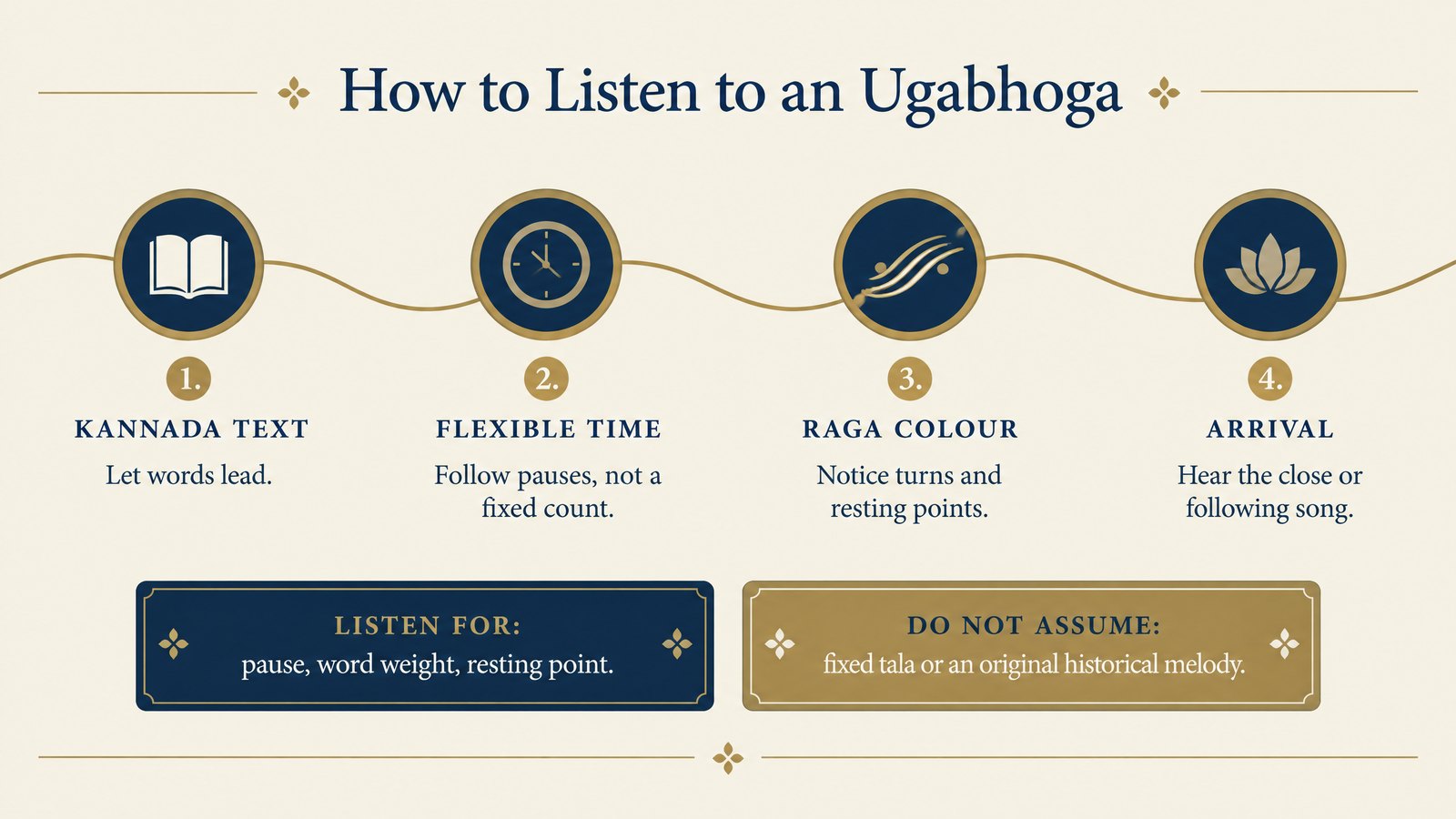
Use one short passage and replay it three times. The aim is not to identify every swara. It is to hear how flexible time becomes meaningful.
First pass: follow the language
Listen for the end of a line or thought. Notice where the voice pauses and begins again. Do not start by counting beats. Let the phrasing arrive on its own.
Second pass: trace one melodic decision
Choose a moment where the voice rises, lingers, or settles. Does it underline a word or close an idea?
Third pass: hear the arrival
If it leads into a song, notice the shift to a steadier arrival. If it stands alone, hear its final resting point. Write down one pause, one word or syllable, and one place where the melody settled.
A Careful Practice Route
Students should start with text and a teacher’s model, rather than force the verse into a count. Speak one line slowly, then hear it sung. Notice the longer syllable and the point of rest.
Ask a specific question: “Which words guide the pause and melodic landing in this version?” This respects both sahitya and musical shape. It is more useful than searching for one universal beat pattern where the presentation may not use one.
When learning from a recording, keep the performer, title, and source with your notes. Do not assume every audible flourish is fixed across traditions. The Carnatic notation guide explains why a written outline still needs sound and demonstration.
Frequently Asked Questions
What is Ugabhoga in Carnatic music?
Ugabhoga is a Haridasa vocal verse that may use flexible timing rather than a fixed recurring tala cycle. Hear its text-led phrasing, melodic colour, and pauses before trying to count it.
Is an Ugabhoga always without tala?
No. The Music Academy report says Ugabhogas could be sung with or without tala. “Free-form” is a useful listening description, not a demand that every version avoid all rhythmic organisation.
Is Ugabhoga the same as a devaranama?
No. Both belong to the wider Haridasa world, but an Ugabhoga is a distinct verse form. Many contemporary devaranama or Dasarapada renditions use a more regular composed flow, but that is a listening comparison rather than a universal rule for the category.
Does every Ugabhoga have a fixed raga?
A rendition can be melodically shaped in a raga, but a modern raga label should not automatically be treated as the original historical melody. Rao’s research shows why manuscripts, lyrics, and later musical sources need to be considered together.
Can a beginner practise an Ugabhoga from notation alone?
Notation can preserve words or a melodic outline, but it does not fully show pause, syllable weight, ornament, or pacing. Start with a teacher or a well-credited recording, then use notation as a reminder of the version being learned.
Conclusion
An Ugabhoga loosens one familiar expectation: music does not need a steady tala cycle to have direction. Hear the Kannada text, silence, and melodic resting point. Place the verse in its Haridasa setting with care, remembering that present-day melodies and older textual histories are not always the same thing.
Published by Medha Naada
This guide is published by Medha Naada, Medha Vidyabhushan's official portfolio. It combines the credited sources below with plain-language listening or learning prompts. Historical details, song credits, and public records are limited to the cited material.
A written guide can support listening and preparation, but a qualified teacher remains the right source for personal vocal technique, pronunciation feedback, or repertoire decisions.
How this guide is supported
This listener guide uses Music Academy research for a bounded form description and for caution about historical melody claims. Comparison language is editorial guidance, not a universal rule for every Ugabhoga or Dasarapada rendition.
- Raga-s of the early Haridasa-s. Dr. Arati N. Rao, The Music Academy Journal. Haridasa manuscript context and the caution that authentic oral traditions back to original composers have not been traced for present-day melody claims.
- Suladis and Ugabhogas conference report. The Music Academy Journal. A reported description of Ugabhogas as ethical and didactic and as singable with or without tala, without making that a universal current rule.
- Ugabhoga classification. Purandaradasa Songs, Lyrics, and Resources. A separate form-specific browsing category for Ugabhoga, used as supplemental navigation rather than historical authority.
- Deena Naanu, Kannada Ugabhoga. Medha Vidyabhushan Official. A first-party portfolio listening example visibly labelled as a Kannada Ugabhoga, not evidence for broader history or theory.